 |
 A Senufo couple, Ivory Coast. Certificate of origin and provenance. Typically carved from wood, Deblé figures depict slender human forms with elongated torsos and minimalistic features. They are often gendered, with male and female pairs representing continuity, fertility, and social balance. Lit.: A lecture of Dr. Junker, "der Originalzustand.. Wo ist er geblieben?" Gottschalk Burkhard, "Senufo, Massa und die Statuen des poro" 2002: 43; Glaze Anita J., "Art and Death in a Senufo Village", Indiana University Press, Bloomington 1981. A related eyemplare: Robert Goldwater, Senufo Sculpture from West Africa, New York, 1964, ills. 88 and 88a, Werner Gillon, Collecting African Art, London, 1979, p. 50, fig. 38 William Rubin, "Primitivism" in 20th Century Art: Affinity of the Tribal and the Modern, New York, 1984, vol. 1, p. 131 William Rubin, Le Primitivisme dans l’art du 20e siècle. Les artistes modernes devant l’art tribal, Paris, 1987, p. 131 Jacques Kerchache, Jean-Louis Paudrat and Lucien Stéphan, L'art africain, Paris, 1988, p. 82, pl. 34, Jacques Kerchache, Jean-Louis Paudrat, and Lucien Stéphan (eds.), Die Kunst des Schwarzen Afrika, Freiburg, 1989, p. 80, pl. 34 Jacques Kerchache, Jean-Louis Paudrat and Lucien Stéphan, Art of Africa, New York, 1993, p. 82, pl. 34 Mary H. Nooter, Secrecy: African Art that Conceals and Reveals, New York, 1993, p. 155, cat. 79. According to Gottschalk, who tried to make a typolgy of the Senufo Déblé, these exemplares would probably be submitted to the group of the kulibèlè and not the fonombèlè. "Während die ersteren (fonombèlè) entweder wegen mangelnder Fähigkeit zu feinerer Arbeit (the fonombèlè are the blacksmiths in the Senufo society) oder als bewußt eingesetztes Stilmittel die klaren und wuchtigen Formen, die kontrastierenden Waagerechten und Senkrechten weitgehend so beließen, wie sie bei der Festlegung der Proportionen entstanden waren, bemühten sich die kulibèlè (the traditional carver) um ein weiches Ineinanderfließen der Körperteile, soweit sie nicht den Stil ihrer älteren Brüder in ihre Arbeit aufnahmen oder ihn mehr oder weniger kopierten." Source: Burkhard Gottschalk More realistic sounds the opinion of Glaze, who described the difficulties of a stylistic typology according to both ethnic groups after she did fieldwork around kufulo (region of Dikodougou). Anita J. Glaze, 81. sold Height: 122 cm / 118 cm |
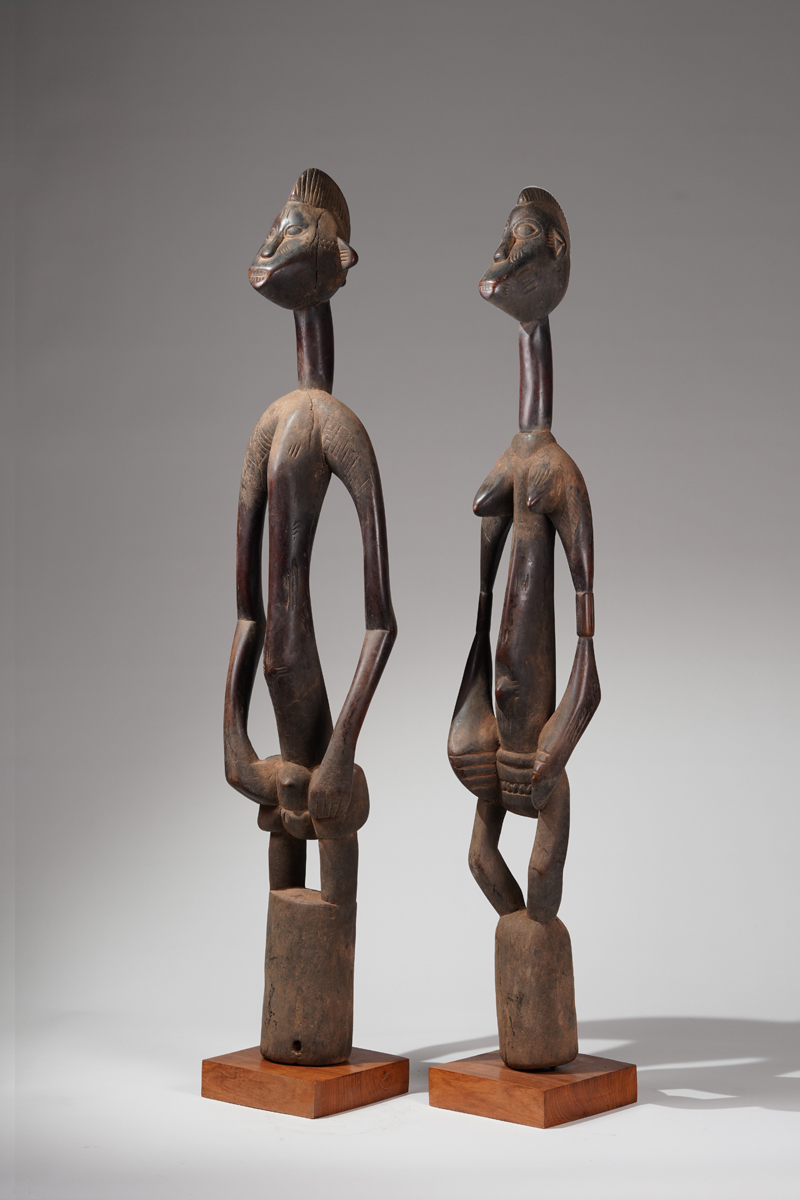 photo: wolfgang-jaenicke.com, for more information, please write us an e-mail with the identification number of the photo identification no. XBD184132.jpg |
 |