 |
 A Mossi bird mask, Burkina Faso. Certificate of origin and provenance. "The Mossi (moss-ee) people have many different types of masks, reflecting their cultural diversity. Mossi cavalry from northern Ghana swept onto the Mossi plateau of central Burkina Faso in the 15th century. Farming peoples, which then included the Dogon, Lela, Winiama, and Nuna, populated this area. Those who did not flee intermarried with the Mossi, resulting in the diversity of sculpture and mask designs found on the plateau today. The contemporary Mossi are primarily famers, tending to crops of millet, sorghum, maize and groundnuts. In the north, some Mossi raise livestock. The Mossi language is known as Mooré, one of the two primary languages of Burkina Faso. Numbering 2.2 million, they are the largest ethnic group in the country. Masks are known as wango (wan-go), which share that name with the mask performers, and are primarily the nyonyosé, descendants of the farming peoples. Mossi masks, such as the ones in the PLU Collection, are made from a single piece of lightweight and soft wood from trees in the genus Ceiba. It is carved with adzes and knives before the wood dries, which makes it is easier to shape. Sand and rough leaves are often used as a form of sandpaper to finish the masks. Pigment is applied in various geometric shapes, with triangles, rectangles and crescents the most common. Colors are produced from various materials, including charcoal, soot, lizard excrement, indigo, eggshell, hematite, kaolin, vegetable resin, and chalk mixed with water or egg whites. Masks are owned by a clan (a group of people claiming descent from the same ancestor) and are used in various ceremonies, including initiations, funerals, and annual year-end sacrifices. The masks represent the spirits of familiar animals and a clan’s ancestor spirits or serve as guardians of fruits. Every member of a clan is connected to the animal that their clan’s masks depict. The animal is involved in the founding myths of the clans and members of a clan cannot kill their clan’s animal. Masks are named after the animal a mask represents, prefixed with the word “wan-”. For example, a gazelle mask would be known as wan-nyaka. The masks are commonly accompanied by a costume made of blackened fibers from the hibiscus plant called a bindu. Young men who are educated in the meanings of the mask are those chosen to wear them, and they are also known by the name wango. The oldest mask a clan owns is known as the wan-tasenga (big mask), and is the principal mask used at funerals and year-end sacrifices. It is brought out less often, and does not leave the primarily village where the clan resides. Lesser masks, called wan-liuli (bird mask), serve as crowd control during rituals, ensuring that the clan members to whom the masks belong are closest to the big mask. Any member of the clan may attend these mask performances." Source:Pacific Lutheran University. sold Height: 75 cm |
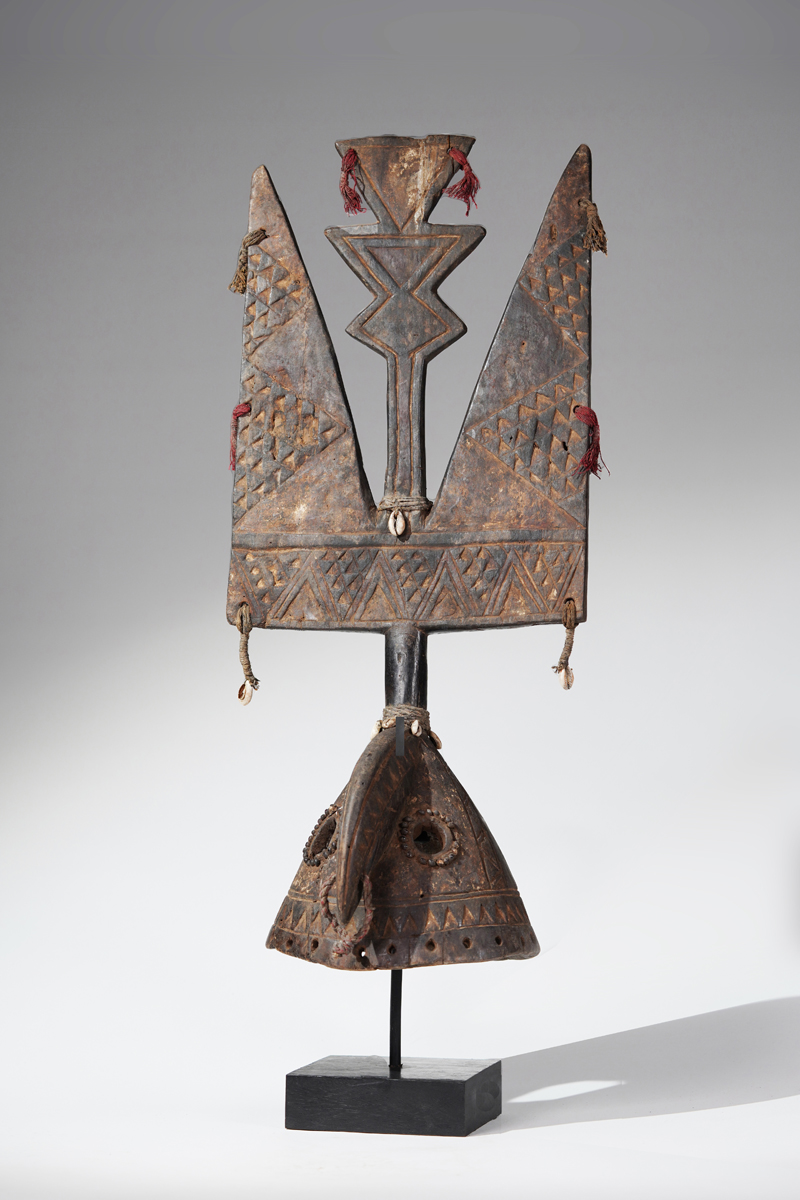 photo: wolfgang-jaenicke.com, for more information, please write us an e-mail with the identification number of the photo identification no. XBD182274l.jpg |
 |