 |
 A Baule Goli mask, Ivory coast, collected in the region Tiebissou, provenance Amadou Bouaflé. Incl. stand . Certificate of origin and provenance. incl. stand The event opens with the appearance of the Kple Kple masks—circular, flat, and marked by prominent horns. These are the most abstract in form and are painted in bold colors, with red representing male energy and black representing female presence. They embody youthful vigor, unpredictability, and the disruptive but creative forces of nature. Their frantic, dynamic movements energize the space and prepare the audience for the deeper spiritual manifestations to follow. The ceremony transitions into more sculptural and animal-like forms, most notably the Goli Glin masks. These represent powerful bush spirits and draw inspiration from wild animals such as the buffalo and the crocodile. Their formidable presence serves to guard the community and mark a solemn engagement with ancestral energies. As the day progresses, the masks take on more anthropomorphic characteristics, culminating in the Kpan Pre and Kpwan masks. The former typically symbolizes a junior female spirit and is associated with elegance, youth, and social poise. The latter, with its elaborate coiffures and symmetrical facial features, represents the idealized image of womanhood and fertility. This mask signifies cultural continuity and the refined ideals of Baule society. These masquerades are not simply performative. They are crucial mechanisms for religious and communal life—used in funerals, agricultural ceremonies, and rites of passage. They serve as a conduit for spiritual communication, linking the human and the divine. As African art scholar Susan M. Vogel observes in her seminal study of Baule aesthetics: sold Height: 34 cm without stand |
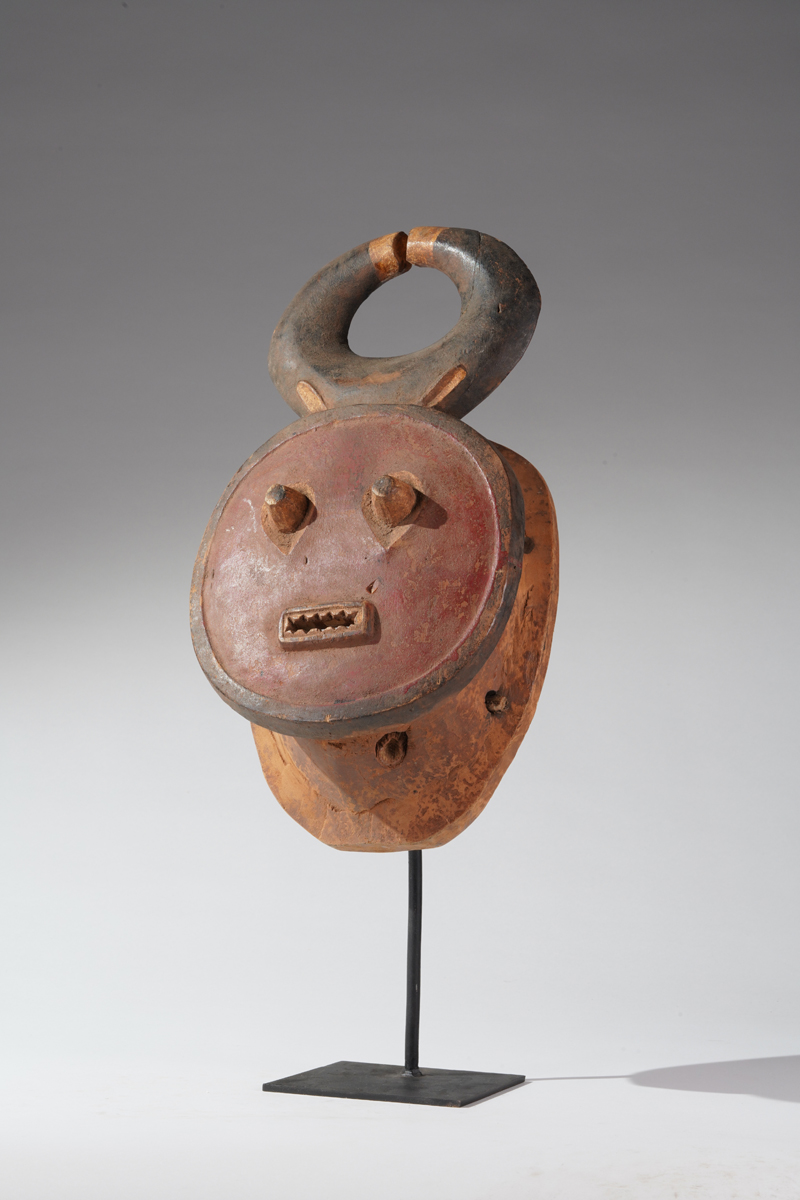 photo: wolfgang-jaenicke.com, for more information, please write us an e-mail with the identification number of the photo identification no. CAB02648.jpg |
 |