 |
 A Baule mask, Ivory Coast, collected in the region of Mbahiakro, provenance Bakari Bouafle. Certificate of origin and provenance. Incl. stand
The Baule mask from Mbahiakro, a region in central Côte d’Ivoire, exemplifies the intricate balance between aesthetics, moral values, and ritual performance that defines Baule art. Carved from wood and often finished with a lustrous patina, these masks reflect an idealized human form—broad forehead, arched eyebrows, lowered eyelids, refined nose, and delicately shaped mouth—projecting calm, dignity, and inner beauty.
This type of mask is most often used in the Mblo masquerade, a form of secular dance theater performed to honor a community member for qualities such as wisdom, generosity, or artistic talent. The Mblo mask is not a portrait in the Western sense; instead, it is an abstraction of the person’s social and moral identity, idealized through the lens of Baule aesthetics. The headdress or coiffure atop the mask is typically complex and symmetrical, reflecting not only the beauty of the honoree but also Baule values of order and refinement. Scarifications on the face are marks of identity, beauty, and lineage.
As renowned Baule art scholar Susan M. Vogel observes:
“Baule masks do not represent spirits. Rather, they refer to them, embody them temporarily, or make them visible. The Baule have created a kind of art that captures the spiritual and moral essence of the subject rather than its physical reality.”
— Susan M. Vogel, “Baule: African Art, Western Eyes” (1997).
sold
Height: 41 cm without stand
Weight: 2,3 kg with stand |
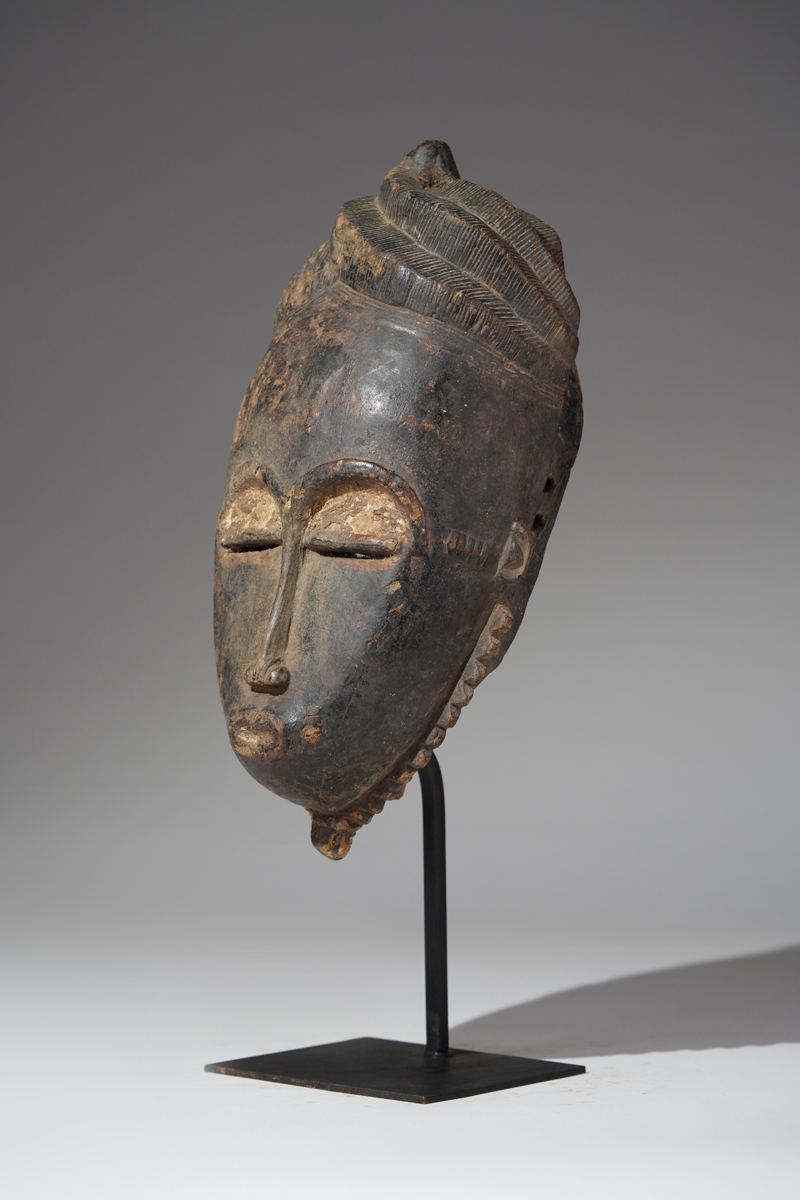 photo: wolfgang-jaenicke.com, for more information, please write us an e-mail with the identification number of the photo identification no. CAB03204.jpg |
|
