 |
 A Beté sculpture, Ivory Coast, collected in the region of Soubre, provenance Bakari Bouaflé. Certificate of origin and provenance.
The Bété sculpture tradition of southwestern Côte d’Ivoire reflects a profound synthesis of ancestral reverence, artistic symbolism, and spiritual engagement. While the Bété are perhaps best known for their dramatic and powerful masks—used in warfare, judgment, and communal rites—their statuary, though less common, offers a subtler yet equally potent expression of cultural identity and metaphysical belief.
Bété sculptures often take the form of ancestral or protective figures. They typically exhibit strong verticality, with solid, geometric bodies, square shoulders, and a large, high-domed forehead—a symbol of wisdom and mental force. Their carved faces are calm, introspective, and abstracted, sometimes with incised scarifications and stylized coiffures, signifying both lineage and beauty. Male and female figures may be paired or shown individually and are used in household or village shrines to embody the spirits of ancestors or serve as mediators with the spiritual world.
These figures are not simply decorative but serve vital ritual functions, believed to house protective spirits or represent mythical ancestors who safeguard the moral and physical well-being of the living.
As African art historian Alisa LaGamma explains:
“The visual restraint and formal rigor of Bété sculpture, with its measured proportions and symbolic abstraction, affirm the presence of spiritual force. These figures are not literal portraits but spiritual condensations—anchoring memory, presence, and ethical example in sculptural form.”
— Alisa LaGamma, “Eternal Ancestors: The Art of the Central African Reliquary” (Metropolitan Museum of Art, 2007).
sold
Height: 68 cm
Weight: 3 kg |
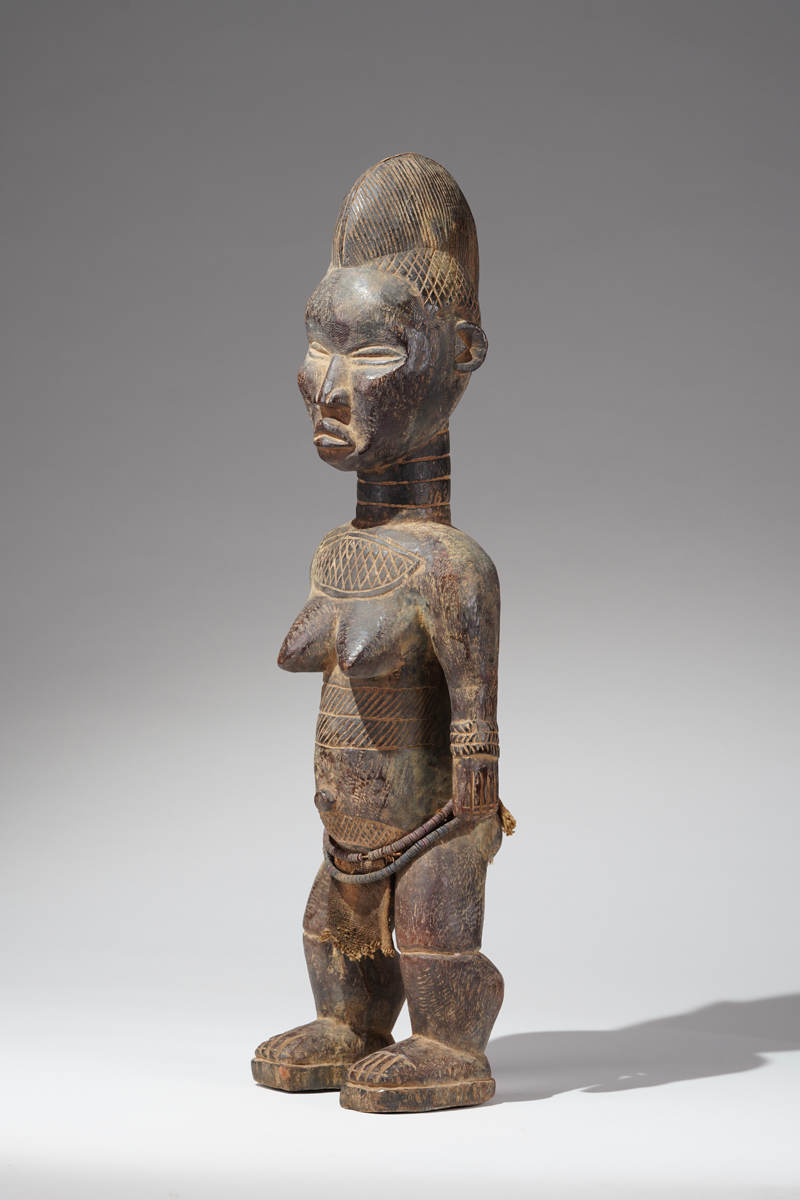 photo: wolfgang-jaenicke.com, for more information, please write us an e-mail with the identification number of the photo identification no. CAB03428.jpg |
|
