 |
 A Winiama Crest Mask, Burkina Faso; certificate of origin and provenance. incl. stand “The Nuna, the Nunuma, the Winiama, and the Léla carve masks that represent spiritual beings from the wilderness, and that are covered with red, white and black geometric patterns. I think that they are the origin of this style in Burkina Faso, the cultural well from which so much of the culture of the other peoples who speak Voltaic languages was drawn. The southwestern Mossi, who use masks today, are descendants of ancient gurunsi peoples who lived throughout the area before the nakomsé invasion. Those gurunsi who did not flee integrated into the new Mossi society, and their descendants use masks that are very similar in style to contemporary Léla, Nuna and Nunuma masks. Most of the Mossi in the southwest who use masks are sukwaba. Some of the Bwa lineages to the west of the Nunuma and Nuna, in contrast, abandoned the use of leaf masks that represent Dwo and adopted the use of wood masks in the years following the arrival of the French (1897). They purchased the rights to Nuna, Winiama, and Nunuma styles as well as the rights to songs and dances. They stole the masks from nearby villages on rare occasions. The result was the transmission of the Nuna, the Winiama, and the Nunuma styles westward in Burkina Faso. Lit: Land of the Flying Masks: Art & Culture in Burkina Faso. The Thomas G.B. Wheelock Collection: Art and Culture in Burkina Faso: The Thomas G.B. Wheelock Collection. sold Height: 81 cm (without stand) |
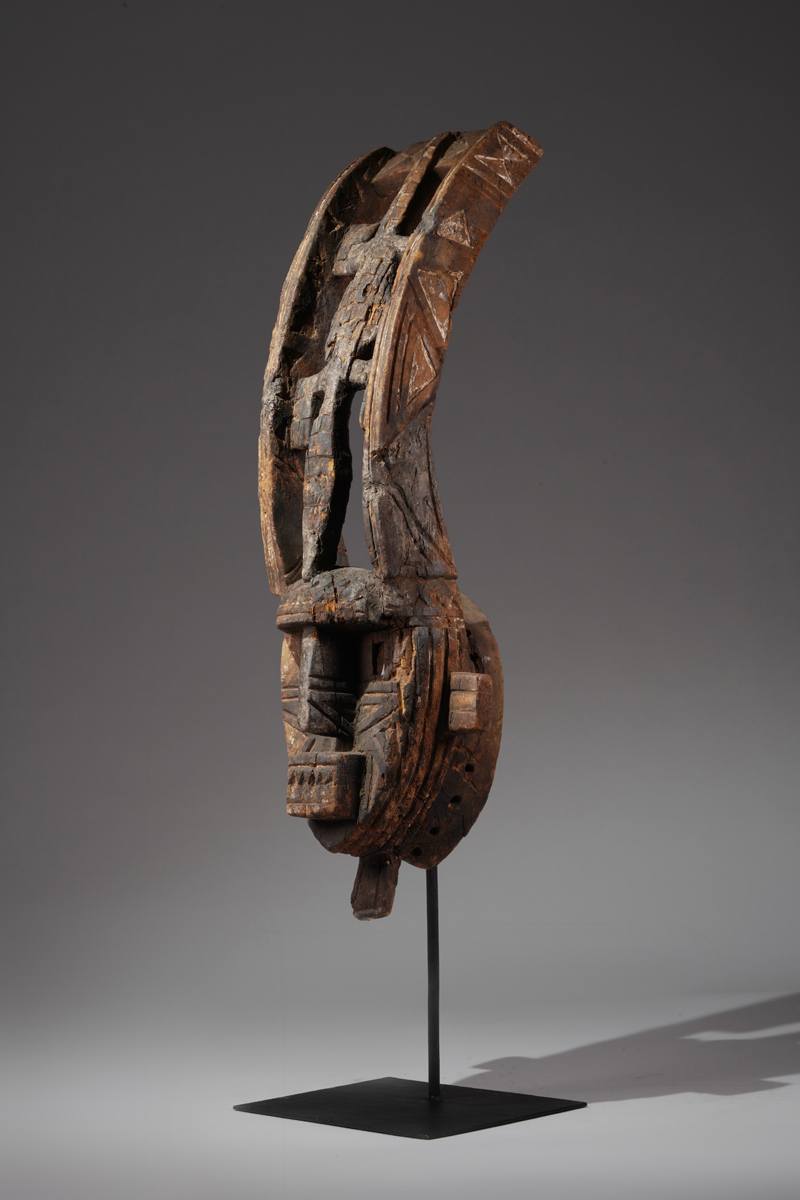 photo: wolfgang-jaenicke.com, for more information, please write us an e-mail with the identification number of the photo identification no. CAB04283.jpg |
 |