 A Luba Owl mask, DRC, region of Tanganyika, Kanteba region. A Luba owl mask from the Democratic Republic of the Congo, specifically from the Tanganyika province and the Kanteba region, represents a rare and significant form within the broader spectrum of Luba visual culture. The Luba people, one of the most influential ethnic groups in Central Africa, are renowned for their refined woodcarving, deeply spiritual symbolism, and complex political and social organization. While the Luba are more widely known for their thrones, memory boards, and female figures, animal masks—particularly those representing owls—play a specialized role in ritual and social life. The owl, in Luba symbolism, is not simply a bird but a potent metaphor. It is associated with mystery, nocturnal power, secrecy, and often with knowledge of the invisible world. Among many Central African cultures, including the Luba, the owl is both feared and respected. It can symbolize sorcery or the presence of a powerful spiritual force. The mask of an owl therefore functions not only as a physical object but as an embodiment of these complex associations, particularly in ceremonies dealing with protection, ancestral communication, or the exposure of hidden knowledge. In the Kanteba region of Tanganyika, such a mask would have been used in secret societies or local judicial and religious rituals. It may have served in initiation rites or in performances designed to settle disputes or expose wrongdoing within the community. Because owls are believed to see what others cannot—especially in the dark—the owl mask becomes a tool of spiritual surveillance, symbolizing the presence of unseen truths or divine judgment. The wearer of the mask would, in a sense, take on these abilities during the ritual performance. Artistically, Luba owl masks are characterized by stylized features, often with exaggerated eyes, curved beaks, and a highly symmetrical composition. The craftsmanship typically emphasizes the owl’s watchful gaze, carved in a way that evokes stillness, vigilance, and spiritual intensity. These masks are sometimes painted or treated with natural pigments to enhance their visual impact during ceremonies held in dimly lit spaces. The wood surface might also carry signs of age, use, or ritual handling, contributing to the mask’s aura and authority. Unlike the more public forms of Luba royal art, the owl mask belongs to the more esoteric side of the culture. Its function is not to celebrate kingship or lineage, but to protect the moral and spiritual order of the community. It may serve as a guardian, a judge, or a silent witness to human behavior. As such, its presence is often both commanding and unsettling—an object that commands respect and evokes reflection. In conclusion, the Luba owl mask from the Kanteba region of Tanganyika holds a powerful place within Luba spiritual life. Through its visual form and symbolic associations, it reveals the Luba understanding of knowledge, mystery, and the unseen forces that shape human existence. It is a mask not of entertainment, but of revelation—an instrument through which deeper truths are seen, remembered, and passed on. sold Height: 29 cm without stand |
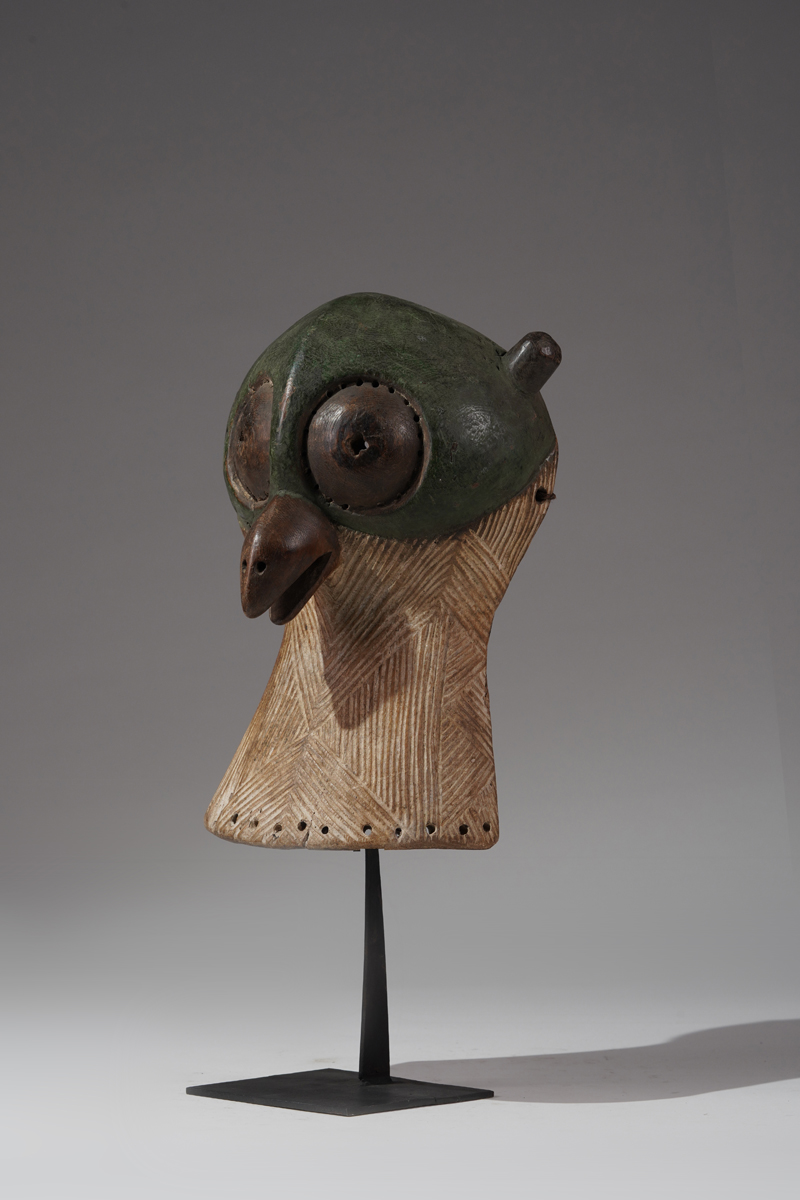 photo: wolfgang-jaenicke.com, for more information, please write us an e-mail with the identification number of the photo identification no. CAB04252.jpg |
 |