 |
 A Lega mask, DRC, Mwenga / South Kivu region, village of Kitutu. This mask represents the beauty of the young woman newly married into the family of the high-ranking traditional chief. During this time, the husband is forbidden to travel and must focus more on his wife's life. Incl. stand. A Lega mask from the Democratic Republic of the Congo, specifically from the Mwenga territory in South Kivu and the village of Kitutu, holds deep significance both in terms of artistic expression and social function. The Lega people, known for their rich sculptural tradition, integrate masks into the heart of their moral and philosophical society. Among the Lega, masks are not theatrical props but symbolic objects tied to the Bwami association, a hierarchical initiation system that guides moral conduct, social advancement, and the transmission of wisdom. The masks created in the Mwenga region, including the village of Kitutu, often reflect a specific regional style. These masks tend to be smaller in size compared to dance masks of other ethnic groups and are typically carved from light wood, then coated with white kaolin clay. The use of kaolin gives the mask a pale, almost ghostly surface, signifying purity, the spirit world, and ancestral presence. The features of these masks are abstract and highly stylized—oval or heart-shaped faces with deeply incised eyes, a narrow nose, and minimal or absent mouths. This abstraction is not merely aesthetic but symbolic, pointing to ideals of inner wisdom and detachment from the physical world. In the Kitutu area, as in other Lega communities, masks serve as visual tools during Bwami ceremonies, where they are used not by being worn on the face but displayed, touched, or held by initiates. Their function is didactic; they are shown at specific moments in the initiation process to teach moral lessons, ethical values, or life principles. Each mask is associated with a proverb, a story, or a lesson passed from elder to initiate. Therefore, the mask is both a work of art and a repository of social knowledge. What distinguishes the Kitutu region’s masks within the larger Lega tradition is often their refinement and elegance in carving, as well as their preservation of older stylistic forms. These masks may appear simple in shape but carry layered meanings and spiritual presence. Their patina, worn edges, and traces of handling reflect their use over generations and their role in a living tradition. The context of Mwenga and Kitutu also suggests historical resilience, as many communities in this region have held onto cultural practices despite external pressures from colonization, conflict, and displacement. In conclusion, a Lega mask from Mwenga, especially from Kitutu village, is far more than an aesthetic object. It is a key to understanding Lega social philosophy, the structure of initiation, and the ways in which art is inseparable from ethical life. Through its material presence and symbolic power, the mask embodies the values of restraint, wisdom, and continuity—central to Lega identity and cultural survival. sold Height: 29 cm without stand |
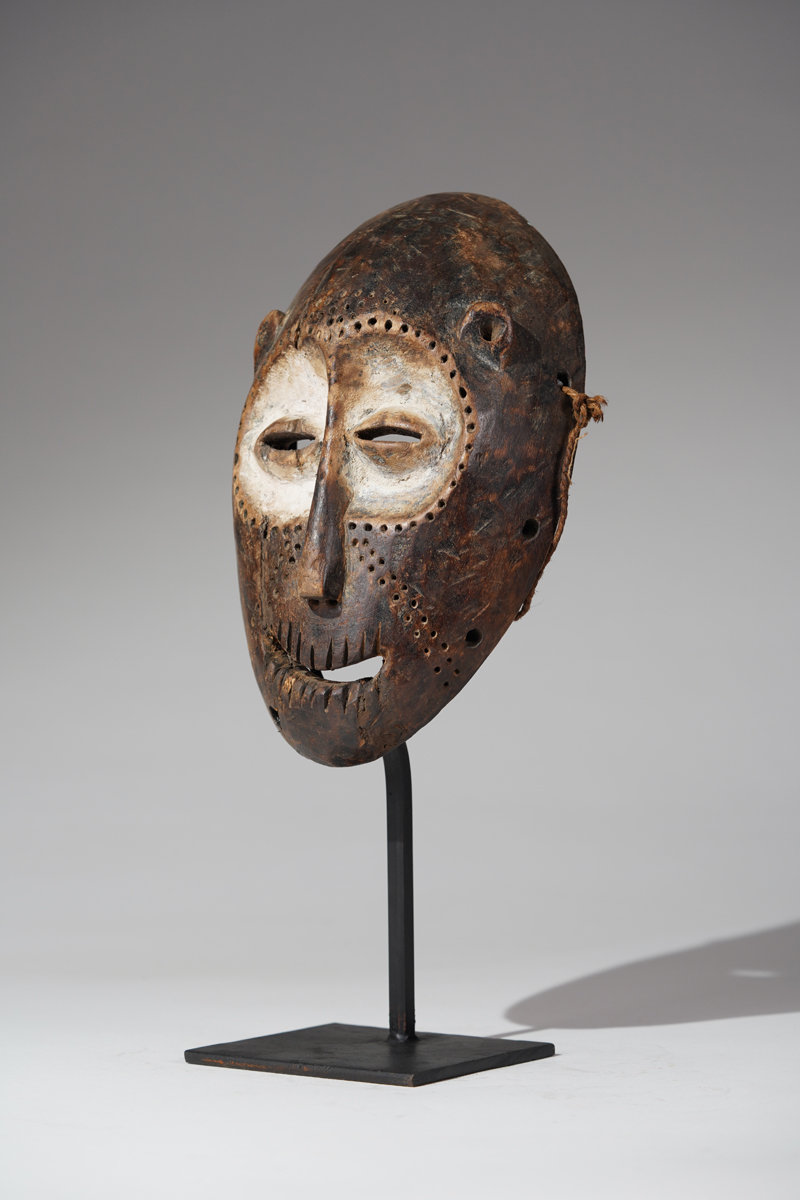 photo: wolfgang-jaenicke.com, for more information, please write us an e-mail with the identification number of the photo identification no. CAB04577.jpg |
 |