 |
 A Kumu mask, DRC, Punia / Maniema region, village of Felekeni. This horn mask was reserved for ceremonial hunting of animals in an area uncontrolled by the hunter.This mask served as an indicator of the direction where the animals were hiding. Certificate of origin and provenance. Incl. stand. The Kumu people, also known as Komo or Bakumu, inhabit the northeastern region of the Democratic Republic of the Congo, particularly in the Ituri and North Kivu provinces. As part of the larger Bantu-speaking populations in Central Africa, the Kumu have developed a distinct cultural identity shaped by their environment, history, and spiritual worldview. Their artistic production, though relatively lesser-known compared to neighboring groups such as the Lega or the Luba, includes powerful ceremonial objects—among them the striking Kumu masks. Kumu masks are most often associated with initiation rites and social control. These masks are traditionally used during ceremonies of male initiation, marking the passage from youth to adulthood. In these contexts, masks are not merely decorative or theatrical, but are regarded as spiritual instruments that embody ancestral forces or protective spirits. The mask acts as a mediator between the visible and invisible worlds, granting the wearer access to powers beyond the human realm. The act of masking is thus an expression of transformation, secrecy, and authority. Visually, Kumu masks are highly expressive and often dramatic in their form. They tend to display a strong sense of asymmetry, bold color contrasts, and sharply defined features. The faces are typically elongated or oval, with large, round or slit eyes, flared nostrils, and exaggerated mouths—sometimes with bared teeth. The surface may be painted in white, red, or black pigments, and the overall design reflects a dynamic and energetic style. In some cases, masks include attachments such as raffia fiber, feathers, or shells, which contribute to their ritual power and visual intensity. Aesthetic choices in Kumu mask-making are closely tied to symbolic meanings. The use of white, for example, may signify the spirit world or the bones of ancestors, while red can suggest vitality, aggression, or transition. The aggressive expression seen in some masks reflects their role in enforcing social norms and intimidating enemies, both human and spiritual. During performances, masked dancers often move with sharp, erratic gestures meant to heighten the sense of supernatural presence. While Kumu masks are rare in public collections compared to other Congolese traditions, they are increasingly recognized for their unique sculptural language and ritual importance. Ethnographic research has shown that the Kumu share certain initiation practices and beliefs with neighboring groups such as the Mbole and the Lengola, which has led to overlapping mask styles and symbolic systems. Still, the Kumu maintain a distinctive approach to mask-making that reflects their particular cosmology and social organization. sold Height: 44 cm without stand |
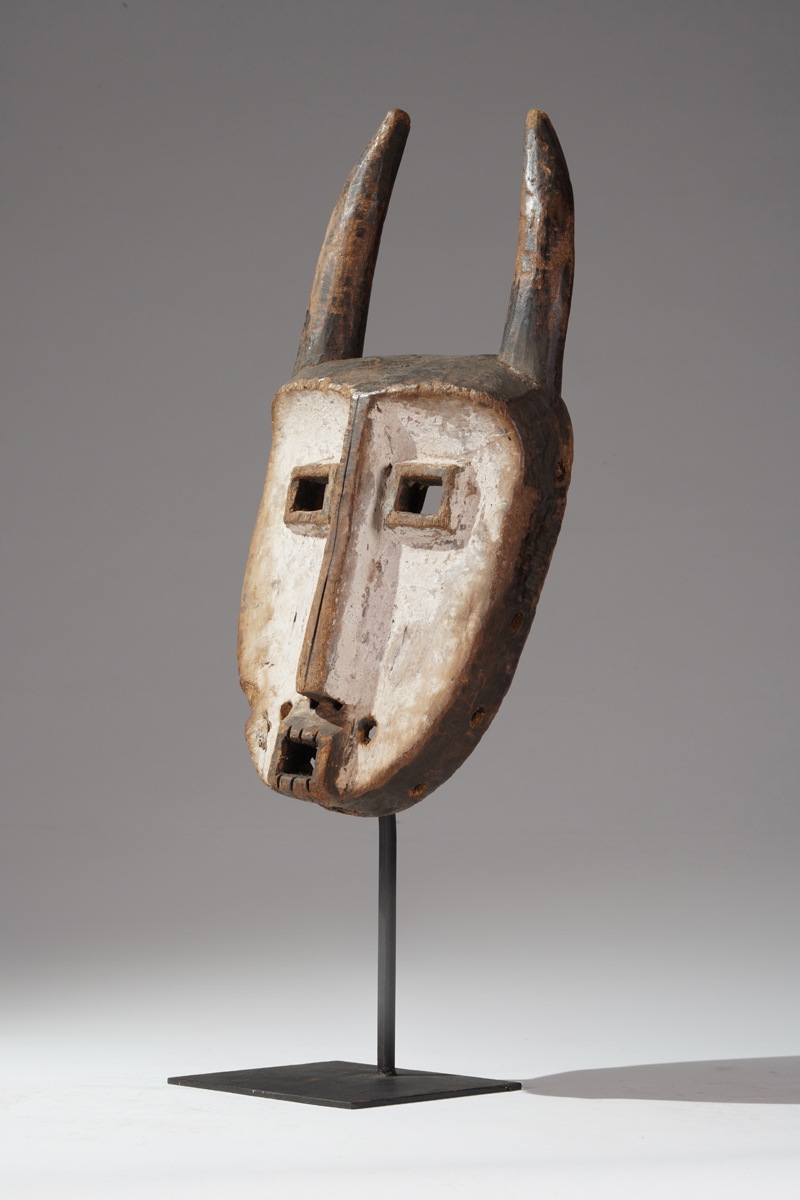 photo: wolfgang-jaenicke.com, for more information, please write us an e-mail with the identification number of the photo identification no. CAB04648.jpg |
 |