 |
 A Senufo Kpelie masks, Cote d'Ivoire, surmounted by a female figure. Signs of ritual use and age.
These funeral festivities are marked by masquerades, which symbolically expresses the fundamental dualities in Senufo Thought: male/female, body, spirit, life, death. In general this type of mask is symbolizing an ideal woman. The unique features which characterize the Kpelie mask include elongated flanges radiating from the bottom part of the mask, which are a reference to the hornbill bird. The horns on the mask refer to the ram, an important sacrificial animal. The nodules on the forehead represent palm nuts as well as vulvas; they are flanked by cicatrization marks that symbolize the twins born to the primordial couple. The significance of the double face are not known, but double- and single- faced Kpelie are used interchangably.
The term kpeliye'e, or "face of the jumping performer," refers to the dynamic performances audiences have continued to associate with the mask. Often centerpieces of entertaining theaters, face masks offer a counterpoint to the region's larger, more combative zoomorphic helmet masks.
Lit.: Kat. Ausst. Die Kunst der Senufo: Elfenbeinküste. Mit einem Beitrag von Till Förster, Staatliche Museen der Preußischer Kulturbesitz, Museum für Völkerkunde Berlin, 16.11.1990 - 24.2.1991, Berlin 1990; Lorenz Homberger: Künstler in Werkstätten der Senufo. In: Eberhard Fischer/Lorenz Homberger: Afrikanische Meister. Kunst der Elfenbeinküste, Zurüch 2014, p. 151-178; Die Kunst der Senufo, Museum Rietberg Zürich, aus Schweizer Sammlung, Zürich 1988; B. Holas, L´Art Sacré Sénoufo, Limoges, First edition, 1957. Frank Herreman, Facing the Mask, Museum for African Art. 1978. Wolfgang Jaenicke blog "Forbidden games”.
sold
Height: 34 cm without stand
Weight: 1,5 kg incl. stand |
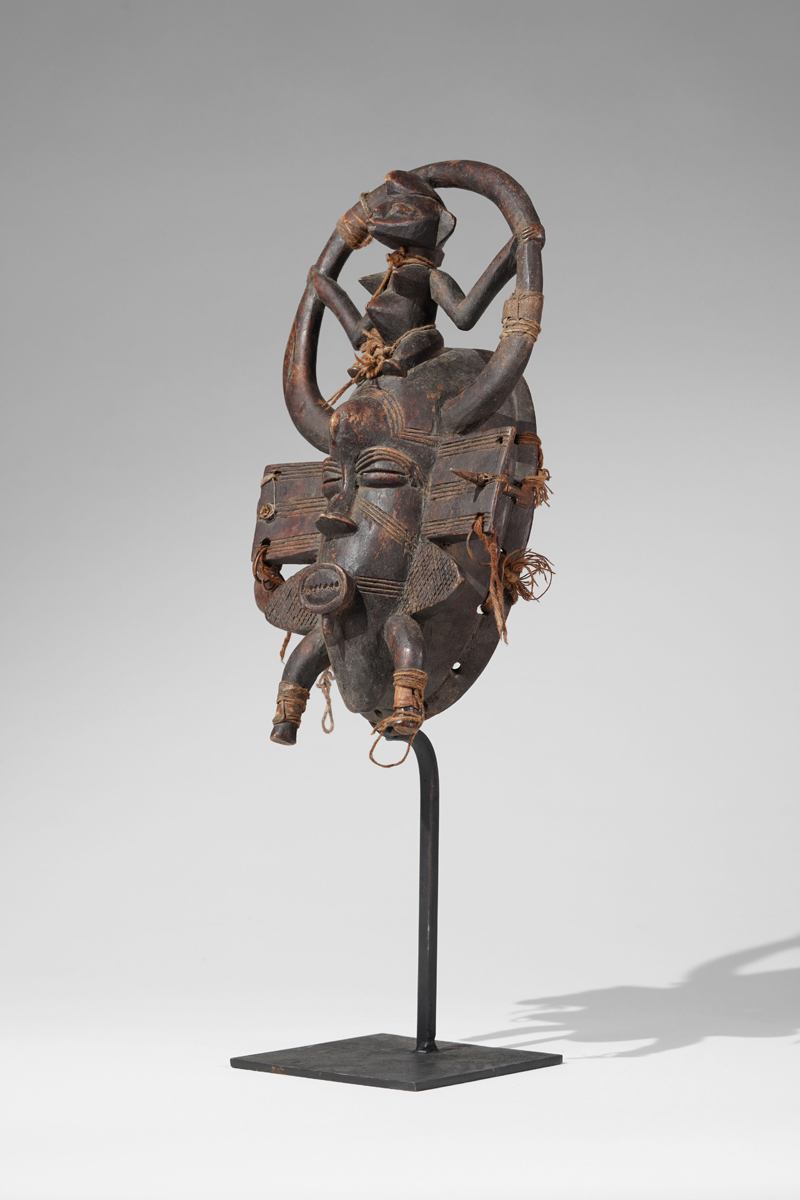 photo: wolfgang-jaenicke.com, for more information, please write us an e-mail with the identification number of the photo identification no. CAB06424.jpg
 |
|
