 |
 A Bamana maternity, Gwandusu, seated on a stool, the slender torso with a child in front of the abdomen, hanging conical breasts bneath rounded shoulders, an elongated neck supporting the oval head with a caplike coiffure, the hair dressed as three tresses, heavy hard wood, dark glossy patina, collected in one of the villages close to Dioila, Mali. About dating of the Bamana Figurative Sculpture "some Bamana carvers today still produce sculpture in the style of nyeleni figures. Others can recall clearly the last time they were commissioned to make nyeleni or sonkalani figures, generally sometime in the 1960s. On contrast, elders in the villages that once had Jo and Gwan figures expressed doubt that carvers today are capable of creating works as beautiful and complicated as their sculptures. Most said their had acquired the Jo and Gwan sculptures before they were born. Since many of these men were in their sixties or seventies when questioned in 1978, their sculptures could have been made in the late ninteenth or early twentieth century. Such a date would correspondence well to the generally accepted view that African wood have little chance of surviving the harsh environmental conditions to which it is exposed." Kate Ezra, A Human Ideal in Africa, Bamana Figurative Sculpture, Washington 1986 In contrary of Kate Ezra nowadays (2009) nearly each type of Bamana sculpture - also Jo and Gwandusu-Figures - are reproduced by the skill of local carvers. But probably there are two big differnces. 1. The choice of the bumbu-wood, which afford a high degree of knowledge for such a large sculpture, which doesn´t show any significant agecracks. 2. The specific patina, which is - according of Daba Diarra - protecting these sculptures against insects and erosion, which "would have little chance of surviving the harsh environmental conditions to which it is exposed." Kate Ezra. I have never seen a recent "Gwansusu or Jo-Sculpture" with a similar, encrusted patina of may layers, which probably takes decades of sacrifucation-rituals. The circumstances about the discovery of this Gwandusu-sculpture is documented in a HD video-film in Bambara, translated in French. Height: 138 cm
|
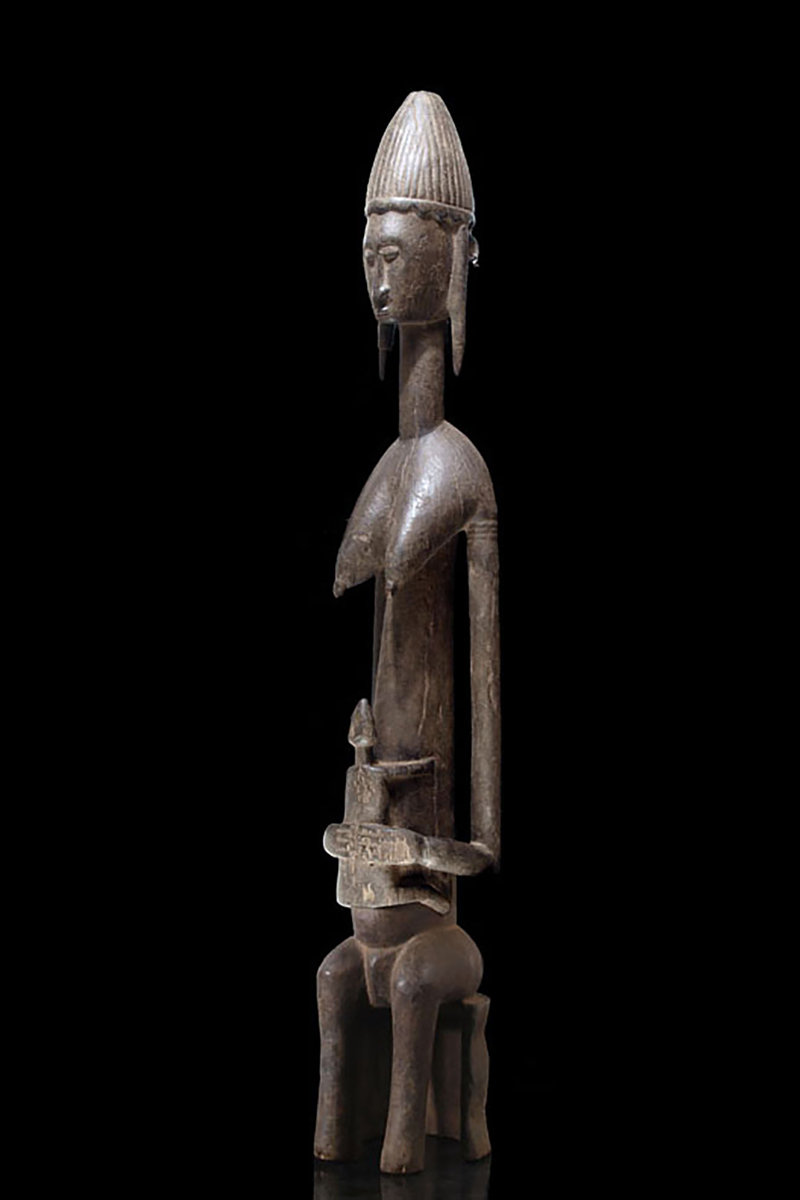 photo: wolfgang-jaenicke.com, for more information, please write us an e-mail with the identification number of the photo identification no. _P5302889.jpg |
 |