 |
 Kela sculpture, DR Congo. Textured, touch patina - signs of ritual use and age. The Kela people, also referred to as Yela, are a relatively small ethnic group residing in the eastern regions of the Democratic Republic of Congo. Closely related to the Mbole and Lega peoples, the Kela share linguistic, cultural, and spiritual traditions that are reflected in their artistic and ritual practices. Their sculptural art—particularly wooden figures and masks—plays a significant role in initiation rites and in the transmission of moral values within secretive moral societies such as the Lilwa. This society bears structural and symbolic similarities to the Bwami system of the Lega (Biebuyck 1986). Kela sculptures are typically marked by an elongated and abstracted formal style. Carved primarily from wood, these objects often feature diamond-shaped heads, simplified facial structures, and strongly geometric profiles. They are frequently treated with natural pigments or allowed to acquire patinated surfaces over time, both of which enhance their symbolic presence during ritual use (Biebuyck 1976). These aesthetic conventions reflect a coded visual language designed to convey spiritual and moral principles, particularly to initiates of the Lilwa society. Among the most significant sculptural types are the ofika figures, which represent individuals who have committed grave moral transgressions such as murder or adultery. These figures are displayed during initiation ceremonies and serve as warnings and ethical guides, symbolizing the social consequences of deviating from community norms. Through such displays, the Lilwa society reinforces its values and transmits them across generations in both visual and performative ways (Felix 1987; Biebuyck 1986). Not all Kela sculptures carry punitive meanings. Many represent honored ancestors or serve as intermediaries between the human and spiritual realms. These figures contribute to communal cohesion and cosmological balance, acting as tangible links between the living and the invisible world. Their dual function—as both moral exemplars and spiritual anchors—exemplifies the integrated nature of art, religion, and education in Kela society (Vogel 1981). Scholarly interest in Kela art has been notably advanced by Daniel Biebuyck, whose fieldwork and publications have contextualized the symbolic functions of Kela and related Yela-Mbole statuary. His analysis of ofika figures within the framework of Lilwa ritual practices has become foundational for understanding the moral and judicial roles of sculpture in Central African cultures (Biebuyck 1986). Ethnographic overviews of Congo Basin art, such as those by Felix (1987) and Vogel (1981), further situate Kela aesthetics within a wider network of spiritual-social artistic production. Although there are currently no major permanent exhibitions dedicated exclusively to Kela art (as of mid-2025), significant works can be found in both public and private collections. The Royal Museum for Central Africa in Tervuren, Belgium, holds a number of Kela and related objects and frequently features them in rotating displays that address the broader themes of initiation societies and colonial collecting histories (RMCA 2023). Tribal art galleries and fairs across Europe—particularly in Belgium, France, Switzerland, and Germany—continue to exhibit and trade Kela sculptures, often supported by scholarly catalog notes that trace their ritual provenance and symbolic meanings (Tribal Art Gallery 2024; Barnebys 2024). In conclusion, Kela sculpture offers a rich lens through which to examine the intersections of visual form, spiritual practice, and social ethics in Central African cultures. By maintaining a focus on both aesthetic style and ritual function, current scholarship continues to deepen our understanding of how communities like the Kela use art to mediate moral order, cosmological belief, and intergenerational knowledge. Biebuyck, Daniel. 1976. Lega: Ethics and Beauty in the Heart of Africa. Los Angeles: UCLA Museum of Cultural History. Biebuyck, Daniel. 1986. “Mbole and Yela (Kela) Figures: Their Role in Secret Societies.” African Arts 19(3): 52–61. Felix, Marc L. 1987. 100 Peoples of Zaire and Their Sculpture: The Handbook. Brussels: Zaire Basin Art History Research Center. RMCA (Royal Museum for Central Africa). 2023. Collections and Exhibitions of Central African Art. Tervuren: RMCA Press. Tribal Art Gallery. 2024. Catalogue: Congo Ritual Art. Paris: Tribal Art Publications. Barnebys. 2024. “Auction Archive: Kela and Mbole Ritual Figures.” Accessed June 2025. https://www.barnebys.de. Vogel, Susan. 1981. Art of Zaire: From the Collection of the Musée Barbier-Mueller. Geneva: Musée Barbier-Mueller. sold Height: 34 cm |
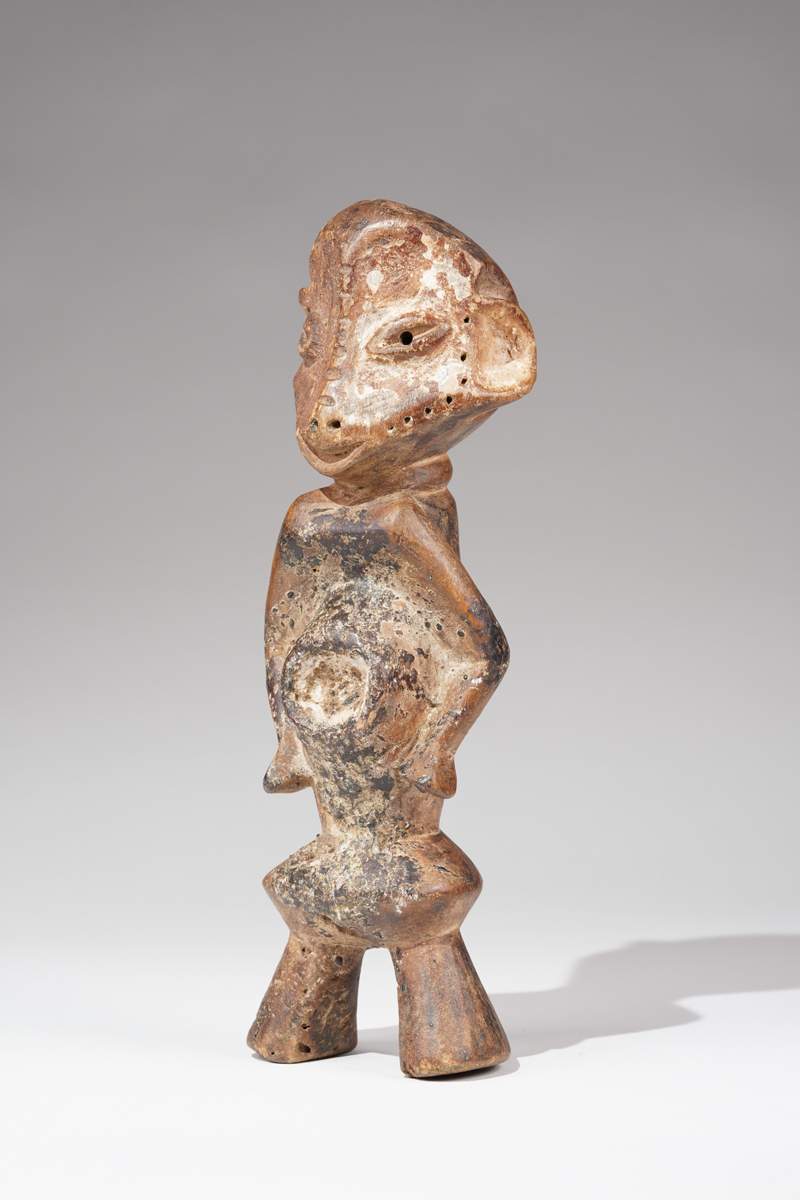 photo: wolfgang-jaenicke.com, for more information, please write us an e-mail with the identification number of the photo identification no. CAB07524.jpg |
 |