Large Standing Court Figure, Probably an Oba or High-Ranking Dignitary Kingdom of Benin, Nigeria Bronze/brass This monumental freestanding metal figure represents a richly adorned dignitary from the historical Kingdom of Benin in present-day Nigeria. On the basis of the extraordinary headdress, the elaborate neck ornament, the richly structured ceremonial costume, and the figure’s strictly hieratic bearing, the person represented may most plausibly be interpreted as an Oba or as a high-ranking member of the Benin court. A definitive identification based solely on the surviving insignia is, however, not possible, since the visual language of Benin court art employs certain attributes for both the ruler himself and individuals of the highest courtly rank. At 86 cm in height and weighing 18.5 kg, the figure possesses a remarkable monumentality for a freestanding Benin metal sculpture. The figure is conceived in an essentially frontal and axial manner. The comparatively large head, elongated torso, and powerful, relatively short legs create an impression not of naturalistic anatomy but of stately and ceremonial presence. Such an emphasis is characteristic of Benin court art, in which individual physiognomic description is often subordinate to the representation of rank, authority, ritual function, and integration into the royal order. The face is defined by large almond-shaped eyes, a strong nose, and a firmly closed mouth. Its controlled and almost immobile expression conveys the kind of authority found in many representations associated with the Benin court. The physiognomy is subordinated to the overall conception of the figure, while the head functions above all as the principal bearer of insignia. Particularly unusual is the tall, almost rectangular crown. Its surfaces are divided by a diagonal lattice pattern and further articulated by projecting horizontal elements. The upper edge terminates in a series of pointed forms. The highly architectural construction of this headdress differs markedly from the more rounded or conical crown types encountered in many other Benin works and constitutes one of the most distinctive iconographic features of the sculpture. Two long, ornamented strands descend from the crown or sides of the head, framing the face and extending far down the torso. Beneath the chin is a substantial collar composed of numerous horizontal rows. In the context of Benin court art, such jewellery is associated with coral beads and therefore with royal authority and elevated social status. Jewellery and costume are not merely decorative elements but essential components of a visual language of rank and power. Of particular interest is the unusual scale- or feather-like garment covering much of the torso, shoulders, and hip area. The individual elements are arranged in regularly overlapping rows and are in places further decorated with finely incised linear patterns. It cannot be determined with certainty whether this structure is intended to represent feathers, textile or leather applications, or a form of lamellar protective clothing. A direct comparison with European scale armour would therefore be too speculative. From an art-historical point of view, the more neutral description of a scale- or feather-like ceremonial garment is preferable. A broad diagonal band runs across the hip and lower body. At the side is an additional pouch- or container-like element with a carefully modelled terminal section. The abundance of such details emphasises the high status of the person represented and at the same time demonstrates the technical ambition of the casting.
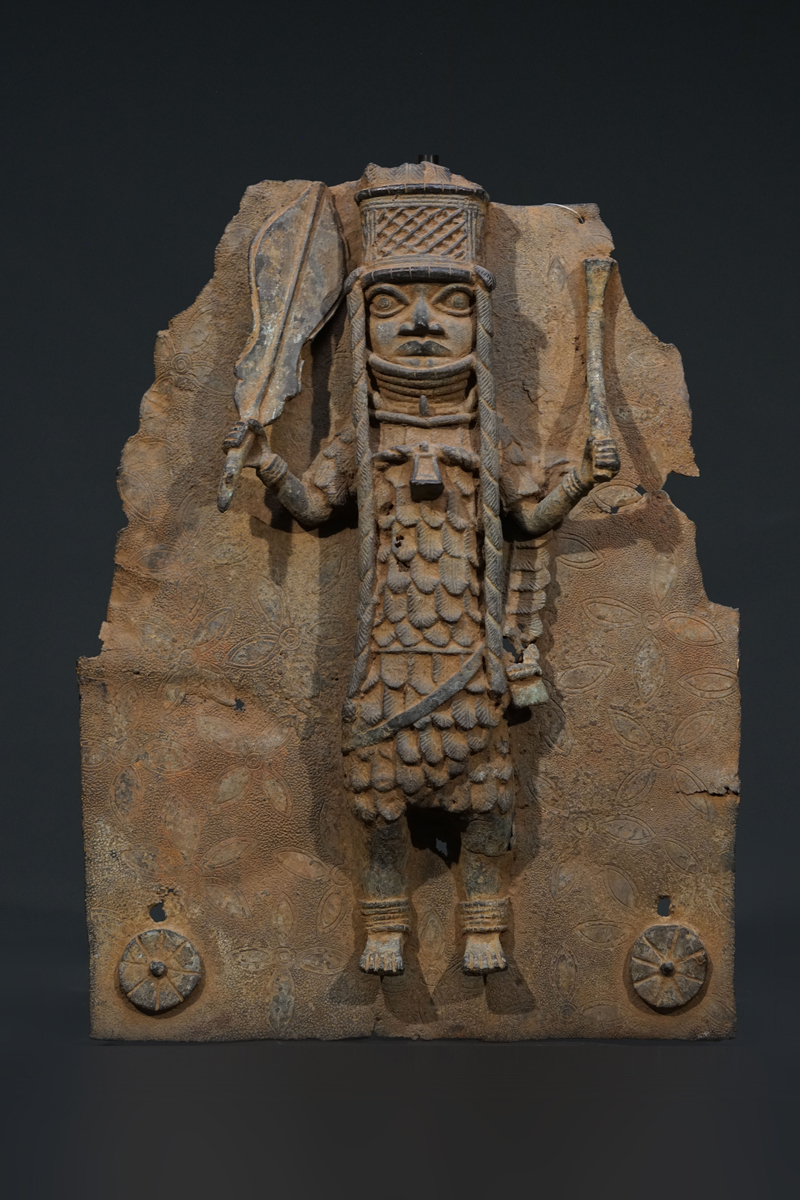
The hands are not shown passively against the body but are engaged in an action. One hand holds an elongated rod-like object or striker, while the other supports a conical or bell-shaped object. The interpretation of the figure as striking a bell or gong is therefore plausible, although it should be regarded as a likely rather than definitively proven identification. Sound-producing instruments played an important role in Benin court and ritual culture, particularly within royal ceremonies and ancestral rites. If the object represented here is indeed a bell or gong, the sculpture combines the representation of elevated courtly status with an active ritual function. An important art-historical comparison is provided by a Benin plaque depicting a remarkably similar high-ranking court figure. The person represented on the plaque wears an almost identical tall crown with lattice decoration. The long lateral ornaments, the substantial neck ornament, and above all the garment composed of overlapping scale- or feather-like elements also show striking correspondences. |
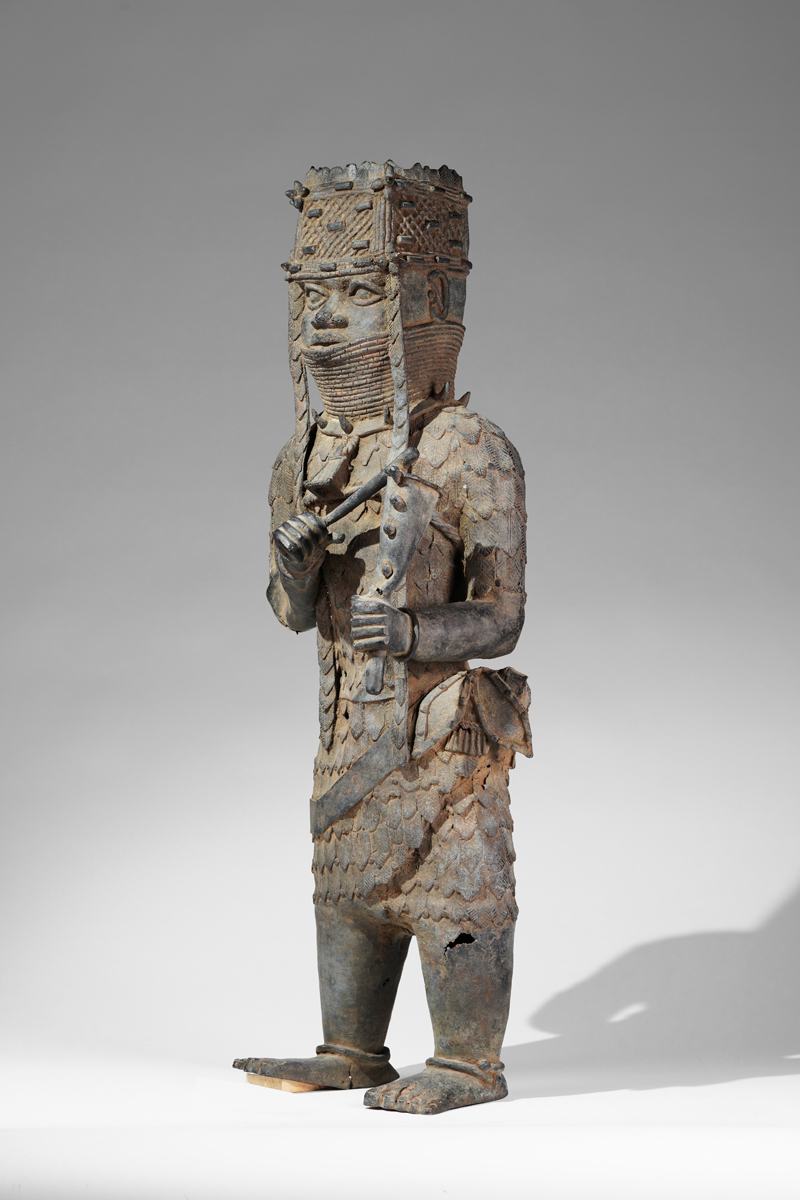 photo: wolfgang-jaenicke.com, for more information, please write us an e-mail with the identification number of the photo identification no. CAB08367.jpg |
 These similarities are considerably more specific than a general stylistic relationship to Benin art. In particular, the combination of the tall rectangular lattice-patterned crown, the long lateral strands, and the layered garment suggests that both works refer to the same or closely related courtly iconographic type. At the same time, the attributes and gestures of the two figures differ. The figure on the plaque raises both arms laterally and holds different objects, whereas the freestanding figure brings its hands together in front of the body and appears to perform an action involving a sound-producing instrument. The sculpture should therefore not be regarded as a three-dimensional copy of the plaque. Rather, both works appear to represent different variations within a shared iconographic vocabulary of the Benin court. The plaque is also relevant to the chronological assessment of the sculpture. If the plaque is stylistically assigned to the 17th or 17th/18th century, it demonstrates that essential features of the freestanding figure derive from an iconographic type already established during that period. The high degree of detail, relatively slender proportions, and sophisticated treatment of the crown, garment, and jewellery likewise suggest an orientation toward earlier courtly forms. Both the freestanding figure and the closely related Benin plaque were publicly exhibited at Galerie Wolfgang Jaenicke in 2018. Their joint presentation forms part of their documented recent exhibition history and is particularly significant from an art-historical perspective because it allowed the close visual relationship between the two works to be directly observed and compared. The figure was produced using a lost-wax or comparable metal-casting technique. Particularly striking is the combination of a monumental overall conception with extremely detailed surface treatment. Crown, jewellery, garment, and accessories are differentiated through incised decoration, relief structures, applied elements, and repeated ornamental patterns. A detailed photograph of the surface reveals a complex and heterogeneous patina. Dark grey to almost black areas alternate with reddish-brown, ochre-coloured, and locally greenish or mineral-like deposits. More compact accumulations are visible within depressions and irregularities, while small pores and isolated corrosion features can also be observed. The patina is not uniformly distributed but consists of a multilayered and irregular surface structure with numerous areas of overlapping deposits. This detail photograph should be reproduced separately in any documentation of the sculpture, since it provides considerably more information about the surface condition than the general views. The exact age or authenticity of the patina cannot, however, be established on the basis of photographs alone. Such conclusions would require material-scientific examination and, where appropriate, analysis of corrosion products. The condition of the sculpture includes several significant areas of damage and deformation, all of which form part of the object’s present appearance and should be clearly documented in any catalogue entry or condition report. A larger loss is visible in the lower rear section of the garment and between the legs. The reverse also shows a pronounced crack across the upper body. Further smaller cracks, losses, corrosion areas, and irregularities are distributed across the surface. The right arm has been displaced or deformed from its original position. Its present angle, and consequently the spatial relationship between the hand, the striker, and the object being held, may therefore no longer correspond to the figure’s original configuration. This alteration is important when interpreting the action represented, since the present position of the attributes may have been affected by later deformation of the arm. The foot area is also damaged. One foot shows a crack and a clear upward deformation or bending. Dents and local distortions are additionally visible on the arms and other parts of the body. These damages should be recorded as part of the object’s history rather than interpreted as stylistic features. A thermoluminescence analysis by Labor Kotalla is recorded under reference CAB08367, with a stated result of approximately 300 years ± 22.9%. This result is relevant to the discussion of the object’s dating but requires careful methodological interpretation. Thermoluminescence does not date the metal itself. In the case of a metal sculpture, the test normally concerns mineral material that was heated during the casting process, such as material from a preserved casting core. The laboratory result should therefore be evaluated together with the precise sampling location and the complete analytical report. In purely numerical terms, an uncertainty of ±22.9% around 300 years corresponds approximately to a range of 231 to 369 years before the date of testing. In combination with stylistic and iconographic analysis, the result may provide an important additional indication, but it cannot replace a broader assessment of casting technique, metal composition, casting core, corrosion, provenance, and comparative material. The particular significance of the sculpture lies in its combination of monumentality, unusual iconography, and exceptional richness of detail. While the upright posture conveys an almost static dignity, the crown, jewellery, layered garment, and active gesture create a highly complex visual presence. Especially important is the close relationship with the comparable Benin plaque. The plaque demonstrates that the unusual combination of crown type, jewellery, and garment has a concrete parallel within the visual language of Benin court art. The sculpture can therefore be connected not merely in a general sense with the Benin artistic tradition, but more specifically with a particular courtly representational type. The probable action of striking a bell or gong adds a ritual dimension to the representation. The figure may therefore embody not only elevated social and political rank but also the performance of a ceremonial function. The combination of courtly or royal insignia with ritual action makes the sculpture particularly noteworthy within the broader context of Benin court imagery. A cautious catalogue designation would therefore be: Large standing court figure, probably an Oba or high-ranking dignitary, striking a bell- or gong-like instrument; in the style of the court metalwork of the Kingdom of Benin, based on an iconographic type of the 17th–18th century. The precise date of manufacture of the present sculpture should continue to be distinguished from the dating of its iconographic prototype. The stylistic parallels, the closely related plaque publicly exhibited together with the figure in 2018, and the available technical analysis nevertheless provide a substantial basis for further art-historical and material investigation. Hinweis: Im Chat selbst kann ich die Schriftgröße technisch nicht auf 12 pt festsetzen; der Text ist hier vollständig ohne Fettdruck formatiert und kann in Word/InDesign durchgehend auf 12 pt gesetzt werden. |