 |
A Bamana Iron horse rider, Mali, Saro region.
The Bamana iron horse rider from the Saro region of Mali is a striking example of the forging tradition and symbolic metalwork associated with the Bamana (Bambara) people, one of Mali’s largest and most culturally influential ethnic groups. These iron sculptures—often small in scale—depict a mounted figure and are forged by numuw, the hereditary blacksmiths of Mande society, whose role encompasses not only metalworking but also spiritual and social mediation. The horse and rider motif is a powerful symbol of status, strength, and ancestral presence, often associated with warriors, founding ancestors, or legendary leader
Such iron riders were not purely artistic—they were ritual objects, sometimes embedded in shrine settings or used in agrarian ceremonies, such as those linked to the Jo or Komo associations, which governed moral order and social cohesion. The abstraction and stylization seen in these figures—elongated limbs, minimalist forms, and exaggerated posture—convey spiritual authority more than physical realism. The horse itself, a rare and prestigious animal in many parts of Mali, symbolizes power, movement, and connection to the ancestral realm
The Saro region is located in southern Mali, within the broader Bamana cultural area, which stretches across central and southern Mali, including the Segou, Dioïla, and Koutiala zones. Saro and its surrounding rural areas are historically tied to blacksmith lineages, agricultural communities, and secret societies that organize initiation rituals, healing practices, and social governance. The region is relatively remote, which has helped maintain traditional artistic and ritual practices, including iron forging—a skill regarded not only as technological but as deeply spiritual.
In Bamana belief, the numu (blacksmith) is a sacred figure with the power to shape both metal and spiritual reality. Regions like Saro are important for preserving the ritual use of iron figures, which are placed in fields, homes, or shrines to invoke fertility, protection, and ancestral guidance. The continuity of this tradition underscores how metallurgy, in Bamana society, is inseparable from cosmology and communal identity. In summary, the iron horse rider from Saro is more than a sculpture—it is a ritual object, forged by spiritually empowered artisans to represent authority, ancestry, and protective force, embedded in a regional tradition where iron is as much about the sacred as the material.
Ezra, Kate. Art of the Dogon: Selections from the Lester Wunderman Collection. The Metropolitan Museum of Art, 1988.
Colleyn, Jean-Paul. Bamana: The Art of Existence in Mali. Museum for African Art, 2001.
Imperato, Pascal James. Traditional Medicine and Medical Pluralism in Mali. African Studies Center, 1977.
sold
Height: 25 cm
Length: 26 cm
Weight: 1 kg |
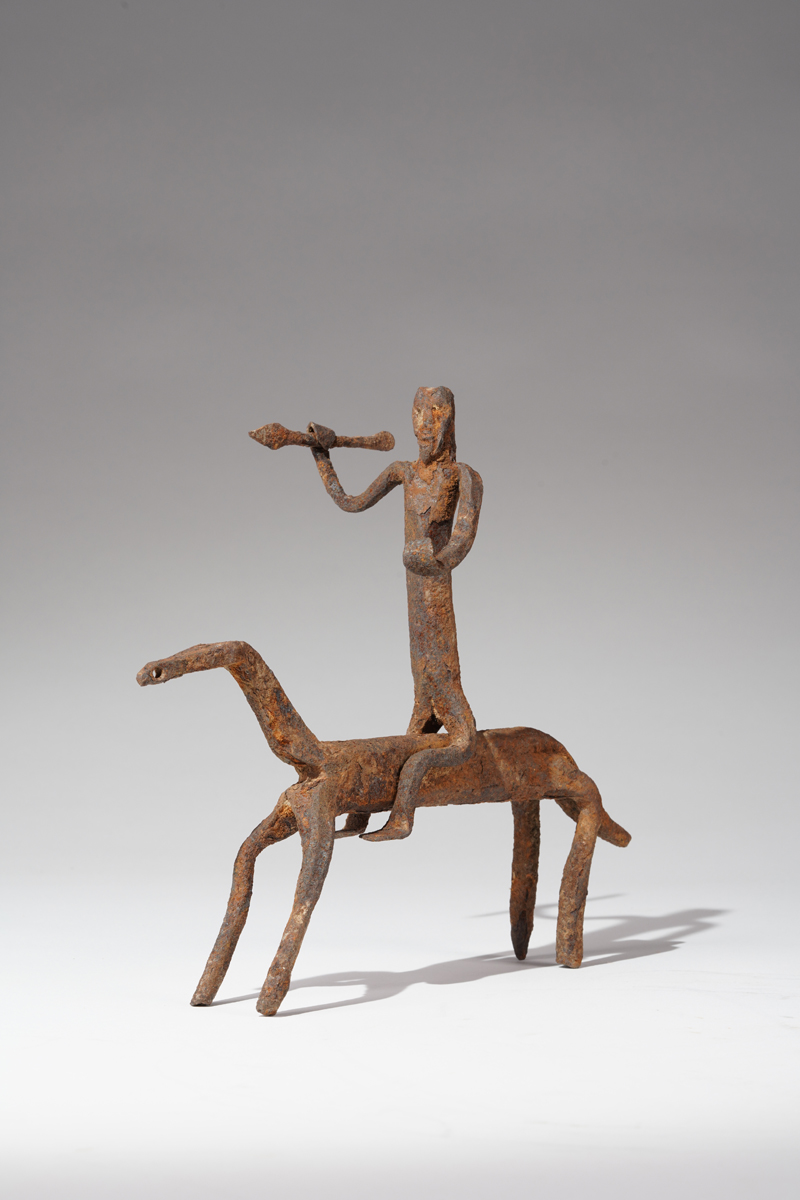 photo: wolfgang-jaenicke.com, for more information, please write us an e-mail with the identification number of the photo identification no. CAB08491.jpg
 |
|

