 |
 An Ashanti comb, Ghana, Koumassi region. Beautifully carved out of one pice of wood; glossy by use, signs of use.
The Ashanti (Asante) Akuaba comb from Ghana is a traditional artifact that blends functionality with deep cultural symbolism. Originating from the Ashanti people of southern Ghana, the comb is often carved from wood and features a stylized representation of the akuaba (plural: akuaba) figure—most commonly, a female with a large, flat, disk-like head, small facial features, and an elongated neck. This form is emblematic of Ashanti ideals of beauty and fertility. While combs served practical purposes for grooming and hair care, they were also prestige items and could signify social status or be used in ceremonial contexts1.
The akuaba motif itself is famously associated with fertility rituals. Traditionally, Ashanti women who wished to conceive would carry these dolls, believing they could aid in promoting pregnancy and ensure the birth of a beautiful child2. Incorporating this figure into combs demonstrates the integration of spiritual beliefs into everyday objects. The combs were often intricately carved and could be passed down through generations, serving as both heirlooms and protective talismans. Today, Akuaba combs remain a powerful symbol of cultural identity and continuity within Ashanti communities and are admired worldwide as examples of African woodcarving artistry
Cole, Herbert M., and Doran H. Ross. The Arts of Ghana. Museum of Cultural History, UCLA, 1977.
McLeod, Malcolm D. The Asante. British Museum Publications, 1981.
Vogel, Susan Mullin. African Art, Western Eyes. Yale University Press, 1997.
sold
Height: 34 cm without stand
Weight: 470 g incl. stand |
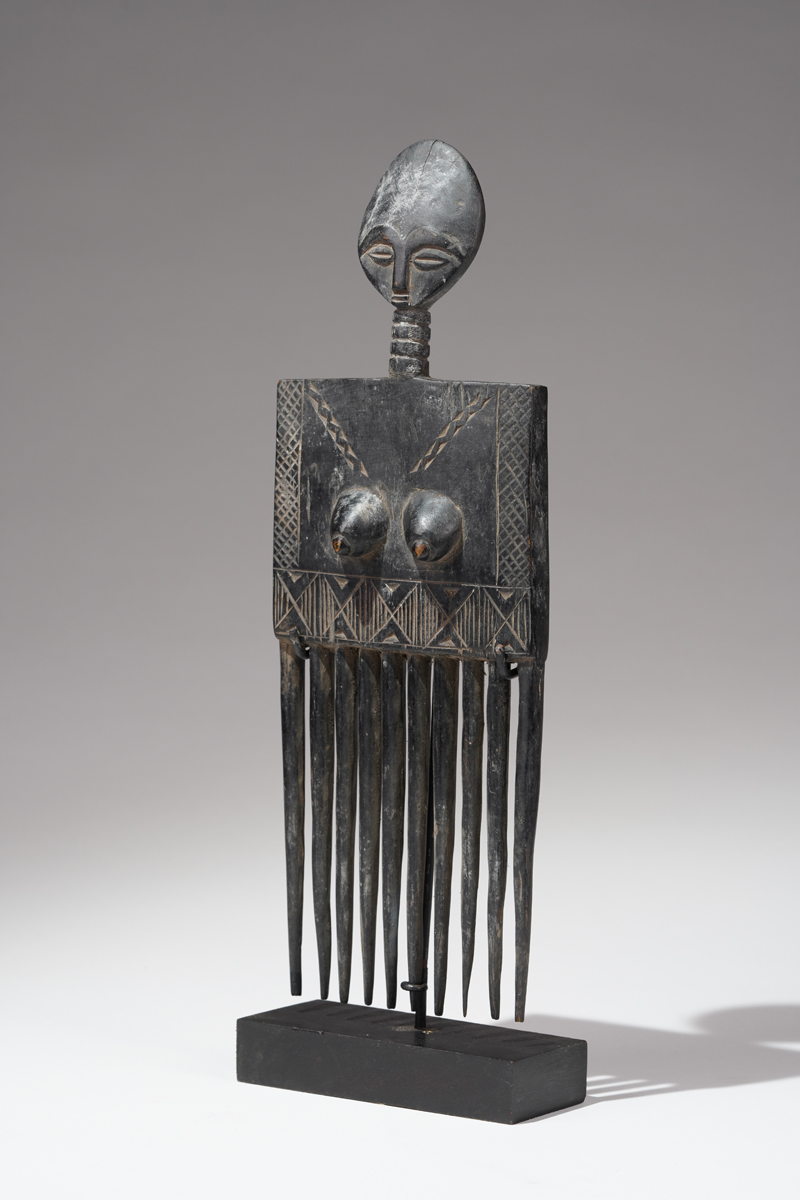 photo: wolfgang-jaenicke.com, for more information, please write us an e-mail with the identification number of the photo identification no. CAB08664.jpg
 |
|
