 |
An Ashanti comb, Ghana, collected in the Koumassi region.
The Ashanti (Asante) comb collected in the Koumassi region of Ghana is a refined example of an object that blends personal grooming, social identity, and spiritual symbolism. Typically carved from wood and intricately designed, Ashanti combs are both functional tools and status-bearing objects, often featuring elaborate finials with symbolic motifs such as human heads, animals, or abstract patterns. These designs are more than decorative; they often encode proverbs, moral values, or references to personal or clan identity1
Combs like these were commonly gifted to young women during rites of passage, weddings, or childbirth ceremonies, symbolizing femininity, beauty, fertility, and maturity. In many cases, they were also worn in the hair or tucked into waistbands as emblems of pride and cultural heritage. A comb with an akuaba-style head (resembling fertility dolls) might express a desire for children, while others with anthropomorphic or zoomorphic finials could signify family lineage or spiritual protection.
Koumassi, sometimes spelled Kumasi, is the capital of the Ashanti Region in southern Ghana and the historical seat of the Ashanti Kingdom, one of the most influential and centralized precolonial states in West Africa. It remains a key center for Ashanti culture, traditional governance, and craftsmanship. The region is especially renowned for its wood carving, goldsmithing, kente weaving, and adinkra stamping.
As the home of the Asantehene (king of the Ashanti), Kumasi has long been a political and spiritual capital, with royal courts, shrines, and artisan guilds producing ceremonial regalia, stools, combs, and sculptures for centuries. The Manhyia Palace Museum in Kumasi preserves many such objects, showcasing their role in court rituals and daily life. The city's bustling Kejetia Market and surrounding craft villages like Ahwiaa and Bonwire are major centers for the production and sale of traditional arts, including carved combs.
In summary, an Ashanti comb collected in Koumassi is not just a grooming tool, but a culturally encoded artifact reflecting the Ashanti ideals of beauty, social identity, and spiritual belief—rooted in one of the most artistically and politically sophisticated regions in West Africa.
Cole, Herbert M., and Doran H. Ross. The Arts of Ghana. University of California, 1977.
McLeod, Malcolm D. The Asante. British Museum Publications, 1981.
Willet, Frank. African Art: An Introduction. Thames & Hudson, 2002.
sold
Height: 36 cm without stand
Weight: 610 cm incl stand |
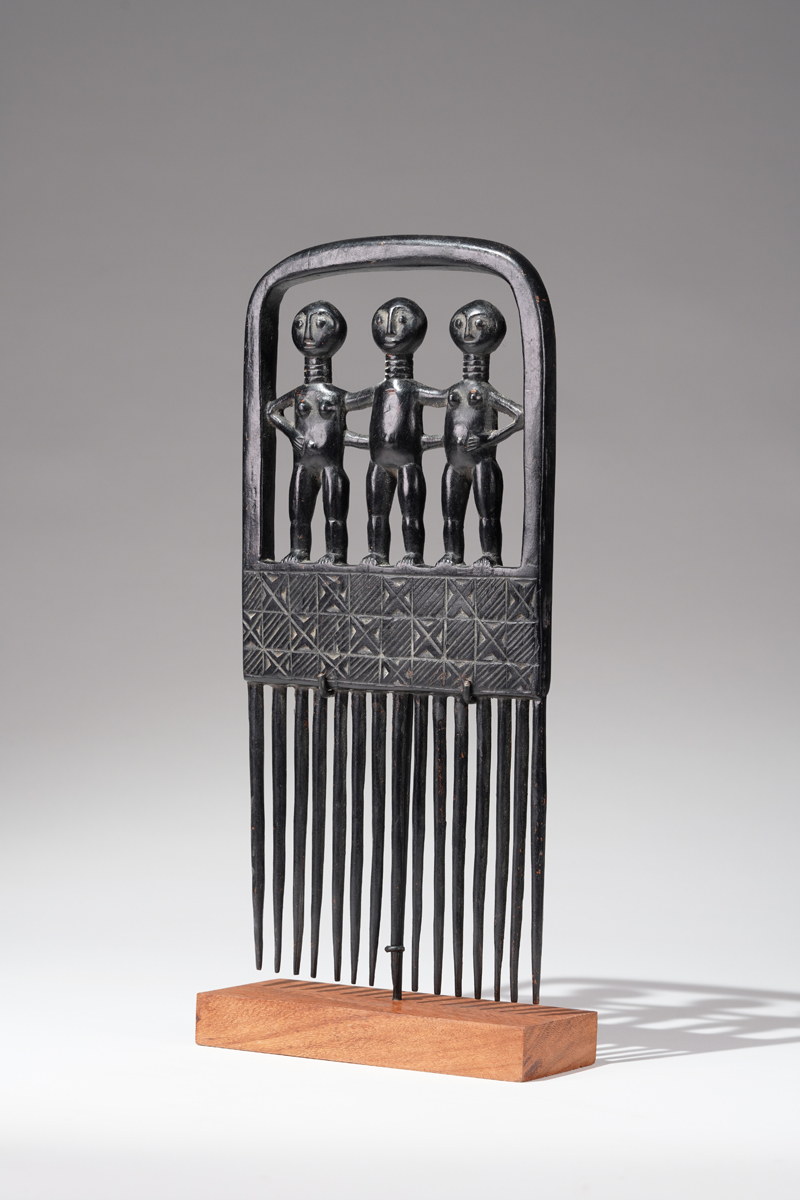 photo: wolfgang-jaenicke.com, for more information, please write us an e-mail with the identification number of the photo identification no. CAB08886.jpg
 |
|

