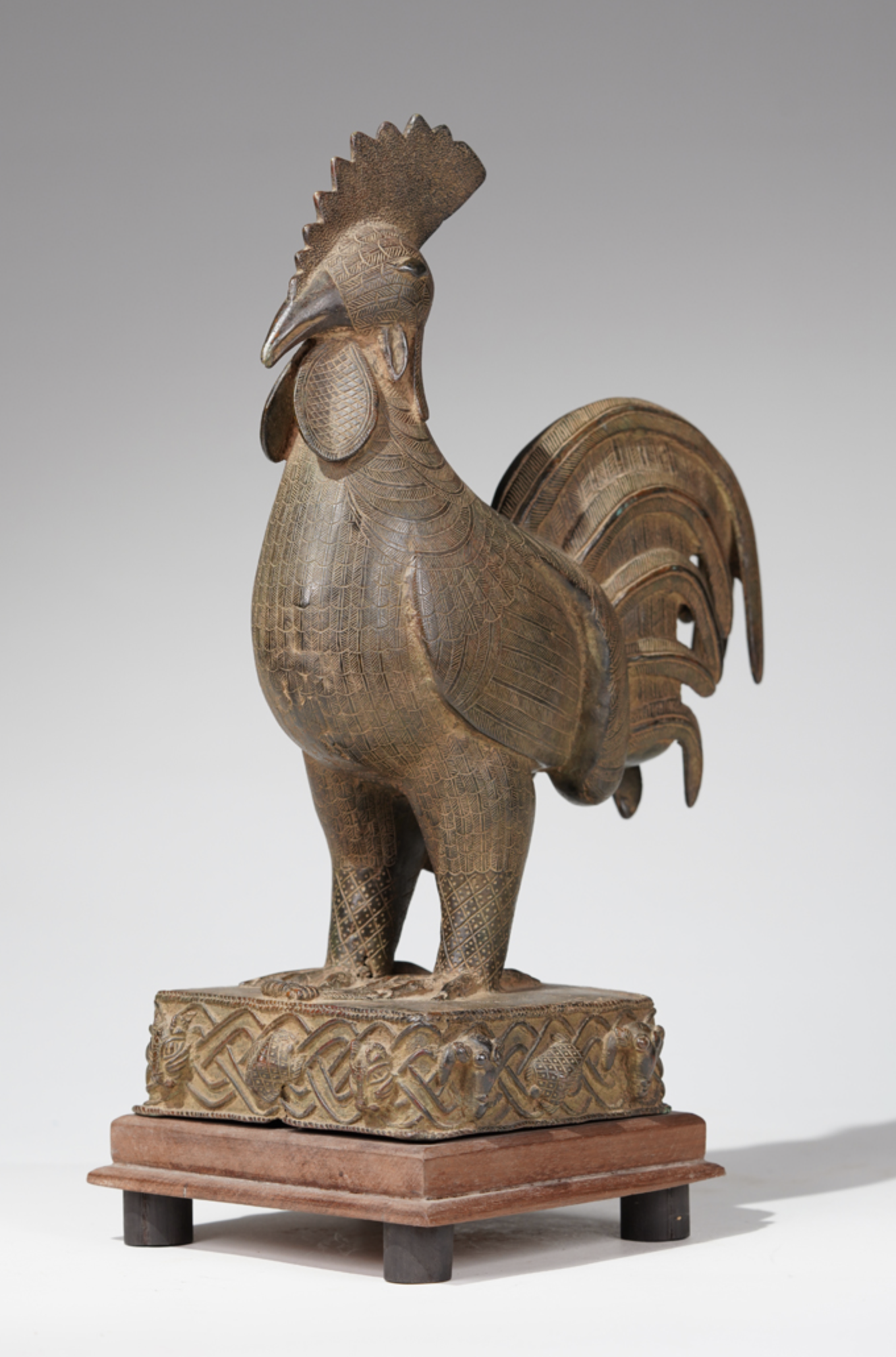
A brass rooster in the shape of an aquamanile, called Ọkpa being a shortened version of Ọkporhu, minor damages in the form of dents, with a head that opens.
These cocks have belonged to the Queen Mother’s (Iyoba's) court or altar, as the Queen Mother in Benin culture had her own palace and spiritual authority, and art objects related to her role were part of separate collections within the royal household. So while we can't definitively say every bronze rooster came from the Queen Mother's collection, it is plausible — and in some interpretations likely — that such an object was associated with the Queen Mother, given its symbolic and ritual importance. In general: The brass cock, which appears in the Benin bronzes, holds significant cultural and symbolic meaning. Cocks (roosters) were often associated with royal regalia and ceremonial life, and in many African cultures, the rooster is a symbol of courage, strength, and vigilance. It was sometimes linked to the divine and served as an emblem of the Oba's authority. A brass cock, in particular, was often included in ritual contexts. It was believed to be connected to the spiritual power of the Oba, symbolizing the king's connection to the gods and his ability to ward off evil. In some depictions, the cockerel would be represented as part of the ceremonial regalia or even as a figure that could serve as an offering to the gods. The Benin Bronzes, a collection of over 900 objects, include plaques, statues, and cockerels. The depiction of animals like the cock in Benin artwork reflected the kingdom's deep engagement with the natural world, as well as its emphasis on fertility, vitality, and strength. Brass cocks were often found in the Benin Royal Palace and were part of the Oba’s court regalia. sold Height: 32 cm |
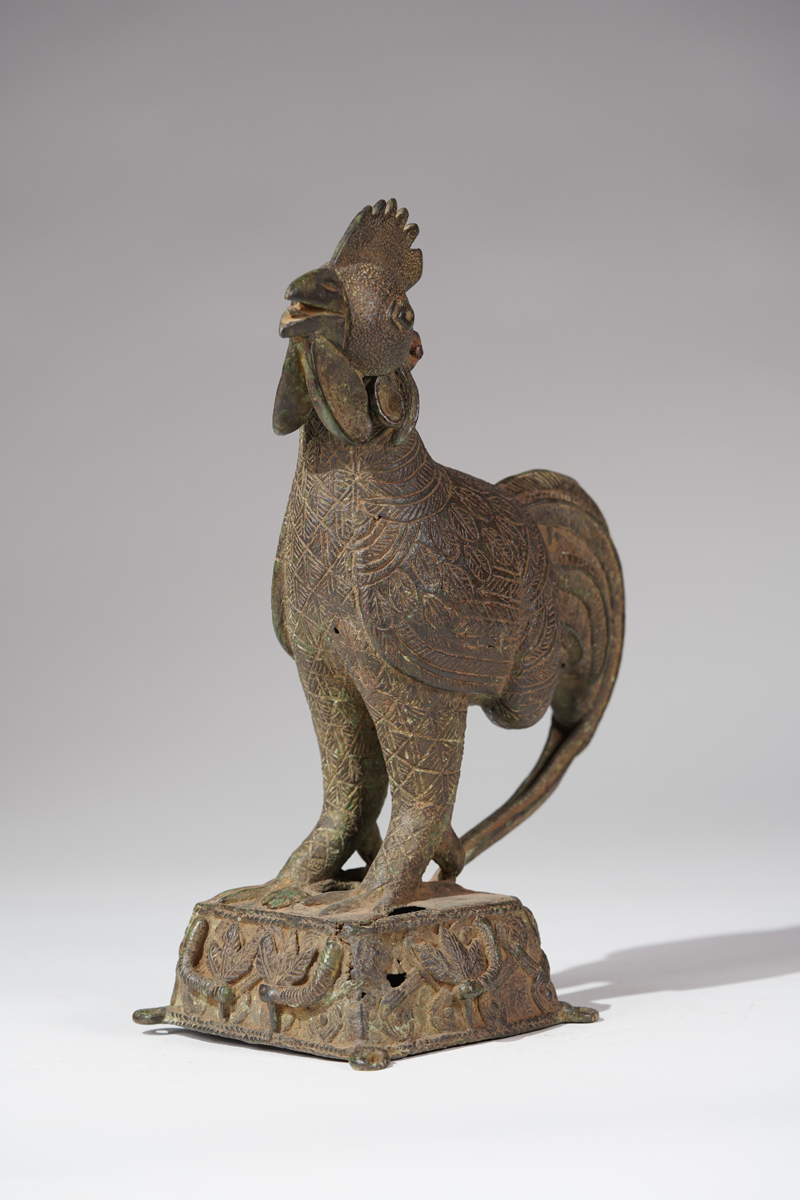 photo: wolfgang-jaenicke.com, for more information, please write us an e-mail with the identification number of the photo identification no. CAB07915.jpg |
 |