 |
 A three headed Gan snake bronze figure, called Torfan, Burkina Faso. Oxidized, signs of ritual use and age. The so-called Torfan represents one of the most complex and symbolically charged bronze ritual objects within the religious system of the Gan people of Burkina Faso. In academic discourse—most notably in the work of Maine Durieu—the multi-headed serpent figure is regarded as a central instrument in divinatory and therapeutic practices. The symbolic power of the Torfan derives from the multiplicity of its serpent heads, with the number of heads directly correlating to the spiritual potency of the object. In some instances, a Torfan may bear up to ten heads—each additional head enhancing the efficacy of the piece within ritual contexts.¹ Durieu emphasizes that such bronzes were exclusively used by high-ranking feticheurs or traditional healers. Their function goes far beyond mere protection against malevolent forces: the Torfan is believed to possess the capacity to reveal hidden, often destructive, elements within the inner being—impulses which, in the cosmological understanding of the Gan, are the source of disorder and spiritual illness.² In divinatory ceremonies—especially those aimed at diagnosing illness or conducting ritual purification—the Torfan operates as both a visual and energetic medium, facilitating communication between the visible world and the invisible realm. The revelation of “that which is vile within” is thus not merely diagnostic but also cathartic.³ The aesthetic and technical execution of these bronzes reflects a deeply embedded iconographic system, in which the spiral, multi-headed forms, and stylized animal motifs express a cyclical, non-linear conception of the world. The Torfan should therefore not be understood merely as an amulet, but as a mediumistic object—a conduit that links physical suffering to cosmic imbalance and restoration.⁴ ¹ See Maine Durieu & Bertrand Goy, Bronzes Gan – La spirale du serpent, Éditions Sépia, 2005, pp. 48–53. sold Height: 26 cm without stand |
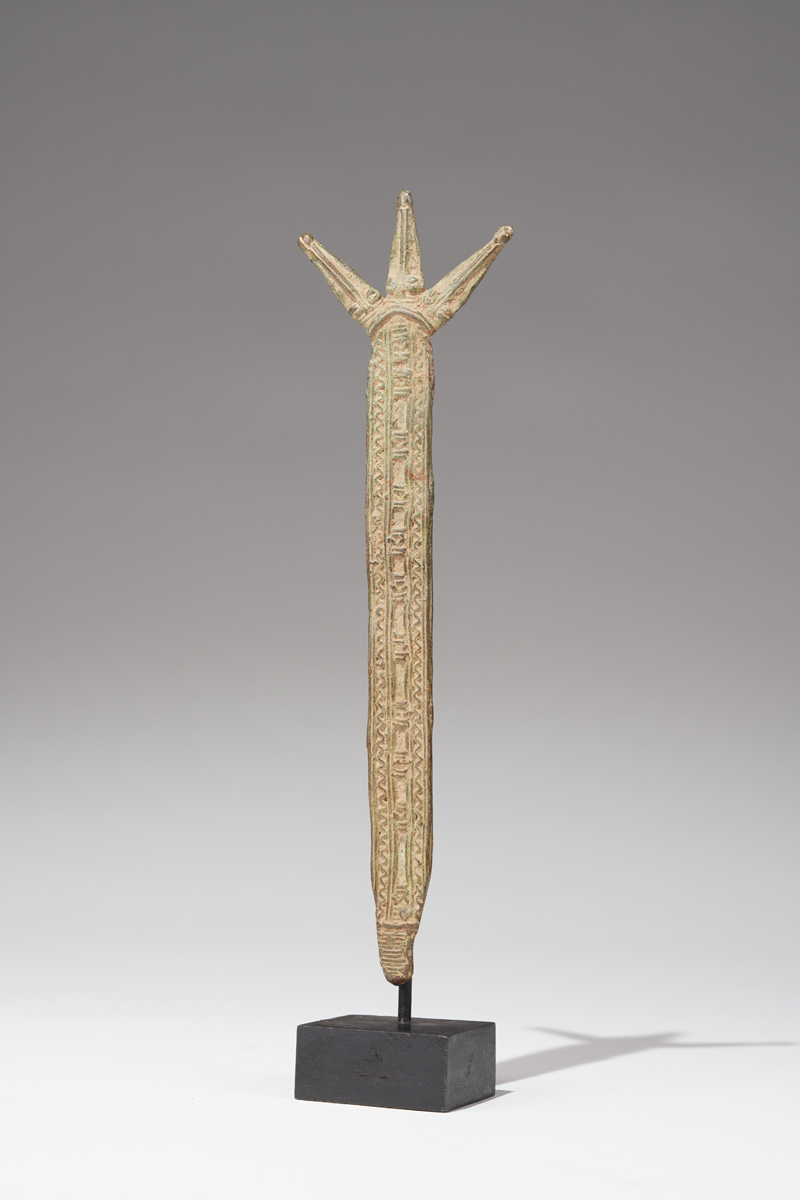 photo: wolfgang-jaenicke.com, for more information, please write us an e-mail with the identification number of the photo identification no. CAB08979.jpg |
 |