 |
 A Moba iron sculpture, Northern Ghana of slender, high abstract form, partly oxidized iron patina, incl. stand. The iron sculptures of the Moba people, found primarily in northern Ghana and neighboring Togo, represent some of the most striking examples of indigenous religious statuary in West Africa. Unlike the often elaborate wooden figures of adjacent cultures, Moba sculptures—known locally as tchitcheri—are marked by a radical formal reduction. Forged from raw iron, these abstract, often anthropomorphic forms exhibit a severe minimalism that conveys an immediate sense of spiritual gravity. Their simplified geometry—typically an upright rod with only minimal indications of head, limbs, or gender—reflects an aesthetic paradigm fundamentally distinct from Western notions of figurative representation. Tchitcheri serve a precise religious function within Moba society. Each figure is commissioned through a diviner in response to particular crises such as illness, infertility, or familial misfortune. Once forged, the sculpture becomes a vessel for an ancestral spirit, acting as an intermediary between the living and the dead. These figures are not meant to be seen as symbolic representations but as literal presences. After their ritual activation, they are placed in family shrines or near dwellings and are regularly engaged through libations of millet beer, animal sacrifice, or the application of sacrificial substances. These offerings do not simply honor the ancestor but sustain the spiritual vitality of the object itself¹. The choice of iron as material is profoundly significant. In Moba cosmology—as in many West African traditions—iron is endowed with powerful spiritual associations. It is the material of the smith, a liminal figure who mediates between the human and spiritual realms. Iron suggests permanence, resilience, and protection; its use in sacred objects underscores their lasting force and potency. The act of forging, furthermore, is not merely a technical procedure but a ritually charged process, with the blacksmith himself understood to participate in a sacred transformation². Western engagement with Moba iron figures has often focused on their striking formal resemblance to modernist sculpture. Artists such as Alberto Giacometti and Jean Fautrier have been compared to the stark abstraction of tchitcheri, and their work has at times been interpreted in dialogue with African ritual aesthetics. Yet to approach Moba sculptures solely through a formalist or aesthetic lens risks obscuring their original function. These are not artworks in the Western sense, but religious instruments—concrete manifestations of spiritual agency, embedded in systems of healing, kinship, and cosmological order³. The academic study of Moba iron sculpture has been enriched by anthropologically informed art historians such as Marc Félix and Jean-Baptiste Bacquart, who have emphasized the ritual context and symbolic logic of these objects. In this light, tchitcheri appear not as static artifacts, but as living elements within a spiritual ecology that continues to shape Moba society. ¹ Jean-Baptiste Bacquart, The Tribal Arts of Africa, London: Thames & Hudson, 1998, pp. 188–189. sold Height: 45 cm |
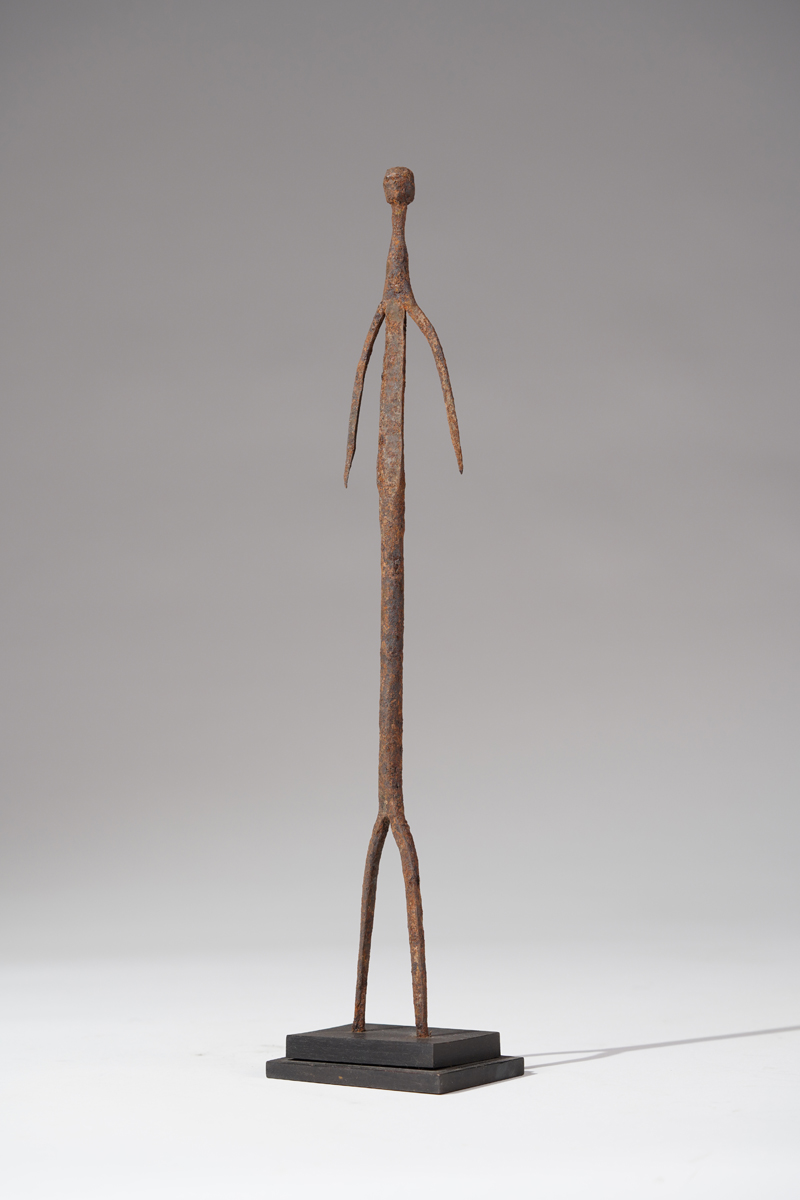 photo: wolfgang-jaenicke.com, for more information, please write us an e-mail with the identification number of the photo identification no. CAB09084.jpg |
 |