 |
 A Lobi or Moba iron sculpture, Burkina Faso/Ghana, of slender, high abstract form, partly oxidized iron patina, incl. stand. Sometimes it is difficult to subsum objects to a special ethnic group, in particular they are living close together, jn anycase a remarkable siron sculpture “The Lobi people live mainly in Burkina Faso, but also in the Nortrh West of Ghana and with smaller groups residing in Cote d’Ivoire and Ghana. They are mainly farmers who sustain themselves growing millet, sorghum and corn, and cash crops like peanuts and cotton. They also raise livestock and will occasionally hunt. Traditionally, the Lobi lived in self-governing villages until 1901 when the French brought colonialism to the area. Despite the significant Islamic influence surrounding them, the Lobi have largely maintained their animistic beliefs.” " The Lobi community is not organized on the basis of kinship or political ties and lacks any kind of centralized political authority in the form of a chief king or council of village elders. Instead the members of the community are united by common adherence to the cult of a nature spirit called “thil” (pl thila) and the rules that determine correct social behavior in the community are the rules that the spirit dictates through the diviner (thildar). The thila are invisible spirits of nature with certain supernatural abilities and powers that they can use for malevolent or benevolent ends. Each village has a particular spirit (dithil) that is responsible for the entire village. Social behavior is regulated by these thila, whose will is passed to ordinary people by priests and diviners." "Wooden or clay sculpture, called bateba, act as an intermediary between a particular thil and the Lobi community. Lobi bateba figures have a wide degree of style and are made for a wide range of purposes. In Lobi communities anyone can learn to carve, it is not limited to people with specialized training. Lobi bateba figures are believed to be able to act in behalf of their owner, they are considered a living being and have the ability to act out against forces that could harm it’s owner or bring good things to it’s owner depending on it’s intended purpose". Source: Brock Martin ’18, Environmental Studies, Pacific Lutheran University. Reference: A History of Art in Africa, Lobi Art and Culture, The Lobi of Burkina Fasso, Lobi Skulpturen. The academic study of Moba iron sculpture has been enriched by anthropologically informed art historians such as Marc Félix and Jean-Baptiste Bacquart, who have emphasized the ritual context and symbolic logic of these objects. In this light, tchitcheri appear not as static artifacts, but as living elements within a spiritual ecology that continues to shape Moba society. ¹ Jean-Baptiste Bacquart, The Tribal Arts of Africa, London: Thames & Hudson, 1998, pp. 188–189. sold Height: 49 cm |
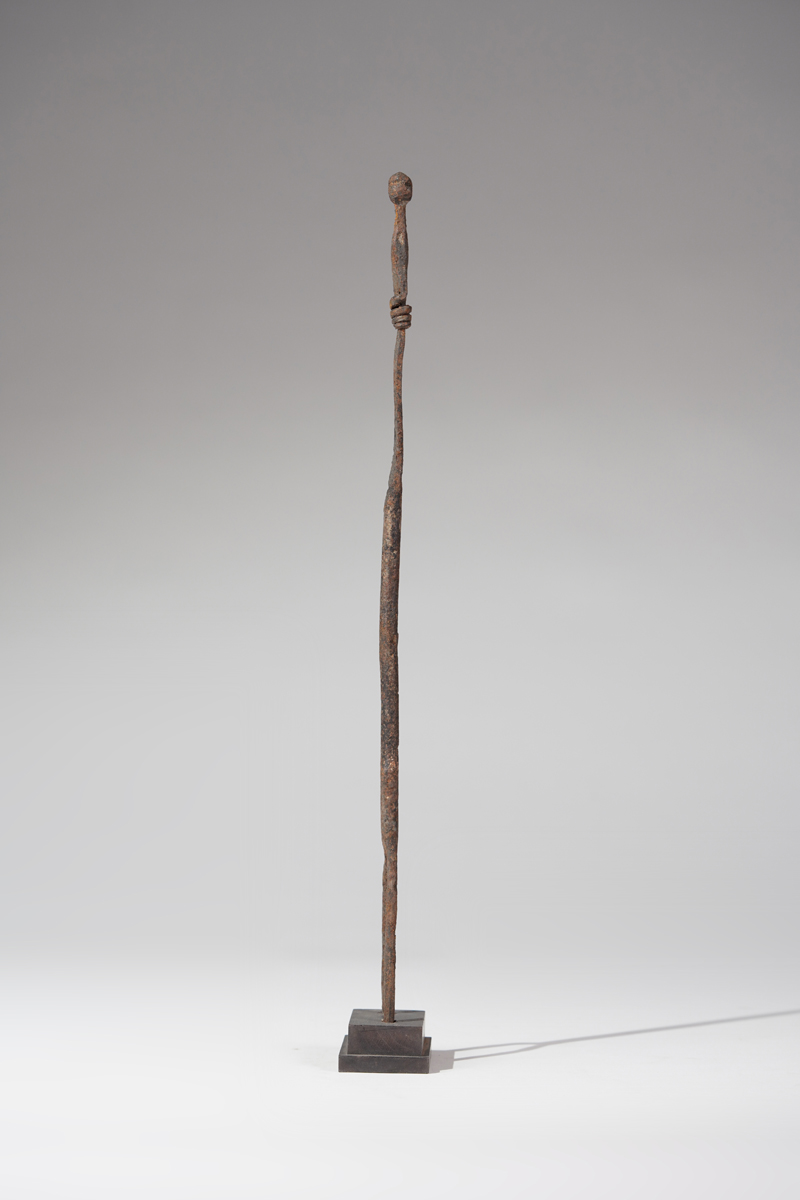 photo: wolfgang-jaenicke.com, for more information, please write us an e-mail with the identification number of the photo identification no. CAB09198.jpg |
 |