 |
 A plaque of an Oba or an Ìyàsẹ́ a Royal Commander, in the style of Benin, Nigeria. Oxidized patina, signs of use and age. This bronze plaque, created in the courtly style of the Benin Kingdom (Edo people, southern Nigeria), depicts either an Oba (divine king) or an Ìyàsẹ́ (royal commander), each a principal figure in the ceremonial and administrative life of the royal palace. To determine the subject, attention must be paid to iconographic details that reflect the distinct roles and visual hierarchies encoded within Benin court art. In representations of the Oba, the figure is often central and disproportionately large compared to surrounding figures, a formal device signifying spiritual authority and political supremacy. The Oba is richly adorned with layers of coral bead regalia — including a beaded crown (okpoho), elaborate chest ornament (egben'yo), and heavy necklaces and anklets — symbols of divine kingship and control over sacred materials. The Oba frequently holds a ceremonial sword (eben) or sits beneath a parasol held by an attendant, reinforcing his transcendental status. In contrast, depictions of the Ìyàsẹ́, though also elaborately dressed, present a more militaristic or administrative character. As the senior war chief and political advisor, the Ìyàsẹ́ may be shown in action — pointing, leading troops, or holding a staff of office. Coral adornments are still present, though they appear in lesser density and arrangement compared to the Oba, indicating his subordinate yet essential role within the palace hierarchy. His figure may appear among a group, rather than in a commanding central position, and is typically portrayed with less symmetry and formality than that of the Oba. Stylistically, both figures are rendered in high relief, with defined facial features and patterned attire, consistent with 16th–18th century court commissions. Such plaques were originally affixed to palace walls, forming a visual archive of royal authority, courtly roles, and ancestral legitimacy. This dichotomy between the Oba and the Ìyàsẹ́ reflects not only their political distinctions but also the Benin concept of ase (authority) and ehi (spiritual destiny), where each figure’s status is mirrored in the materials, scale, and gestures employed by the bronze casters of the royal guild. Ezra, Kate. Royal Art of Benin: The Perls Collection in the Metropolitan Museum of Art. Metropolitan Museum of Art, 1992. sold Height: 57 cm |
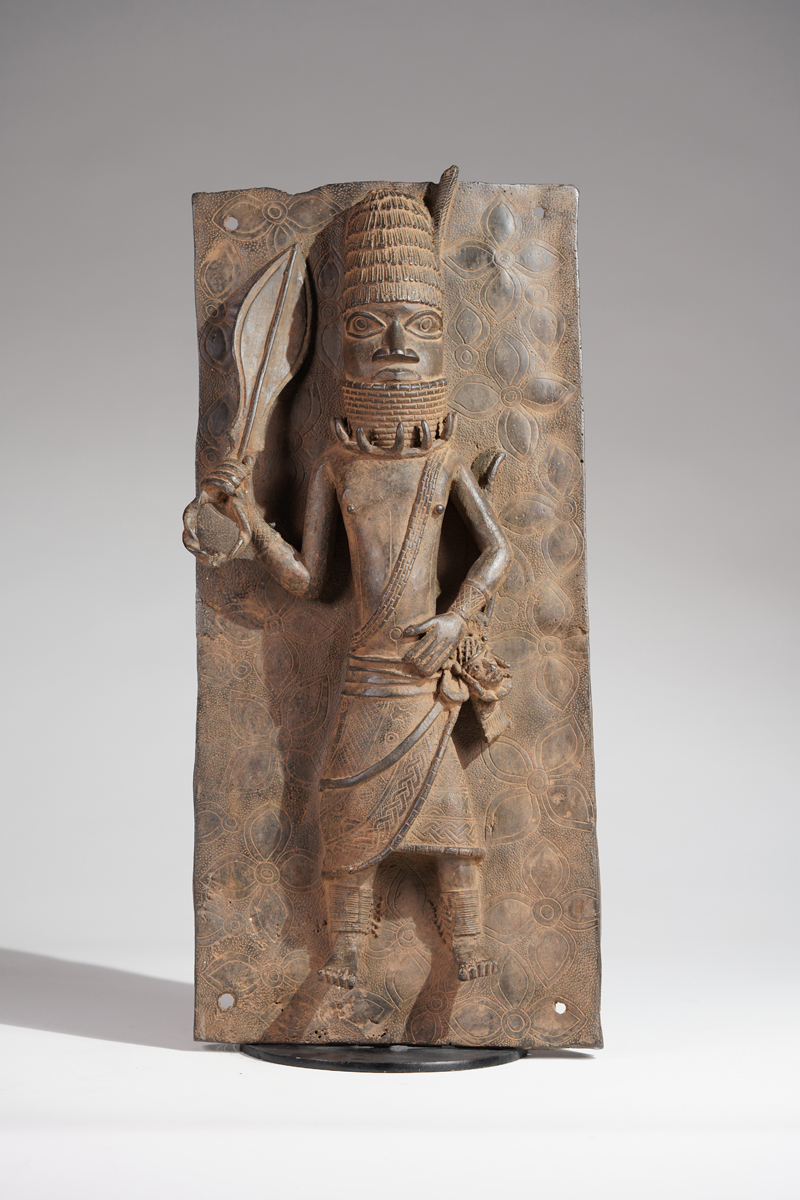 photo: wolfgang-jaenicke.com, for more information, please write us an e-mail with the identification number of the photo identification no. CAB09223.jpg |
 |