 |
 An Akan doll couple, Ghana, Koumasi region. In the cultural landscape of Kumasi, the historic capital of the Asante (Ashanti) kingdom in southern Ghana, Akan doll couples—especially akua'mma and their male counterparts—occupy a significant place within the symbolic world of fertility, lineage, and gender identity. Traditionally, akua'mma (singular of akua'mma) are female-styled fertility dolls, often carved with disc-like heads, stylized facial features, and elongated necks, used by Akan women to ensure conception and healthy childbirth. However, paired figures—representing male and female—extend this symbolism by emphasizing balance, matrimonial harmony, and the ideal union that secures social continuity through procreation. Originating from Kumasi and surrounding Akan regions, such dolls are not merely children’s toys or ritual tools, but powerful icons that encode gendered ideals, ancestral presence, and spiritual efficacy. These figures are often carried on the back like children, bathed, and fed during fertility rites, and kept in shrines when no longer in active ritual use. The prominence of such doll couples in Akan material culture is a reflection of the centrality of matrilineal inheritance and procreative success to the stability of the abusua (extended family). As Kwame Arhin notes, “To the Akan, the procreative couple embodies not only biological generation but the moral fabric of society; their representation in art is at once a prayer, a model, and a statement of communal order” (Arhin, 1985, p. 94). In addition to fertility, such figures may also symbolize twin births, which are culturally significant among the Akan, or serve as mnemonic devices linking the living to the ancestors. In Kumasi, the Asantehene’s court historically sponsored the preservation and circulation of such sculptural forms through royal workshops, lending them both ritual and political weight. Their smooth surfaces, balanced proportions, and serene expressions mirror Akan aesthetic ideals of order, beauty (fɛ), and moral uprightness (suban pa), reinforcing the notion that true fertility lies not just in birth, but in the perpetuation of ethical and social harmony. sold Height: 27 cm / 22 cm |
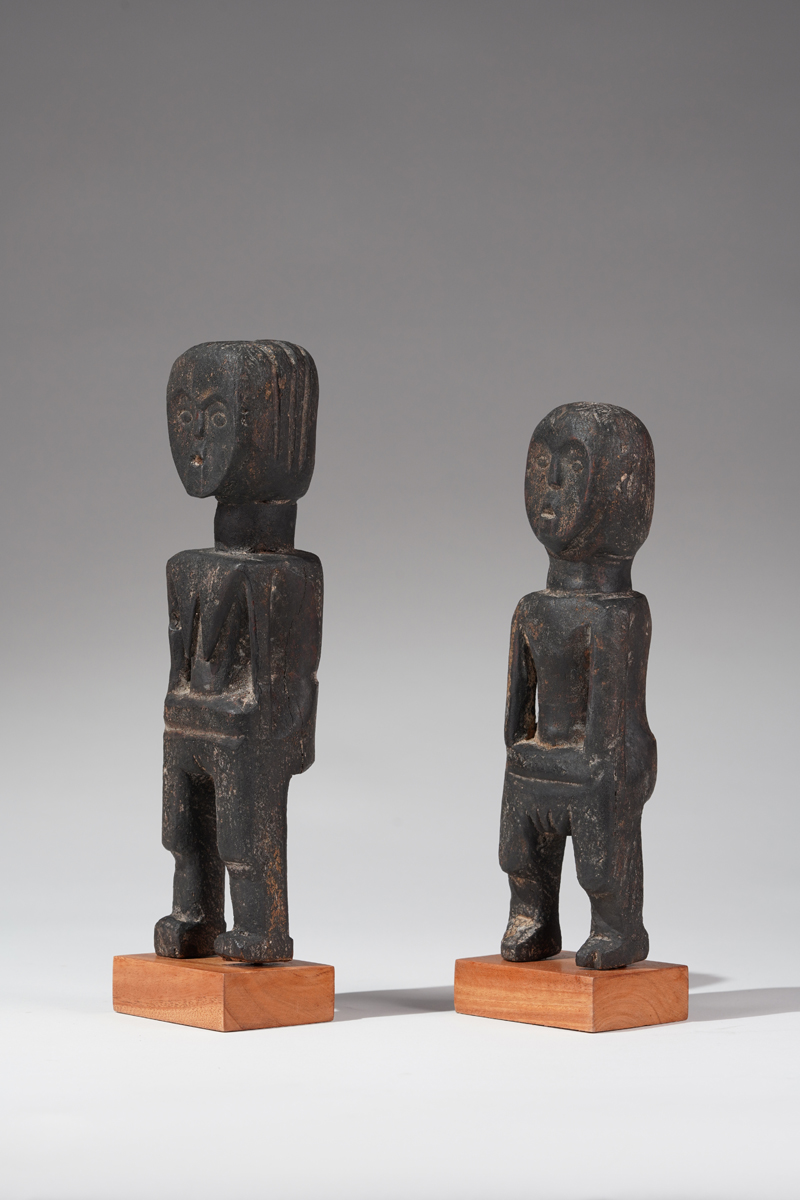 photo: wolfgang-jaenicke.com, for more information, please write us an e-mail with the identification number of the photo identification no. CAB09933.jpg |
 |