 |
 A Montol sculpture, Nigeria, Plateau State region. The Montol people of central Plateau State in Nigeria—part of the Chadic-speaking groups inhabiting the mountainous region near the Jos Plateau—are known for their deeply rooted ritual practices, in which wooden sculpture plays a central role. Typically associated with ancestral veneration and protective spiritual power, Montol sculptures are carved with expressive, often abstracted features, reflecting an aesthetic tradition that prioritizes spiritual force (num) and ancestral authority over formal realism. These figures—ranging from upright human forms to hybrid or symbolic representations—are commonly installed in shrine contexts, where they serve as vessels for ancestral spirits or as intermediaries in divination and healing ceremonies. While Montol sculpture has historically received less scholarly attention than that of their southern neighbors (such as the Yoruba or Igbo), its visual language is no less profound. The Plateau region’s topography and relative cultural insulation have preserved distinct artistic traditions among the Montol and neighboring ethnic groups like the Goemai and Angas, contributing to a richly varied yet locally coherent style of figurative wood carving. Montol figures often feature geometric bodies, prominent heads, and exaggerated limbs, thought to enhance their spiritual presence and communicative power. As Fardon (1991) notes in his ethnographic study of Plateau groups, “In these upland communities, sculpture is not an object of display, but a node of ritual action—an embodied spirit with the capacity to affect human affairs through its material presence and ancestral resonance” (Fardon, 1991, p. 108). These works are ritually activated through offerings, song, and libation, and are frequently involved in community protection, fertility rites, or agricultural success. Though relatively rare in museum collections, Montol sculptures offer compelling insight into the ways in which small-scale, decentralized societies articulate cosmological meaning through materially potent art forms, particularly in a region where religious syncretism and colonial disruption have only recently begun to be critically documented by art historians and anthropologists. sold Height: 27 cm |
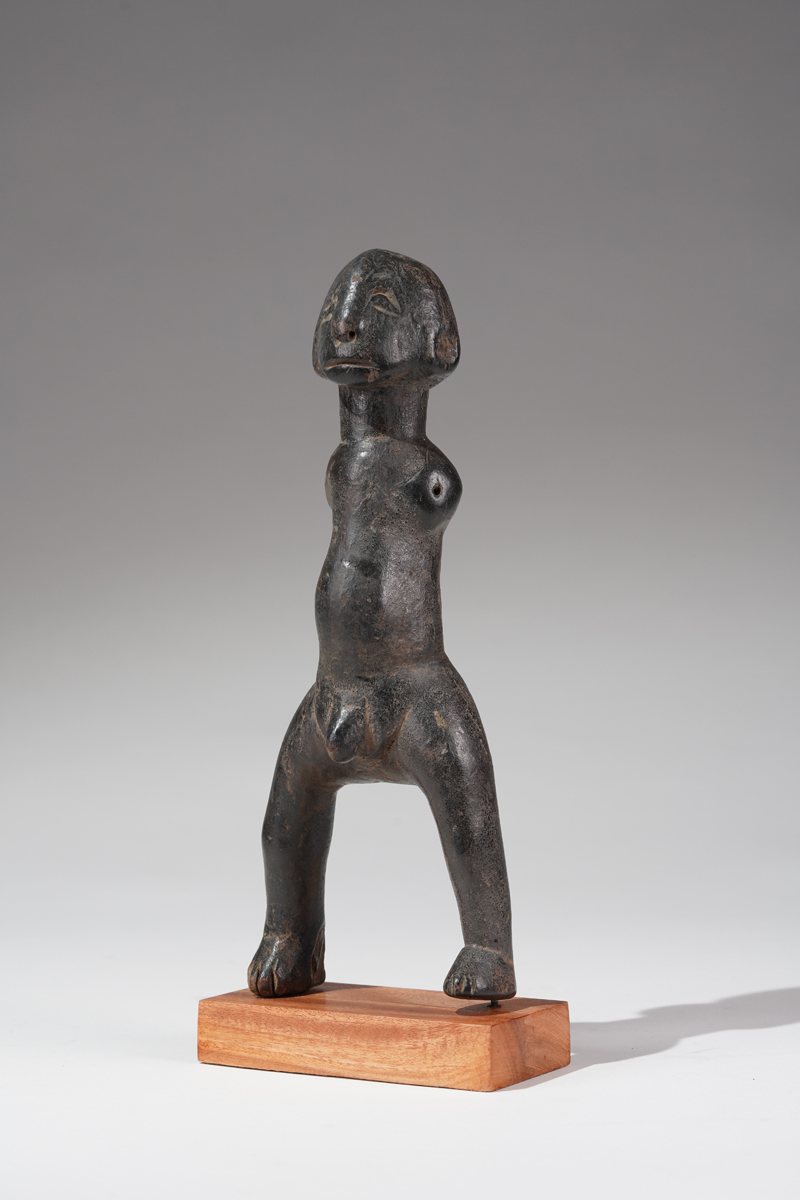 photo: wolfgang-jaenicke.com, for more information, please write us an e-mail with the identification number of the photo identification no. CAB09976.jpg |
 |