|
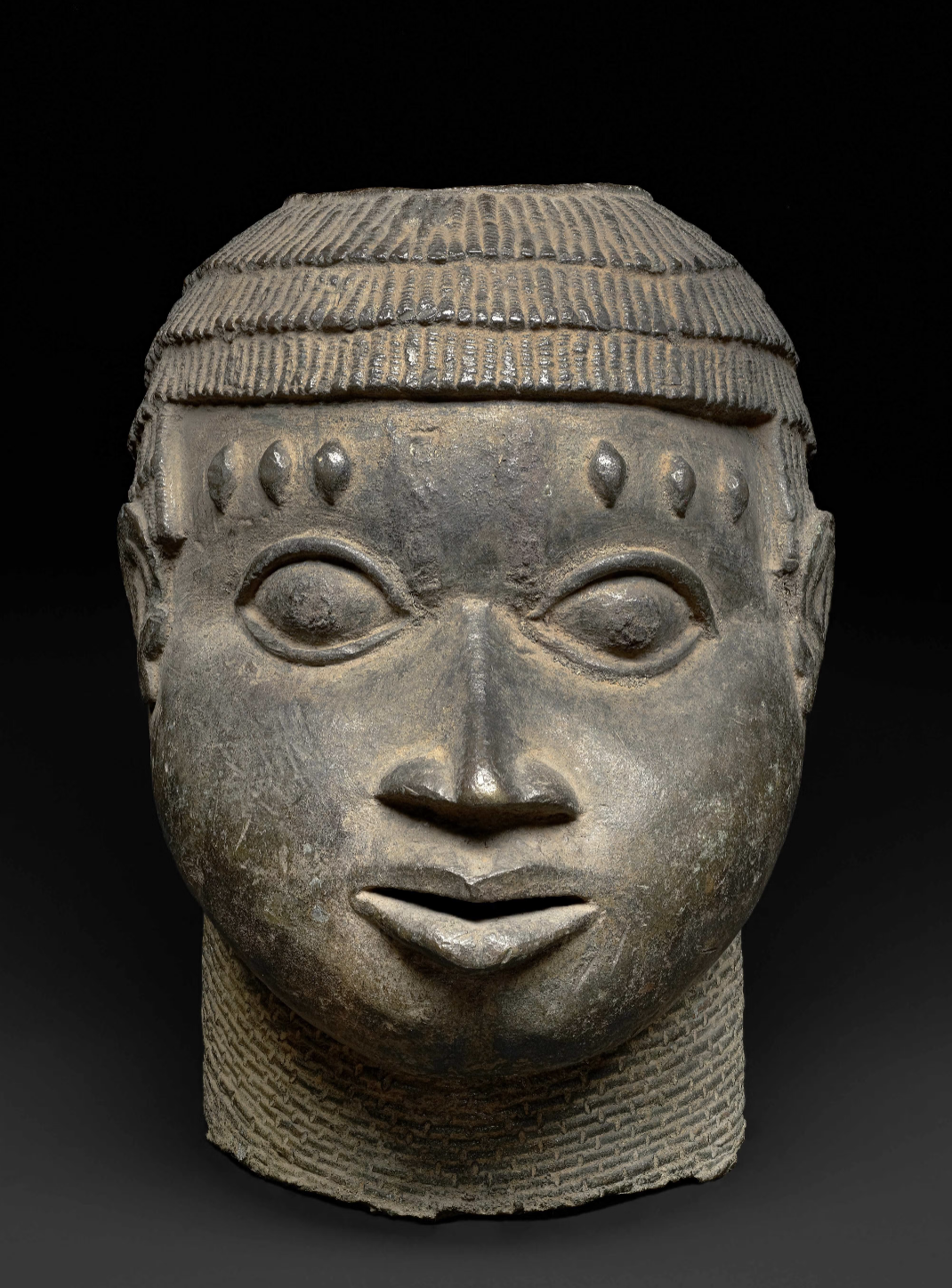
 A Commemorative Bronze head, in the style of Benin, Nigeria, with acoral-bead necklace, a hole on top of the layered hairstyle, oxidised iron inlays as pupils, fragmentary remnants of iron at the forehead, a whisker-like tattoos at the cheeks, see also magnifications of the different layers of patina at the end of this photsequence. This bronze of distinctive features that are typical of royal portraiture from the manner of the 16th ventury period. These include the elaborate scarification marks on the forehead, a coral-bead necklace, a carefully arranged plaited hairstyle composed of concentric rings—often referred to as the "Ibo hairstyle"—and a hole at the top of the head, likely intended for the insertion of an ivory tusk or ceremonial emblem. The heart-shaped, slightly parted lips, a recurring motif among similar heads, add to the expressive quality of the work. The reddish coloration on the forehead indicates the former presence of thin iron inlays used to highlight the scarification marks. Similarly, the pupils were often inlaid with iron to emphasize the gaze—here, the inlay survives only in the left eye. The use of iron in Benin bronzes is not merely decorative: in many African cultures, iron is associated with spiritual power and transformation. In the case of Benin, it was often employed to mark important features such as eyes and ritual scars, enhancing both the visual and symbolic impact of the figure. A striking and unusual element of this particular head is the incised motif resembling stylized whiskers on the upper lip—a type of facial tattoo not commonly seen on other heads of this kind. Yet in nearly every other respect, the head aligns closely with the more standard examples from Benin's courtly tradition. This strong formal resemblance suggests a shared meaning or function, although the precise origin and significance of the whisker-like tattoo remain unclear. Art historian Philip J. C. Dark has noted a possible connection to a standing messenger figure that bears similar facial markings. However, this figure’s role is also debated, having been interpreted variously as a messenger, a priest, a king, or a member of a secret society. The link to the messenger figure seems plausible and points more broadly to the object’s cultural grounding within the Benin court tradition. Nonetheless, scholars such as Paula Ben-Amos have questioned the strict attribution of such heads to Benin, suggesting alternative readings. As long as the symbolism of the facial tattoo remains unresolved, the precise meaning and function of this particular head must also remain open to interpretation.
A frequentary asked question: Is this bronze head a Messanger, a Commemorative Bronze head or a Ivbiotọ (trophy heads) Given the material, style, and iconographic elements, this bronze head is best understood as a commemorative royal head, rather than a depiction of a messenger. The defining features—coral-bead regalia, scarification marks, the Ibo-style coiffure, and especially the hole at the crown for the insertion of an ivory tusk—are characteristic of commemorative heads created for royal ancestral altars in the Benin court. These heads were cast to honour deceased Obas (kings) and placed on altars by their successors as part of a broader system of dynastic memory, ritual, and political legitimacy. The presence of the unusual whisker-like tattoo above the lip has prompted some speculation. Philip J. C. Dark noted a possible link to a standing figure interpreted as a messenger, due to the shared facial markings. However, this interpretation remains speculative. The standing figure’s role is ambiguous and contested, and no broader corpus of bronze heads confirms the existence of a distinct "messenger type." No indicators of subordination or service roles—such as would be expected of a messenger or attendant—are present in this head. Instead, its regalia and execution clearly align it with the tradition of royal portraiture within Benin’s commemorative practice. In conclusion, despite the presence of an anomalous facial marking, the overall evidence supports the classification of this work as a commemorative bronze head, most likely representing an Oba or a high-ranking royal ancestor within the ritual-political framework of the Benin kingdom. However DIGITAL BENIN subsumes these types of Benin Bronze heads to the Ivbiotọ (trophy heads) based on oral conversation. They... "are thought to represent decapitated heads of former Benin vassals who rebelled against the Ọba. When a rebel vassal was defeated, his head was removed and brought to Benin in an Ẹkpoki. The Ọba sent it to the Igun Ẹronmwon, where they made bronze replicas. The three Udari, or suborbital markings, show that the image is that of a non-Benin male." Based on a conversation with Chief Ihama in 1976, Ben-Amos (1995[53]) argued that these represent the decapitated heads of conquered kings. The Ọba kept one of the cast heads in the palace, while the other was sent to the son of the rebel vassal to constantly remind him of what happened to his father in case he chose to rebel against the Ọba. According to Chief Inneh, such heads were placed on the shrines of the ancestors, whereas Nevadomsky (1986) suggested they were placed on the shrine of war, the Aro-Okuo. sold Height: 25 cm |
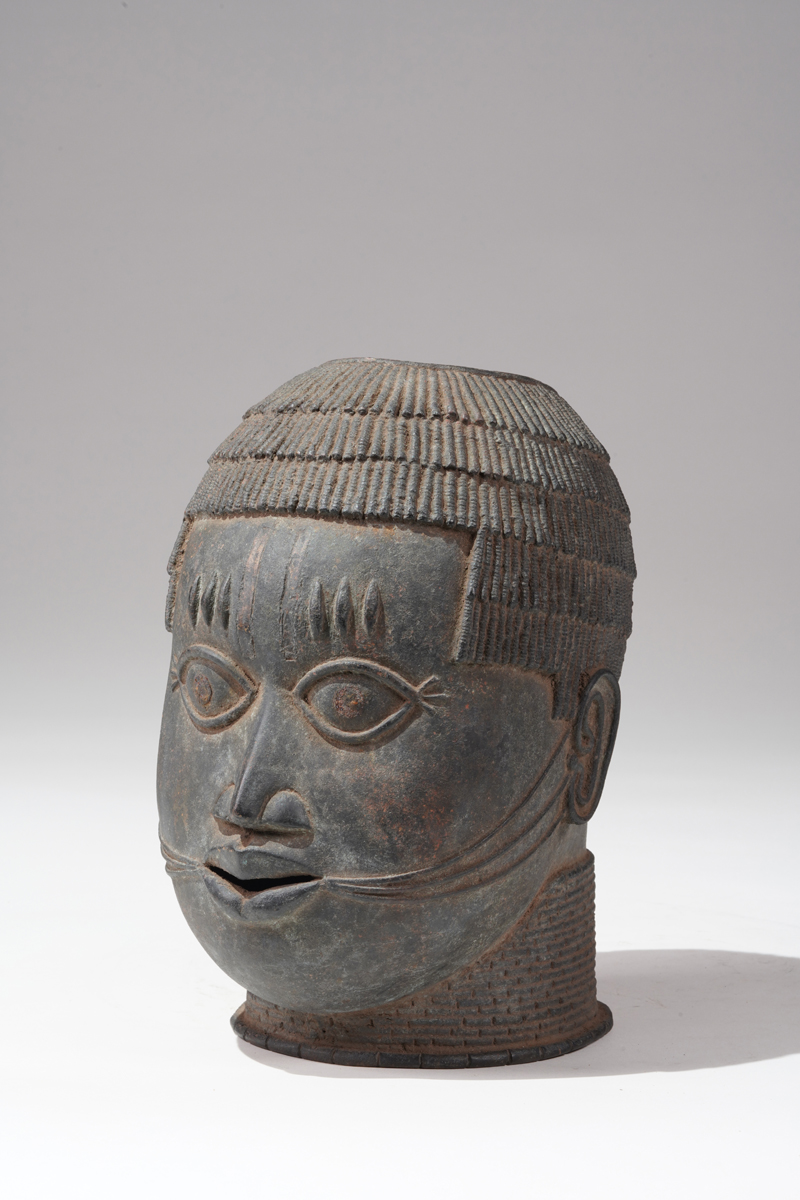 photo: wolfgang-jaenicke.com, for more information, please write us an e-mail with the identification number of the photo identification no. CAB07093.jpg |
 |