 |
A Mambila (?) bronze vessel, Nigeria, likely a ritualistic or ceremonial object, featuring zoomorphic and anthropomorphic elements. Dark patina, signs of elemental exposure and ritual use.
Bronze vessels cast in the form of roosters or birds are part of a distinctive sculptural tradition associated with the Mambila people, who reside along the mountainous Nigeria-Cameroon border. These vessels, executed in copper alloy through the lost-wax casting technique, are rare and reflect both ritual function and symbolic expression. Although the Mambila are more commonly known for their anthropomorphic wooden figures and masks, a small but significant group of zoomorphic bronzes—especially those in the form of birds—occupies an important place in their ritual material culture.
The vessels typically take the form of stylized birds, often interpreted as domestic roosters, characterized by exaggerated tail feathers, upright combs, and raised heads. The modeling is abstract but recognizable, with surface detailing that includes linear incision and punched patterns to indicate plumage or decorative surface treatments. In many examples, the bird’s back is hollowed out, forming a shallow or lidded container, and in some cases, the tail may serve as a handle or spout. These structural features suggest their use as containers for ritual substances, such as divination powder, medicines, or offerings.
Symbolically, the rooster form is closely associated with ritual sacrifice, dawn, and male authority. In many West African cosmologies, birds—particularly roosters—function as mediators between the terrestrial and spiritual worlds. The crowing of the rooster is often linked with the announcement of daybreak and the presence of ancestral spirits, making it an appropriate form for objects intended for use in communication with the unseen world. In the Mambila context, these bird-form bronzes likely functioned within shrine environments, either as offering vessels or as protective and symbolic icons themselves.
The presence of such elaborate animal-shaped bronze vessels in a largely non-urban and relatively decentralized society such as the Mambila challenges the long-held association of sophisticated metal casting with centralized kingdoms like Benin or Ife. These Mambila pieces appear to reflect localized elite patronage, where objects of prestige were commissioned by diviners, clan leaders, or ritual specialists for specific ceremonial or spiritual roles.
Dating and provenance for these works remain imprecise due to the scarcity of documented field collections and the limited archaeological investigation of the region. However, stylistic comparisons and patination suggest that the majority of these vessels were made between the late 19th and early 20th centuries. It is possible that some were made even earlier, but there is insufficient evidence to support definitive chronological assertions.
Although examples of these rooster-form vessels are held in a number of public and private collections, their relative rarity and the complexity of their form set them apart within the corpus of West African bronze sculpture. They demonstrate not only technical skill but also a rich symbolic engagement with animal imagery that is deeply embedded in Mambila ritual thought.
References
Nicklin, Keith. Traditional Metalwork of the Blacksmiths of Nigeria. Museum of Mankind, London, 1977.
Berns, Marla C. The Material Culture of the Mambila: Art and Performance. PhD Dissertation, UCLA, 1983.
LaGamma, Alisa, ed. Heroic Africans: Legendary Leaders, Iconic Sculptures. The Metropolitan Museum of Art, 2011.
Willett, Frank. African Art: An Introduction. Thames & Hudson, 2002.
Lembezat, Bertrand. Les Montagnards du Cameroun. Paris: Éditions Berger-Levrault, 1950.
sold
Height: 30 cm
Weight: 3,2 kg |
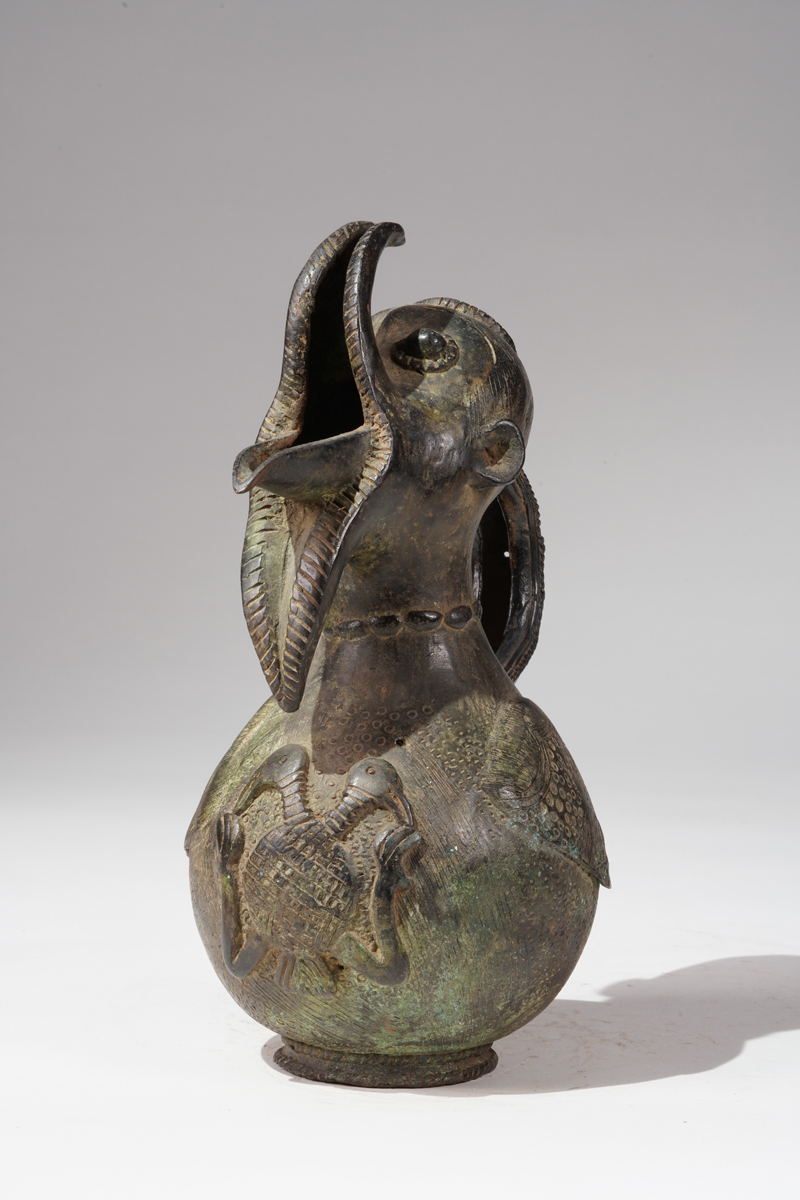 photo: wolfgang-jaenicke.com, for more information, please write us an e-mail with the identification number of the photo identification no. CAB07107.jpg
 |
|

