 |
 A small bronze horserider, Tschad, parrty greenish oxidised patina. The figure of the Tschad horserider occupies a central place in the cultural and political iconography of the Sahelian and Saharan regions. Emerging from centuries of nomadic mobility, trans-Saharan trade, and militarized state formation, the mounted warrior is more than a historical artifact; he is a living symbol of continuity, status, and defiance. In the Lake Chad Basin, particularly among the Kanem-Bornu polity and later Islamic emirates, the equestrian elite functioned as guardians of both territorial sovereignty and spiritual order. These riders were often aristocrats or warriors bound by strict codes of conduct, their authority reflected in the ornamentation of their mounts, the stylization of their garments, and their public visibility during festivals and rituals¹. The horse itself became a marker of prestige and access, connoting not only wealth but cosmological proximity to divine or ancestral forces. In many Sahelian cosmologies, the horse links the earthly to the transcendent, enabling its rider to traverse not only geography but also domains of political and spiritual legitimacy². This symbolic economy continues to inform ceremonial events such as the Geerewol among the Wodaabe or the Durbar festivals in northern Nigeria, where choreographed equestrian performances signal a re-inscription of power across generations³. In such contexts, the rider is both actor and archive, embodying forms of memory that resist erasure by colonial narratives or globalized aesthetics⁴. Contemporary artists referencing Tschad horseriders often invoke these histories to destabilize dominant visual regimes. Whether through photography, sculpture, performance, or textile, the reappearance of the mounted figure introduces layered commentaries on agency, migration, masculinity, and the afterlives of empire⁵. These works do not simply resurrect a precolonial past; rather, they rearticulate it within the contested terrains of postcolonial identity, where the horseman serves as a figure of movement—across borders, epochs, and epistemologies⁶. The exhibition Tschad Horseriders: Resistance and Ritual brings together works that engage the aesthetic, political, and mythological dimensions of equestrian iconography in African visual culture. These images are neither nostalgic nor ethnographic. Instead, they explore how the figure of the mounted warrior continues to shape imaginaries of resistance, sovereignty, and cultural endurance in the present. ¹ Lange, Dierk. “The Founding of Kanem by Assyrian Refugees c. 600 BCE.” Anthropos 106, no. 2 (2011): 579–595. sold Height: 6 cm |
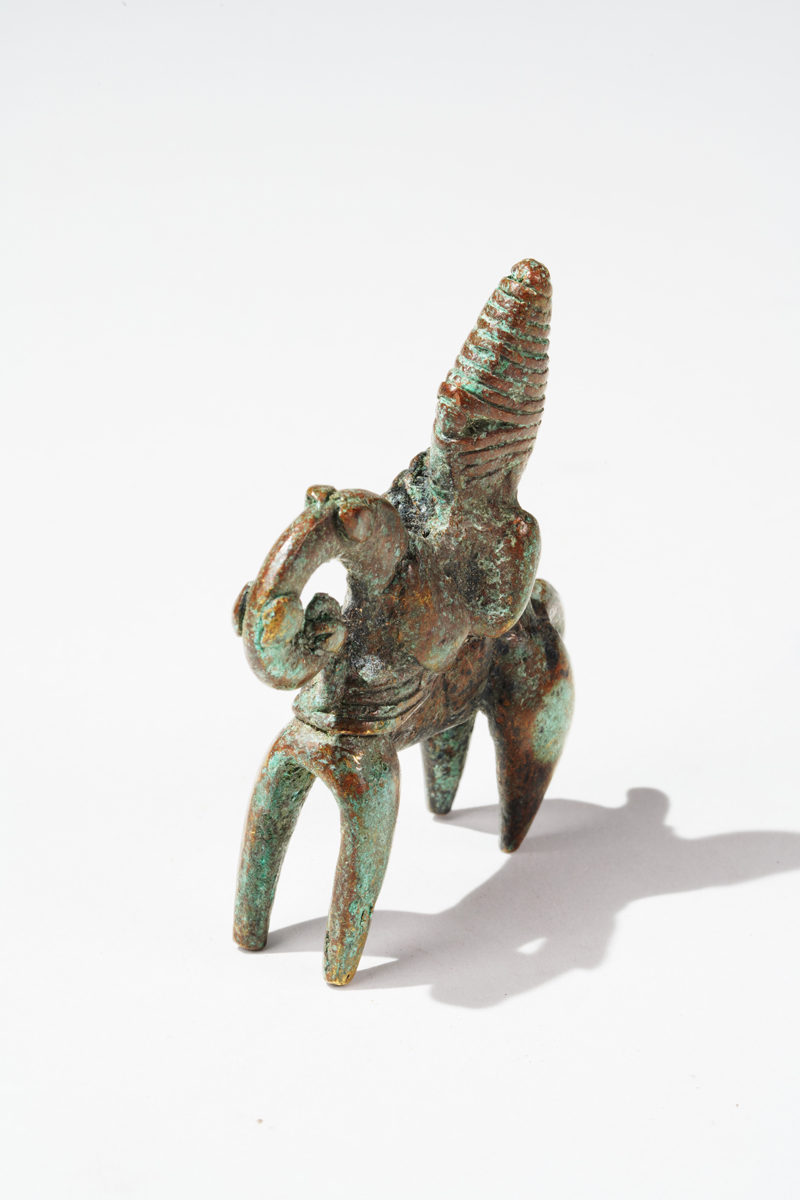 photo: wolfgang-jaenicke.com, for more information, please write us an e-mail with the identification number of the photo identification no. CAB08805.jpg |
 |