 |
 A female Akan sculpture, Ghana, touching her hands close to the abdomen, with a pointed navel in the center. Akan sculpture from Ghana often embodies symbolic and ritualistic dimensions that reflect broader cultural values. One notable motif is the female figure depicted with her hands resting close to the abdomen, frequently framing a pronounced or pointed navel. This pose is not merely aesthetic; it holds deep significance in Akan cosmology and social thought. The positioning of the hands near the stomach is commonly interpreted as a gesture of fecundity, spiritual strength, and the generative powers of womanhood. In many Akan societies, the abdomen is regarded as the seat of life, not only in the literal sense of gestation but also in terms of ancestral continuity and social identity. The pointed or protruding navel, often stylized and centered, acts as a visual anchor in such sculptures. It can be read as a symbol of origin—the navel being the physical marker of one’s bond to the maternal line and, by extension, to the clan and ancestors. This motif occurs in wooden shrine figures (abosomfie) and in representations associated with queen mothers (ɔhemmaa) or important female ancestors. These sculptures may have served as conduits for spiritual communication or as embodiments of ideals related to lineage and moral authority. Their standardized posture—upright, symmetrical, with eyes alert and hands close to the womb—echoes broader iconographic conventions within Akan carving, which privileges balance, restraint, and composure as visual correlates of ethical and political order The style is also shaped by the ritual function of such objects. Many of these figures were used in domestic or communal shrines and were believed to house or attract spirits. As such, their form follows an internal logic of sacred representation rather than naturalistic fidelity. The stylization of the navel and hands thus serves a semiotic function, marking the sculpture as an active participant in rites of remembrance, invocation, and healing.
sold Height: 52 cm |
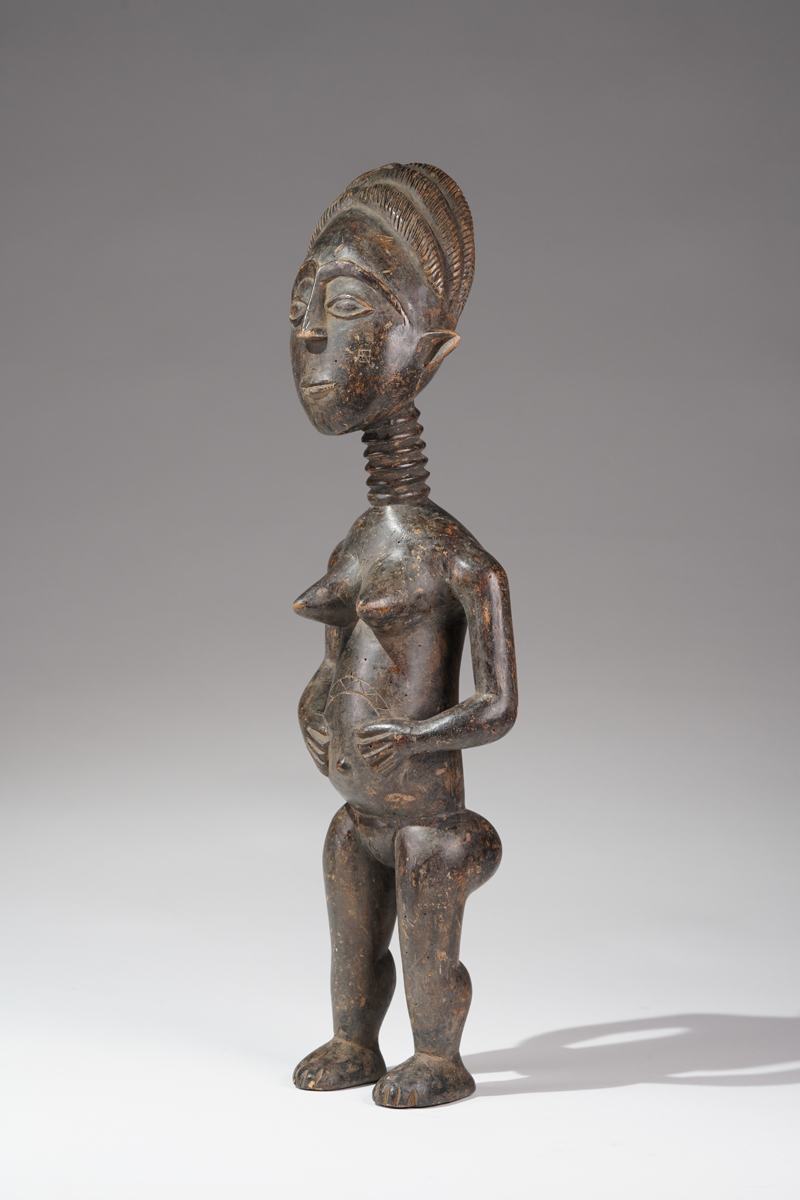 photo: wolfgang-jaenicke.com, for more information, please write us an e-mail with the identification number of the photo identification no. CAB09803.jpg |
 |