 |
 A male Mossi sculpture, Burkina Faso, incl. stand. A male Mossi sculpture from Burkina Faso embodies the spiritual and social dynamics of one of West Africa’s most populous ethnic groups. The Mossi, whose centralized kingdoms emerged around the 15th century, developed distinct sculptural forms that function within a highly stratified society comprising political rulers, spiritual leaders, and commoners. Male figures, such as the one considered here, typically represent ancestors or mythic founders and are used in rituals concerned with lineage, protection, and continuity of the family or clan. Mossi figural sculpture varies across the northern and southern regions of Burkina Faso. In the north, particularly in the Yatenga and Risiam areas, sculptures are often anthropomorphic with vertical proportions, abstracted forms, and a restrained treatment of facial features. The high forehead, often a marker of intelligence or status, along with elongated limbs and stylized musculature, suggests both idealization and a symbolic rather than mimetic approach to the human figure. These figures are not designed for public display but are stored in shrines and activated through offerings and ritual performances intended to maintain the favor of the ancestors. The role of such sculptures is intimately tied to the Mossi concept of nyama, or vital force, which resides in both people and objects. The act of carving is itself a controlled release and redirection of this energy. Male figures may be commissioned by lineage heads and used during rites of passage, commemorative ceremonies, or in response to misfortune, illness, or drought. Their power is not inherent in the sculpture as an object but emerges through its ritual use and the invocations it facilitates. The anonymity of Mossi sculptors reflects the collective nature of spiritual practice and the subordination of individual authorship to lineage and ritual function. Sculptures are not typically signed, and stylistic variation is determined more by regional workshop traditions than by individual innovation. The restrained aesthetic of the male figure—its calm expression, rigid posture, and emphasis on verticality—contrasts with the more dynamic forms associated with neighboring traditions, underlining the Mossi preference for austerity and stability in objects intended for ancestral communion. These sculptures also reflect the social order of Mossi kingdoms, in which the nakomse (ruling lineage) uses figurative art, while the tengabisi (spiritual custodians and non-ruling populations) are more associated with masks and other forms of non-anthropomorphic ritual art. Thus, male sculptures such as this one are also political symbols, bound up with the assertion of dynastic continuity and the legitimization of authority through ancestral presence. In sum, the male Mossi sculpture is a multifaceted object: spiritual implement, historical marker, and formal expression of a distinctly Mossi worldview in which power, memory, and aesthetics converge within a ritual economy grounded in the relationship between the living and the dead. References:
sold Height: 35 cm |
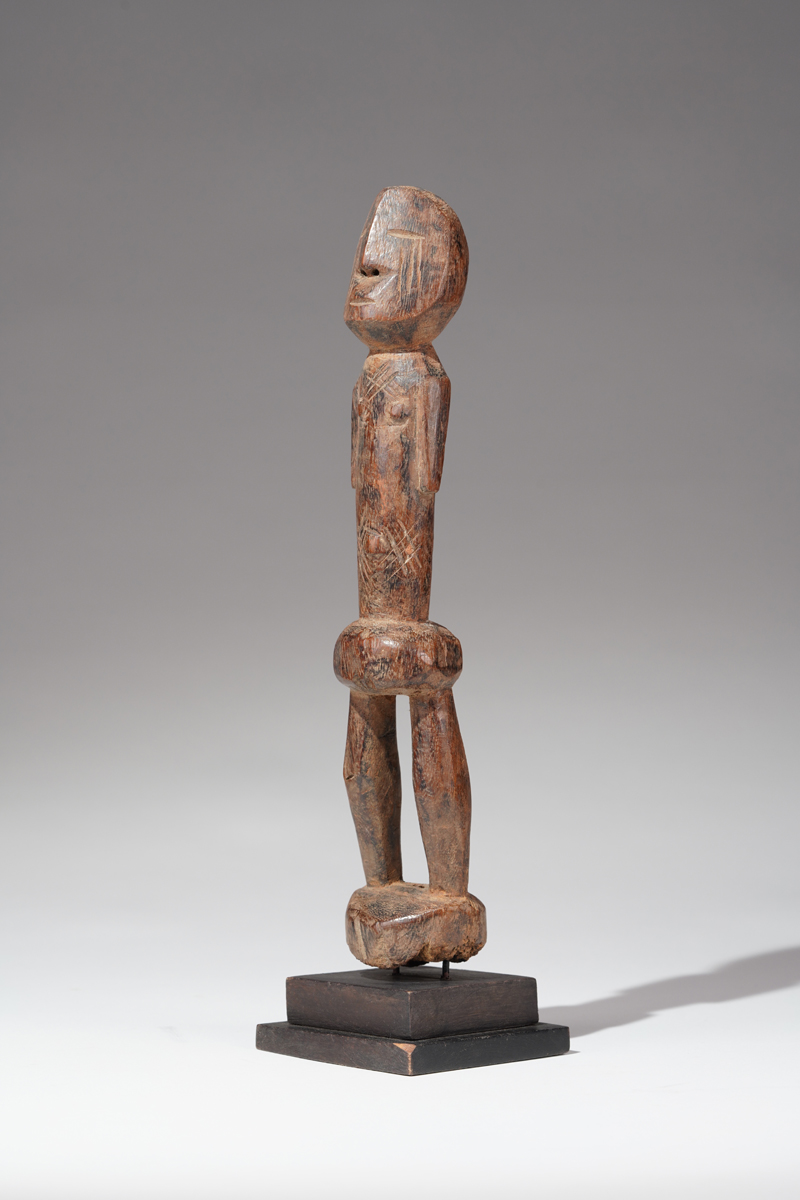 photo: wolfgang-jaenicke.com, for more information, please write us an e-mail with the identification number of the photo identification no. CAB09901.jpg |
 |