 |
 A Senoufo bronze pendant, Ivory Coast, of a high abstract, stylized animal, probably a panther, smooth oxidized, partly greenish patina Senoufo bronze pendants represent a distinctive form of West African metalwork, traditionally produced by the Senoufo people, who inhabit northern Côte d'Ivoire and parts of Mali and Burkina Faso. These pendants, often created using the lost-wax casting technique, reflect both aesthetic sensibility and symbolic significance within Senoufo ritual and social structures. The pendants are typically small in scale and were historically worn as part of necklaces or attached to ceremonial garments. Their iconography is often abstract, though figural representations—such as stylized human forms, birds, and hybrid beings—are also present. Such forms resonate with Senoufo cosmology and are frequently associated with the Poro society, the central male initiation institution among the Senoufo. The Poro regulates knowledge transmission and plays a crucial role in religious and political life. Bronze, while less abundant than wood in Senoufo art, holds particular ritual value. The process of bronze casting itself was considered a sacred act, undertaken by specialized artisans often working in isolation due to the esoteric nature of their knowledge. The pendants' use in initiation and healing ceremonies underlines their function beyond ornamentation, linking them to ancestral power and spiritual protection. Senoufo bronze objects, including pendants, gained attention in Western collections during the colonial period. Their abstraction resonated with early modernist aesthetics, particularly in France, where artists such as Picasso and Derain were influenced by West African forms. However, these objects' ritual contexts were often lost or overlooked in their transposition to European museums and private collections. Today, Senoufo bronze pendants are recognized not only as artworks but as historical documents of religious, artistic, and social practice. Their study requires interdisciplinary methods, combining art historical analysis with ethnographic and archaeological approaches to recover the meanings embedded in their forms and functions.
sold Height: 7 cm |
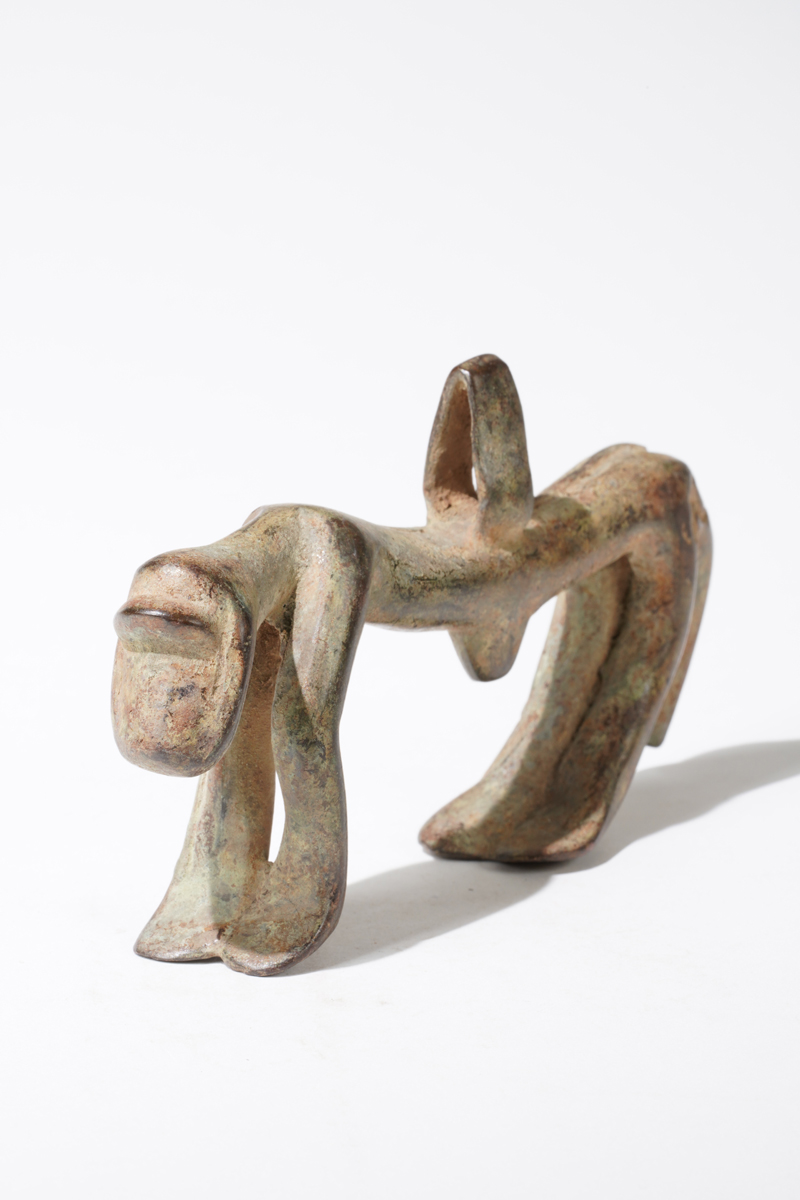 photo: wolfgang-jaenicke.com, for more information, please write us an e-mail with the identification number of the photo identification no. MAZ03114.jpg |
 |