 |
A Kulango bronze, Ivory Coast/Ghana, posted on a blackened stand.
The Kulango bronze tradition of the Buna region is an important part of West African cultural history. The Kulango people live mainly in northeastern Ivory Coast and parts of Ghana, including the Buna area. They belong to the larger group of Gur-speaking peoples, known for rich traditions in art and craft. Among these traditions is bronze casting, which holds both cultural and spiritual significance.
Bronze casting has a long history in West Africa. Many ethnic groups developed unique styles and techniques for working with bronze, often using the lost-wax casting method. This technique involves creating a wax model of the desired object, covering it with a clay mold, then melting the wax away to leave a cavity for molten bronze. The bronze is poured into the mold to form the final piece. The Kulango people adopted this technique to produce ritual objects, figurines, and ornamental items.
The bronze artworks made by the Kulango are often small and symbolic. They include representations of ancestors, spirits, animals, and other motifs important to Kulango beliefs. These objects were used in ceremonies and rituals, serving as a connection between the physical and spiritual worlds. They also symbolized social status and power within the community, especially among leaders and priests.
Historically, the Kulango bronze tradition likely developed in the late precolonial period, from the eighteenth to nineteenth centuries. It continued through the colonial era, although European influence caused disruptions. Despite limited documentation compared to more famous bronze traditions like those of Benin or the Ashanti, Kulango bronzes remain valuable for understanding the diversity of West African art.
Today, Kulango bronze pieces are rare but important artifacts that help preserve the cultural heritage of the Buna region. They reflect a history of skilled craftsmanship and the deep spiritual life of the Kulango people. Studying these bronzes offers insight into the complex social and religious systems of West Africa and highlights the artistic achievements of the Kulango community.
sold
Height: 15 cm without stand
Weight: 170 g incl. stand |
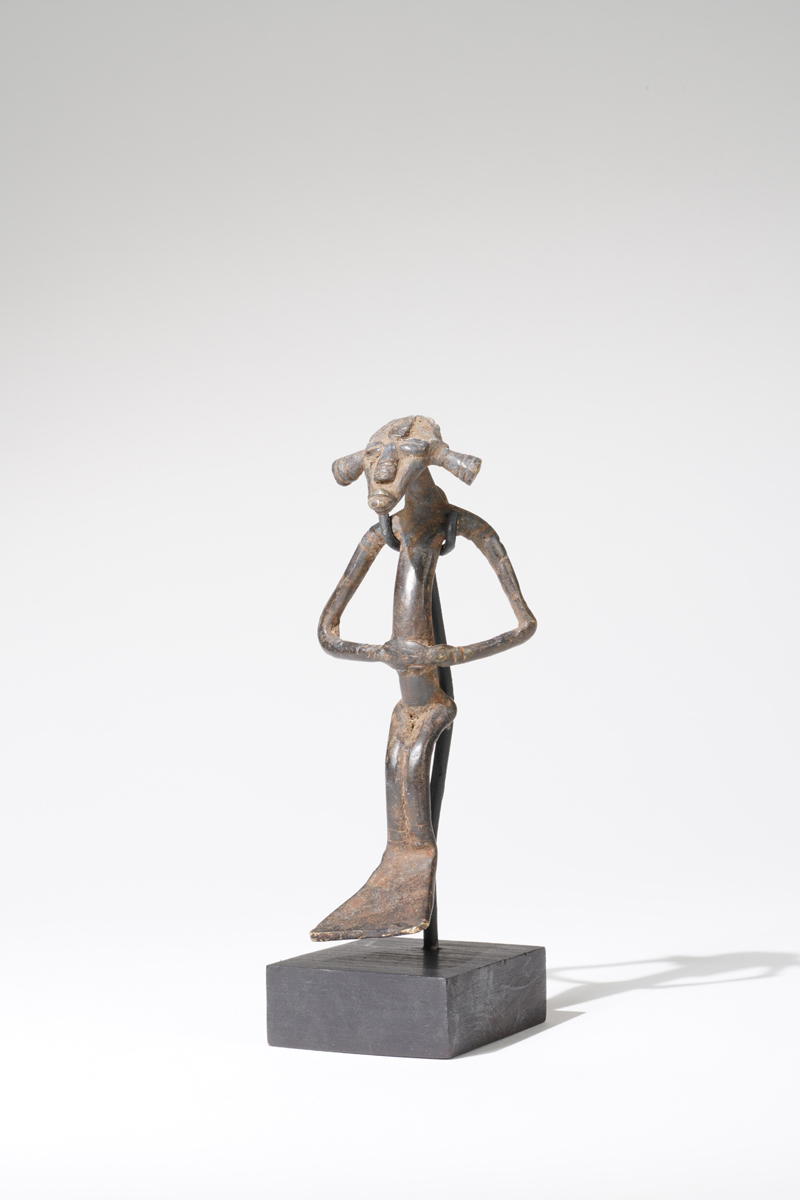 photo: wolfgang-jaenicke.com, for more information, please write us an e-mail with the identification number of the photo identification no. MAZ03126.jpg
 |
|

