 |
 A Moba bone sculpture, Northern Ghana, Moba bone sculptures represent a lesser-known yet profoundly significant aspect of the ritual practices of the Moba people, who inhabit parts of northern Togo and Ghana. While the wooden tchitcheri figures have been documented in some detail since the mid-20th century, their counterparts made from bone have received comparatively little scholarly attention. These objects, often smaller and more fragile than the wooden statues, serve distinct spiritual purposes within the context of Moba ancestral veneration and divination systems. The Moba worldview is structured around a firm belief in ancestral spirits (biɛ) as active forces in the lives of the living. Wooden figures are typically installed outdoors and are often abstract in form, with a simplified verticality and minimal facial features. Bone sculptures, by contrast, are generally concealed from public view and may incorporate human or animal remains. Their power derives in part from the material itself, which is considered to retain a spiritual charge long after death. The presence of bone in ritual sculpture emphasizes a direct connection to the deceased and signals an intensified relationship between the object and the ancestral realm. These sculptures are not designed as aesthetic objects, but rather as functional tools in ritual contexts. Bone figures are frequently associated with diviners (sɔsɔnaab) and are used in the interpretation of dreams, illness, or misfortune. Their deployment may be temporary or situational, depending on the nature of the problem being addressed. Once the ritual purpose is fulfilled, the sculptures may be buried, hidden, or ritually deactivated. Their temporal use contrasts with the often permanent installation of wooden figures in family or clan sanctuaries. The sparse visual language of Moba bone sculptures challenges Western expectations of anthropomorphic representation. The form may be reduced to a fragment or to an ambiguous shape that nonetheless carries immense symbolic and spiritual weight. In this sense, the sculpture's efficacy is not dependent on its resemblance to a human figure but on the potency of its material, its ritual activation, and its connection to lineage and land. The scarcity of Moba bone sculptures in museum collections may be attributed to their ephemeral use, their ritual secrecy, and the difficulty of their preservation. Ethnographic accounts suggest that bone figures were never intended for public display or for circulation outside their ritual context. As such, any extant examples must be approached with an awareness of their partial meanings and with a recognition of the limitations of museological interpretation. Debra Klein, Yoruba Bàtá Goes Global: Artists, Culture Brokers, and Fans, Indiana University Press, 2007, though not focused on the Moba, provides comparative insight into West African ritual arts.
sold Height: 22 cm |
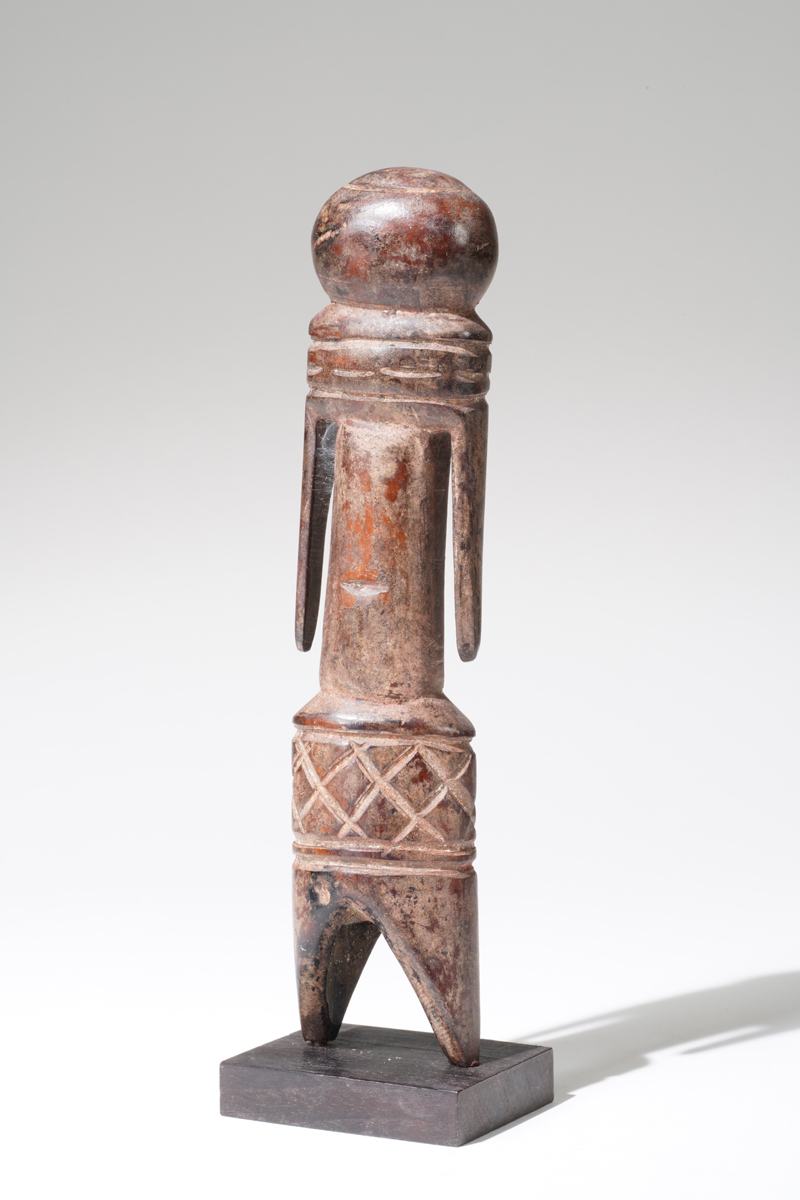 photo: wolfgang-jaenicke.com, for more information, please write us an e-mail with the identification number of the photo identification no. MAZ03138.jpg |
 |