 |
 A Kulango bronze sculpture, Ivory Coast/Ghana, posted on a blackened stand. The Kulango people, residing primarily in the northeastern region of Côte d’Ivoire near the border with Ghana, have produced a distinct corpus of small bronze sculptures that play both ritual and commemorative roles within their society. While stylistically diverse, these bronzes are often diminutive in scale and exhibit intricate detail, revealing the technical sophistication of lost-wax casting traditions sustained over generations in this region. Kulango bronzes typically depict human or anthropomorphic forms, though zoomorphic elements also appear. These figures can be found with exaggerated heads, elaborate hairstyles, and ornamented torsos, suggesting a close relationship to social markers such as status, age, or gender. Despite their size—often only a few centimeters tall—the works convey a sense of presence and spiritual weight, indicating their function was never merely decorative. These bronzes were commonly used in divination practices, where they served as intermediaries between the physical and spiritual worlds. In some contexts, they were employed by diviners (often known as komyenfwe) as part of diagnostic rituals, in which the sculptures were consulted to identify causes of misfortune, illness, or social disorder. Their use in such rituals reflects a broader West African tradition in which small-scale sculpture operates as a medium of communication with the invisible realm. Additionally, Kulango bronzes were often included in personal or familial shrines as protective figures or mnemonic devices. Some scholars argue that these objects may have also functioned as representations of ancestors or tutelary spirits, especially in cases where they were passed down or enshrined in compounds. Their portability facilitated their circulation both within and beyond their communities, particularly through trade and exchange networks, which has led to their presence in early colonial collections. The stylistic attributes of Kulango bronzes have at times been conflated with those of neighboring cultures, particularly the Lobi and the Senufo, reflecting the permeability of ethnic and artistic boundaries in this region. However, the specific iconographic and ritual uses attributed to the Kulango distinguish their sculptural vocabulary as uniquely embedded in localized practices of knowledge, protection, and memory. In the broader history of West African bronze casting, the Kulango tradition represents a vital, though less extensively studied, contribution. The bronzes encapsulate a synthesis of material mastery and spiritual utility, inviting consideration not only of form but also of the performative and epistemological contexts in which they were activated.
sold Height: 14 cm without stand
|
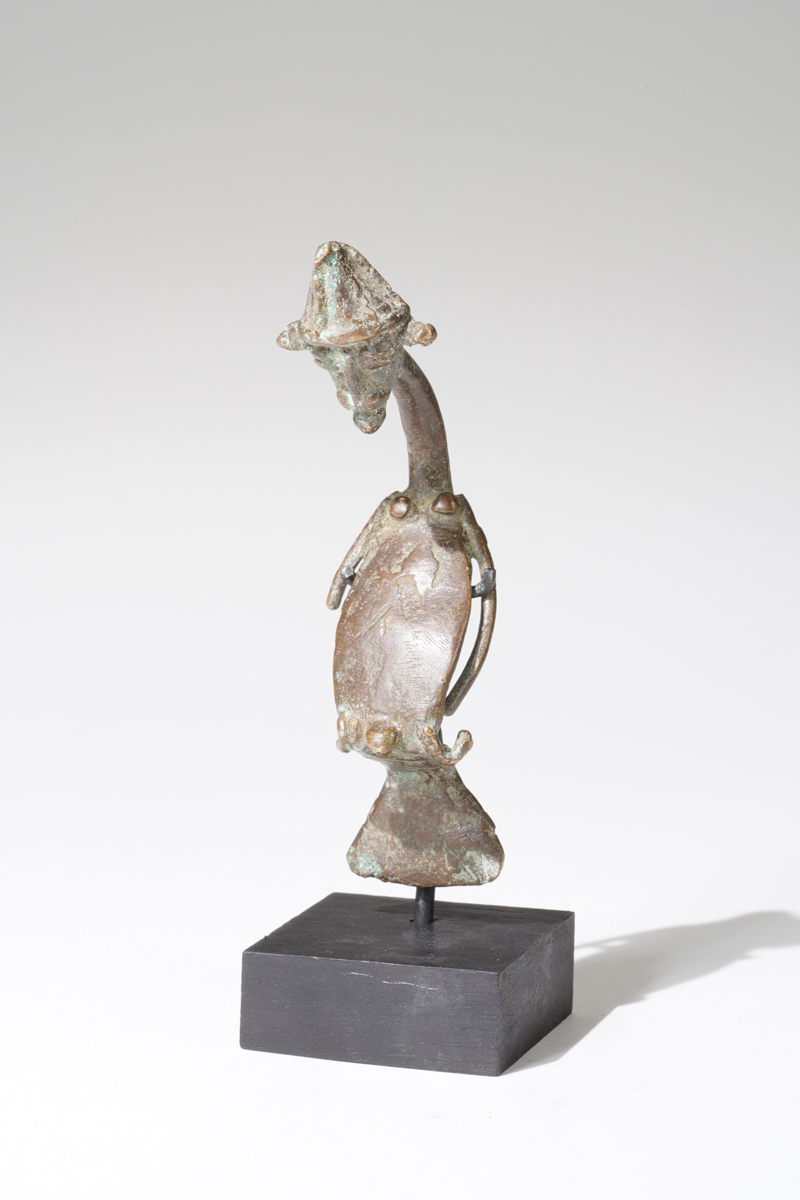 photo: wolfgang-jaenicke.com, for more information, please write us an e-mail with the identification number of the photo identification no. MAZ03151.jpg |
 |