 A fragmentary female Motol sculpture, Nigeria, the arms in open work close to the column torso, the arms ending in finlike handsm which shows a certain relation to the Mumuye sculptures, one foot exists only partly. The Montol people, also referred to as Tɛɛl or Tɛɛl Montoel, are a small Chadic-speaking ethnic group residing predominantly in the Plateau State of central Nigeria. Their sculptural traditions form part of the wider cultural and ritual landscape of the Benue-Congo region, yet remain understudied in comparison to those of their neighbors such as the Goemai, Angas, or Mumuye. Montol sculptures, especially their anthropomorphic figures and ritual paraphernalia, are notable for their compact volumes, geometric stylization, and spiritual potency within initiation and healing contexts. Carved in wood, the sculptures often depict human figures with block-like torsos, prominent facial features, and simplified limbs. These works were primarily used in ritual contexts, including healing ceremonies, protective rites, and initiation rituals. The physical appearance of the sculptures—marked by abstraction and schematic form—suggests an aesthetic affinity with neighboring Central Nigerian carving styles, particularly those associated with the Tarok and Ron, yet Montol works maintain a distinct identity through the integration of local mythologies and esoteric knowledge. Montol figures were often kept in shrines and activated through libations or sacrificial offerings. Their power was not inherent in the wood alone, but rather in the combination of physical form, spiritual invocation, and communal memory. As such, these sculptures served as mediators between the human and spiritual realms, embodying ancestors or protective spirits. The rough surface treatment, scarification patterns, and posture of many figures may relate to specific ritual codes or social hierarchies, though further fieldwork is needed to decode their full semiotic value. While some Montol sculptures have entered Western collections through colonial or missionary encounters in the early 20th century, they remain marginal in canonical accounts of African art history. This marginality reflects both their geographic location—on the periphery of major cultural zones—and the scarcity of ethnographic documentation. However, recent scholarship has begun to reassess the artistic production of so-called "minor" groups in central Nigeria, recognizing the complexity and historical depth of their material cultures. The study of Montol sculpture thus raises critical questions about representation, classification, and the historiography of African art. It underscores the need to move beyond stylistic taxonomies based on visual resemblance alone, towards more integrated approaches that consider language, ritual practice, and interethnic exchange. ¹ Ames, Herbert. Ethnographic Survey of Northern Nigeria. London: Government Press, 1931. sold Height: 78 cm |
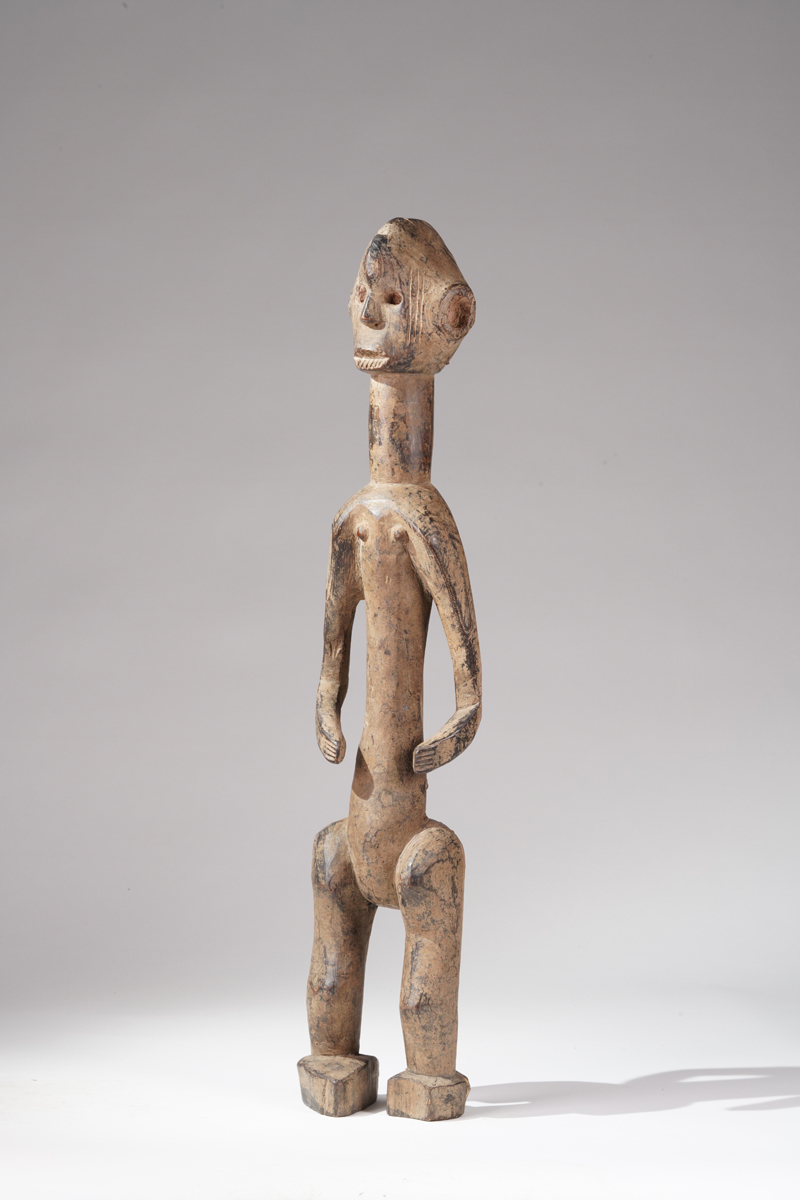 photo: wolfgang-jaenicke.com, for more information, please write us an e-mail with the identification number of the photo identification no. CAB08204.jpg |
 |