 |
 A Baule Maternity, Ivory Coast, holding a child on her knees. seated on an Akan stool, some abraisions, brownish patina. Baule maternities, or mother-and-child sculptures, represent a significant artistic and cultural tradition of the Baule people, who inhabit the central region of Côte d’Ivoire in West Africa. These sculptures are emblematic of the Baule's sophisticated woodcarving techniques and their complex social and spiritual values surrounding motherhood and fertility. The mother-and-child motif in Baule art encapsulates both the physical and metaphysical dimensions of maternity, serving as a symbol of nurturing, protection, and the continuation of lineage within the community. The stylistic characteristics of Baule maternities typically include a smooth, polished surface with highly refined and idealized human forms. The mother is often depicted in a seated or standing posture, holding her child in a tender embrace. The facial features are delicately rendered, with an emphasis on symmetry and serenity, including oval-shaped faces, almond eyes, and full lips. These aesthetic choices reflect an idealized conception of feminine beauty and maternal care that transcends mere physical representation and enters the realm of spiritual symbolism. Functionally, Baule maternities are not merely decorative objects but play an important role in ritual and social practices. They are used in ceremonies related to fertility, family protection, and ancestor veneration, thereby serving as intermediaries between the physical world and spiritual forces. The sculptures embody social ideals about the role of women as bearers and sustainers of life, and they reinforce the importance of maternal lineage in the maintenance of social cohesion and continuity. The Baule tradition of mother-and-child figures forms part of a broader West African artistic motif found among various neighboring groups, such as the Yoruba and Senufo. However, Baule maternities are distinguished by their particular stylistic finesse and the cultural emphasis on the protective and nurturing aspects of motherhood. Most commonly carved from wood, these sculptures may also feature scarification patterns or subtle painted details that add to their expressive quality. In the context of African art history, Baule maternities have attracted considerable scholarly interest for their combination of formal elegance and cultural depth. They are frequently collected by museums and private collectors worldwide and studied for what they reveal about gender, family structure, and spirituality among the Baule. As artifacts, they provide insight into the ways in which artistic expression mediates social values and religious beliefs in
sold Height: 42 cm |
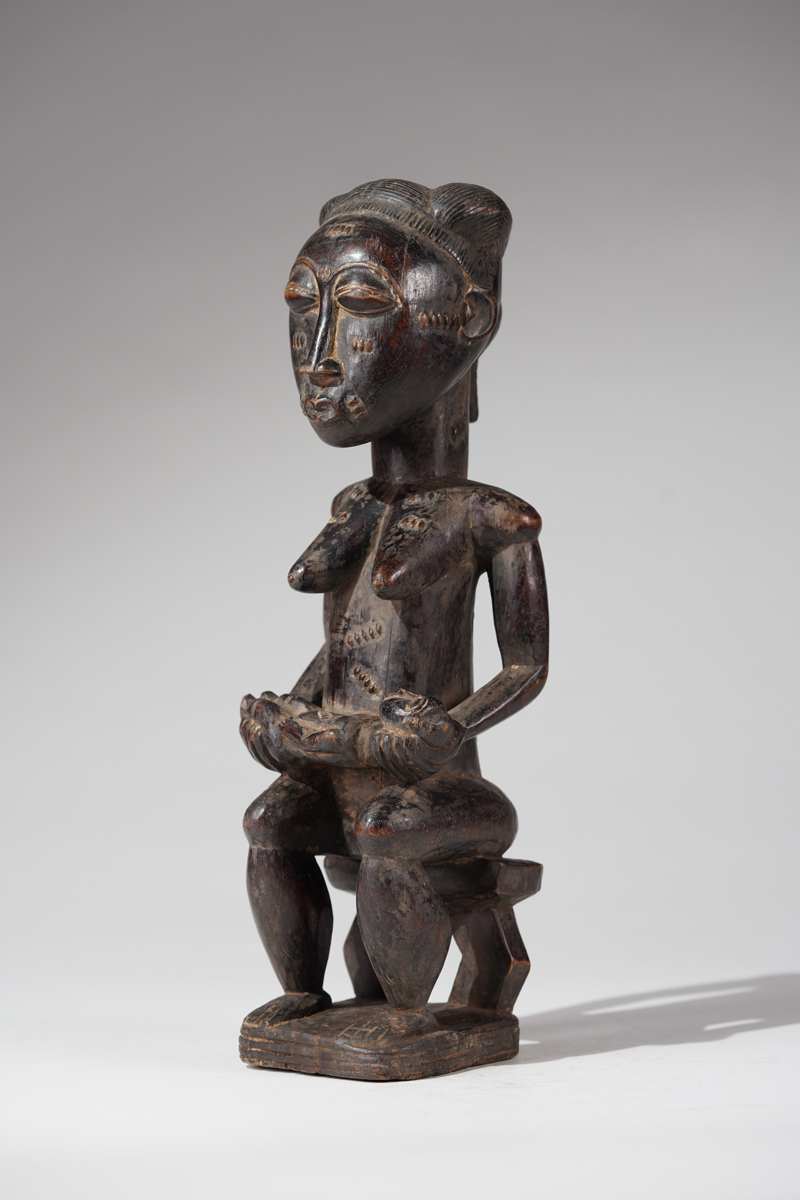 photo: wolfgang-jaenicke.com, for more information, please write us an e-mail with the identification number of the photo identification no. CAB10448.jpg |
 |