 |
 A Yorouba horseman, Nigeria, on a rounded plinth, remants of the old patina, but in general washed off. Yoruba horseman sculptures date primarily from the medieval period, roughly between the twelfth and fifteenth centuries, coinciding with the rise of powerful Yoruba city-states such as Ife and Owo. This period marked a significant development in Yoruba art and metallurgy, reflecting the emergence of complex political and religious systems within the region.^1 The horse was introduced into Yoruba society through trans-Saharan trade routes and contact with northern Sahelian peoples such as the Hausa and Tuareg. Although horses were not native to the Yoruba forest region, they became highly prized as symbols of military strength and prestige. Mastery over horses and cavalry units was a critical factor in territorial expansion and defense for Yoruba rulers.^2 The political context of Yoruba kingdoms was centered on monarchs known as Obas, who employed horsemen both as warriors and as ceremonial figures to embody royal power. Mounted horsemen served as visual representations of the king’s authority and military might. Sculptures of horsemen often portrayed notable chiefs or generals who led armies or held high status within the royal court.^3 Yoruba kings commissioned skilled bronze and brass casters to create these sculptures as emblems of their reign and to honor distinguished horsemen. The kingdom of Ife, in particular, became renowned for its sophisticated bronze work, which included both naturalistic and stylized representations of humans and animals. These bronzes were used in palaces and shrines, reinforcing the political and spiritual legitimacy of the rulers.^4 Horseman sculptures also functioned as commemorative objects, preserving the memory of key figures in Yoruba history. Often placed in royal shrines or displayed during festivals, these works honored ancestors and warriors who had protected the kingdom. The horseman image symbolized not only earthly power but also divine sanction and spiritual protection of the community.^5 Archaeological excavations in Ife and Owo have uncovered numerous bronze and brass horseman figures alongside other courtly sculptures. These artifacts provide insight into Yoruba social hierarchy, warfare, and artistic techniques of the time. The detailed craftsmanship reflects a high degree of metallurgical knowledge and the cultural importance attributed to horsemen within Yoruba society.^6
sold Height: 30 cm |
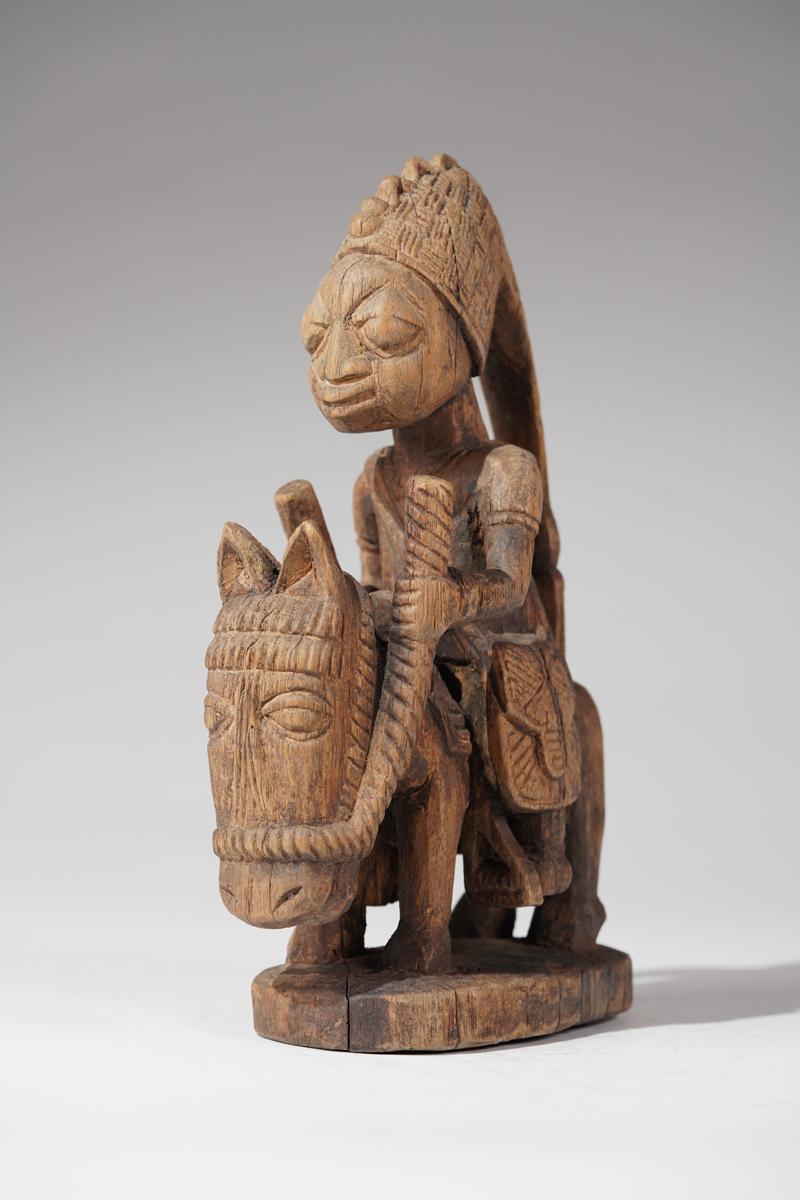 photo: wolfgang-jaenicke.com, for more information, please write us an e-mail with the identification number of the photo identification no. CAB10487.jpg |
 |