 |
 A male Jukun sculpture, Nigeria, covered with an encrusted sacrification sculpture. The sculptural tradition of the Jukun people, who inhabit present-day Taraba State and adjacent regions in central Nigeria, represents one of the most compelling yet comparatively understudied forms of artistic expression in West Africa. These works are best understood within the cultural and historical framework of the former Kwararafa Confederacy, a regional power that exerted political and religious influence in the Middle Benue region between the fifteenth and eighteenth centuries. Within this socio-political order, sculpture functioned not merely as artistic production, but as a vital medium of ritual mediation and cosmological manifestation. Jukun sculptures are predominantly carved from wood, though examples in terracotta and, more rarely, metal are known. They typically depict abstracted human figures, often interpreted as representations of ancestors or spiritual beings. Their formal characteristics reflect a deliberate departure from naturalism. Verticality is a defining trait, with elongated cylindrical torsos, stylized limbs, and symmetrical facial features. The faces are mask-like, with minimal expression and a closed, introspective quality that suggests a spiritual or trance-like state. This formal reduction points to a conception of sculpture not as mimetic representation, but as the bearer of spiritual presence. These figures were embedded in complex religious practices, ranging from ancestor veneration and divination to initiation rites. Within Jukun traditional religion, sculptures were understood as animated objects—“activated” through ritual actions such as anointing, offerings, and invocations. They stood at the center of cultic practices, often housed in shrines or accessible only to initiated persons. Their significance was not autonomous but emerged within a system of symbolic communication between the visible and invisible worlds. Stylistically and functionally, Jukun sculpture is closely related to that of other cultures in Nigeria’s Middle Belt, notably the Mumuye, Chamba, and Bachama. This region, marked by high ethnic diversity and a relative continuity of indigenous religious practices into the twentieth century, has been identified by scholars such as Herbert M. Cole as part of the “Middle Benue Style Complex.” Despite regional variation, these traditions share a tendency toward abstraction, spiritual gravitas, and formal austerity. In contrast to the courtly art of southern Nigerian polities like Benin or Ife, these are not state-sponsored or publicly monumental sculptures; rather, they belong to non-centralized, often esoteric ritual systems. As with many African art traditions, Jukun sculpture suffered under the pressures of colonial incursion, Christian missionary suppression, and economic transformation. Numerous works were removed from their original contexts and entered European collections—frequently without documentation of their function or provenance. Today, Jukun sculptures can be found in institutions such as the Musée du quai Branly in Paris and the British Museum in London, where they stand as both aesthetic and ethnographic objects—though often disconnected from the ritual systems that once gave them life. In their formal restraint, spiritual intensity, and ritual embeddedness, the sculptures of the Jukun offer critical insight into African art traditions beyond the courts and urban centers. They invite us to reconsider art not as representation, but as rrt of Africa (Washington, D.C.: Smithsonian Institution Press, 1989). Jean-Paul Barbier, Art of the Upper Benue River (Milan: 5 Continents Editions, 2002). Frank Willett, African Art: An Introduction (London: Thames & Hudson, 2002). William Fagg, Nigerian Images (London: Lund Humphries, 1963). sold Height: 58 cm |
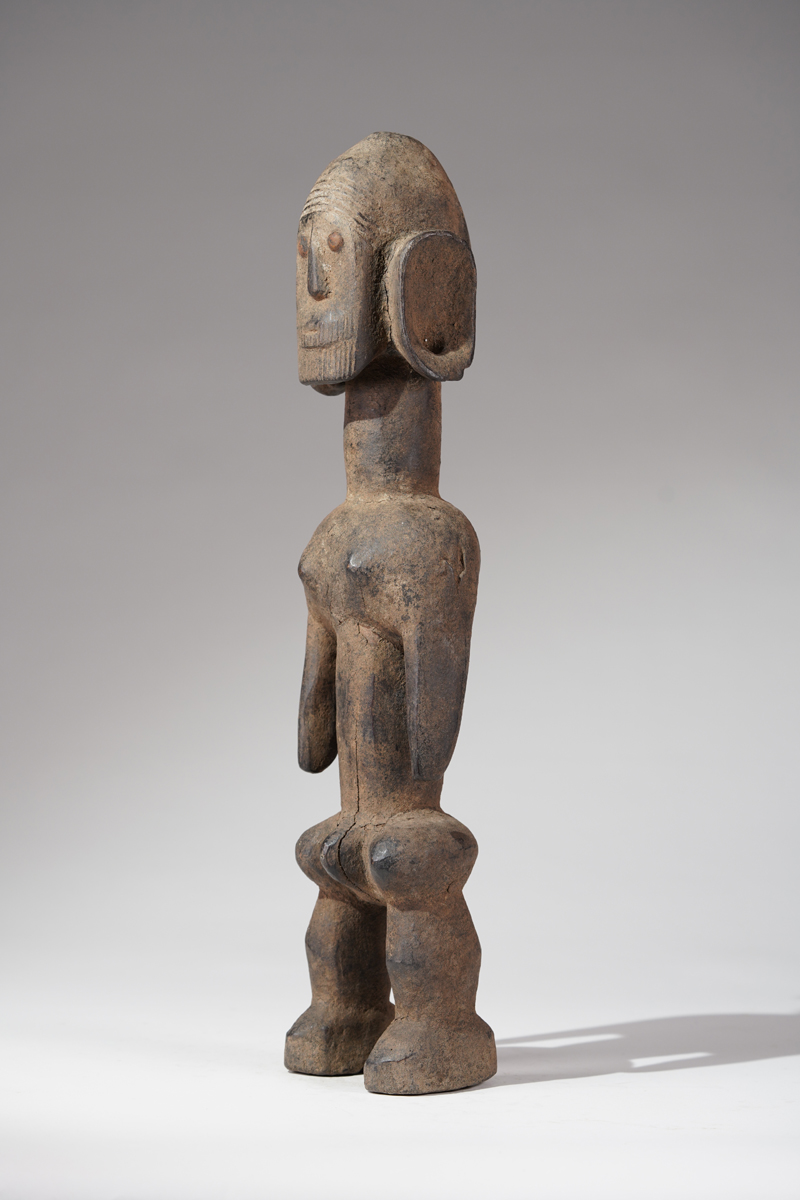 photo: wolfgang-jaenicke.com, for more information, please write us an e-mail with the identification number of the photo identification no. CAB10508.jpg |
 |