 |
 A terracotta couple in the style of Bankoni. Mali, incl. stands. The Bankoni terracotta sculptures from Mali represent an important yet relatively understudied tradition of West African art. These artifacts are associated with the cultural landscape around Bamako, the capital of modern-day Mali, and are typically dated between the 12th and 16th centuries CE The Bankoni style is characterized by abstracted and elongated human and animal forms, often with stylized features and tubular limbs. The figures are typically made from terracotta clay, fired at relatively low temperatures. The artistic treatment suggests a distinct local tradition that may or may not be directly linked to the better-known Djenne-Djenno terracotta culture, though they share certain formal similarities, such as schematic facial modeling and frontal posture Archaeological investigations indicate that the Bankoni figures were created by sedentary farming communities that likely engaged in long-distance trade, as suggested by the presence of imported goods in some excavated contexts. However, unlike Djenne-Djenno, the Bankoni region has not yielded extensive evidence of urban development, which complicates efforts to fully contextualize these sculptures in terms of social complexity and political organization. One of the central challenges in interpreting Bankoni terracotta lies in the lack of written records and the scarcity of stratified archaeological excavations. Much of the material has entered museum collections through the art market, often with little or no provenance, making it difficult to determine original context, function, or precise chronology Despite these limitations, it is generally believed that the Bankoni terracotta figures had a ritual or symbolic role, possibly related to ancestor veneration, fertility rites, or protective functions. Some scholars suggest they may have served as shrines or grave goods, indicating a belief system in which spiritual intercession or the memory of the dead played a prominent role in community life In recent decades, the rise in looting and illicit trafficking of terracotta sculptures from Mali has prompted both local and international calls for stronger protection of cultural heritage. These concerns have also intensified debates about the ethics of collecting and exhibiting such objects, especially in European and North American institutions
sold Height: 36 cm / 39 cm without stands |
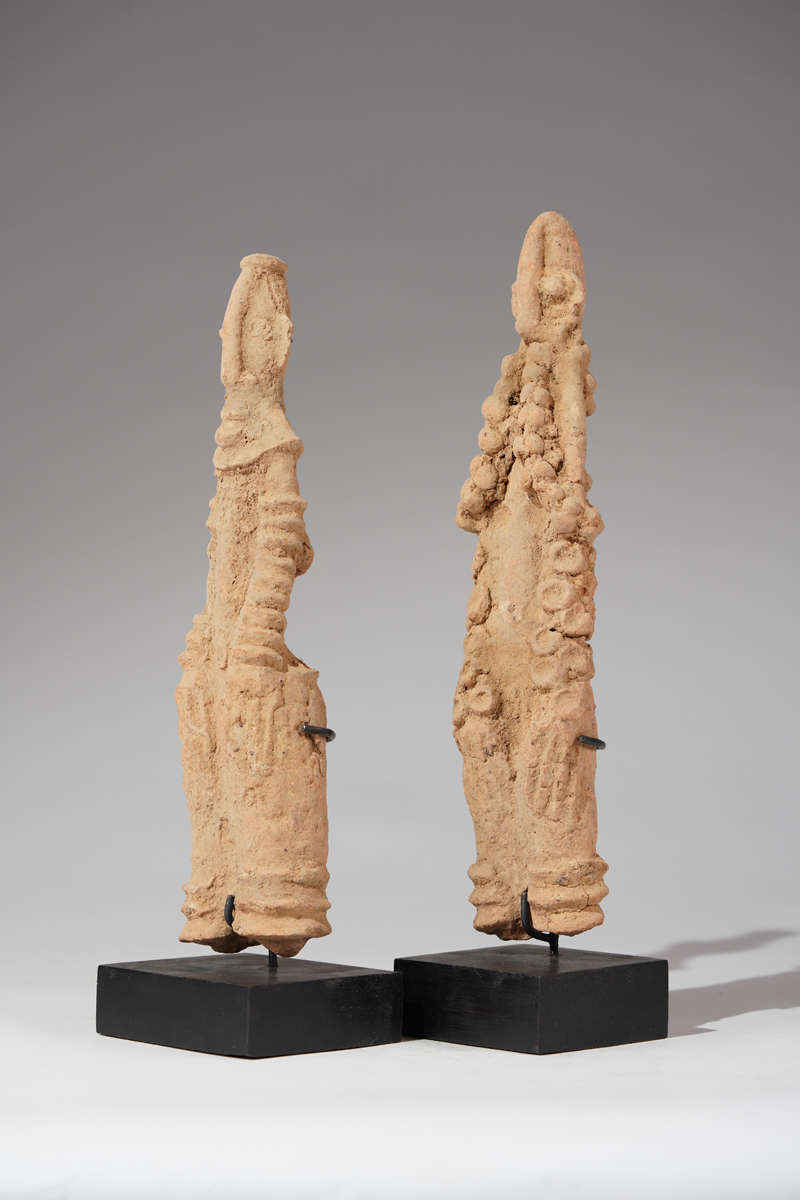 photo: wolfgang-jaenicke.com, for more information, please write us an e-mail with the identification number of the photo identification no. CAB10637.jpg |
 |