 |
 A Yoruba bone carving of a male person, Nigeria, with an stylized "Ebẹn"in his hands. which shows the connection to the classical Benin art. The Ebẹn is one of the two of the most common types of ceremonial swords found in the Kingdom of Benin, along with the Ada. The blade is the main distinguishing characteristic of these two swords. The Ebẹn blade is similar in shape to an oar and can be perforated and/or decorated with brass inlays most commonly shaped as small Ebẹn and leopards. In contrast, Ada typically have a J-shaped blade. The blades of both Ada and Ebẹn are made from iron, however the Ada often has a carved ivory or cast-brass-hafted handle. In contrast, the handle of the Ebẹn is unique in shape, with a large ring-shaped handle set at a ninety-degree angle from the flat blade. The distinctive shapes of these swords make them relatively easy to identify. However, a wider range of material, including other kinds of swords, knives and daggers are less easily identifiable with specific terms. Source: Digital Benin Yoruba bone carvings occupy a subtle yet significant position within the wider landscape of Yoruba material culture. Unlike the more prominent wood sculptures or brass castings for which the Yoruba are widely known, bone as a medium appears in more intimate, esoteric, and often ritual contexts. These objects, typically small and carefully worked, reveal a nuanced relationship between form, function, and cosmology. Bone carvings among the Yoruba are not widespread, and their rarity in collections suggests both their limited production and their primarily private or sacred usage. While wood and metal served the public and ceremonial dimensions of Yoruba art, bone was often associated with personal, medicinal, or divinatory purposes. Its tactile, organic quality and association with the body imbued it with spiritual resonance. In the context of Yoruba cosmology, where materials carry innate àṣẹ—spiritual power—bone held particular value for its vitality and its link to life and death. Many of the extant examples of Yoruba bone carving are linked to traditional healing practices or the paraphernalia of Ifá divination. Healers and diviners might carry small carved bones inscribed with symbols or anthropomorphic forms, charged with protective or communicative power. These objects were not made for public display but were instead tools of knowledge and intercession, handled only by those with specific ritual training. The carvings may depict stylized human figures, animals, or motifs associated with particular orisha, especially those governing thresholds, communication, or protection such as Èṣù and Ogun. As a medium, bone also speaks to the Yoruba understanding of transformation and metaphysical presence. Its durability and whiteness evoke both permanence and the ancestral, while its origin in the animal body marks it as a conduit between material and immaterial realms. In this sense, the bone carving operates not merely as an artistic artifact but as a symbolic node within a broader system of meaning and ritual performance. Despite their limited visibility in the canon of Yoruba art history, bone carvings demand attention for the way they condense spiritual, aesthetic, and epistemological values into compact, often enigmatic forms. Their marginal status in collections reflects more on curatorial and colonial hierarchies of value than on the objects themselves. For Yoruba practitioners, such objects remained potent, active, and meaningful—speaking across worlds even in their silence. sold Height: 19 cm |
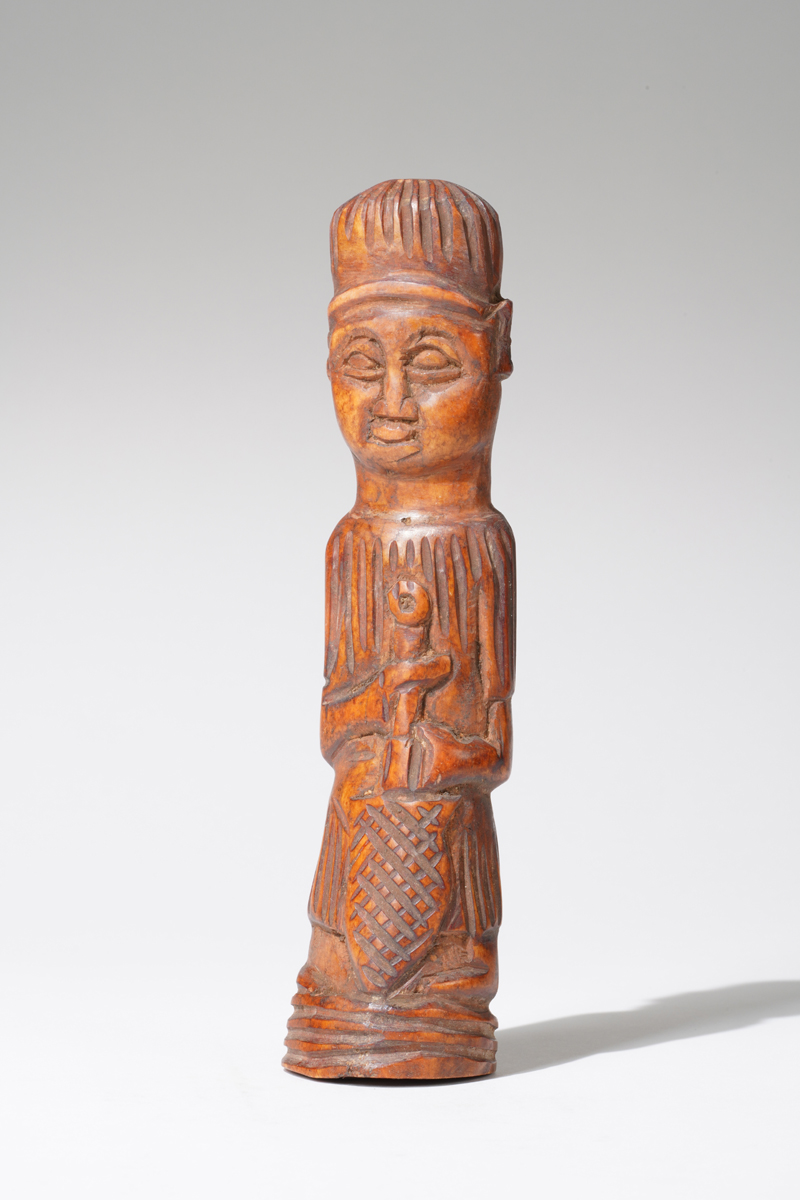 photo: wolfgang-jaenicke.com, for more information, please write us an e-mail with the identification number of the photo identification no. MAZ03303.jpg |
 |