 |
 A Touareg bronze spoon, incl. stand. Among the Tuareg—nomadic Berber-speaking communities inhabiting the Saharan expanses of present-day Mali, Niger, Algeria, and Libya—everyday objects serve not only pragmatic purposes but also function as expressions of social identity, cosmology, and refined artisanal aesthetics. Shaped by the constraints and possibilities of a mobile desert existence, Tuareg material culture reveals a distinctive synthesis of portability, durability, and symbolic abstraction. The Tuareg household, often demarcated by a woven tent of palm matting and leather, is furnished with items whose design responds directly to the demands of life in constant transit. Furniture such as collapsible stools, wooden headrests, and intricately stitched leather bags must be lightweight, foldable, and resistant to climatic extremes. These objects, however, are never merely utilitarian; they are often inscribed with geometric ornamentation, echoing a broader Tuareg visual language that eschews figural representation in favour of abstract motifs. These patterns—triangles, chevrons, and lozenges—carry protective and symbolic meanings rooted in both pre-Islamic beliefs and Islamic esotericism.¹ Leather, treated with natural dyes and tanned by hand, plays a central role in Tuareg craftsmanship. It is employed in the making of storage containers, travel pouches, tent panels, and saddlebags. While leatherworking is practiced widely across the Sahara and Sahel, among the Tuareg it attains a particular refinement. The objects often bear embossed or pierced decorations and are dyed with indigo, whose deep blue holds not only aesthetic but also cultural and spiritual significance. Indigo-stained items are associated with prestige and, in some contexts, with protective properties against evil influences.² The production of utilitarian objects is embedded within a caste-based social structure. Artisanal work is traditionally carried out by the Inadan, a hereditary class of blacksmiths and leatherworkers whose social role is both marginal and indispensable. While noble lineages have historically relied on the Inadan for the fabrication of tools, weapons, and ornaments, these artisans are simultaneously perceived as occupying a liminal position within Tuareg society.³ This tension between dependency and marginality is mirrored in the objects themselves, which often inhabit the threshold between domestic necessity and ritualised meaning. In comparison to the material cultures of sedentary groups in West Africa—such as the Dogon or the Akan—the Tuareg approach to utilitarian design is notable for its minimalism, abstraction, and emphasis on portability. Where other traditions might favour monumental sculpture or richly figurative pottery, the Tuareg prioritise mobility and restraint, aligning aesthetic expression with nomadic pragmatism.⁴ Yet this simplicity is deceptive: embedded within even the most functional items are layers of meaning, memory, and cosmological reference. Tuareg utilitarian objects thus resist strict categorisation. They are at once tools of daily survival and bearers of identity, artfully crafted items in which the boundaries between the sacred and the profane, the practical and the poetic, are continually negotiated. ¹ Rasmussen, Susan J. The Poetics and Politics of Tuareg Aging: Life Course and Personal Destiny in Niger. Northern Illinois University Press, 1997. sold Height: 20 cm without stand |
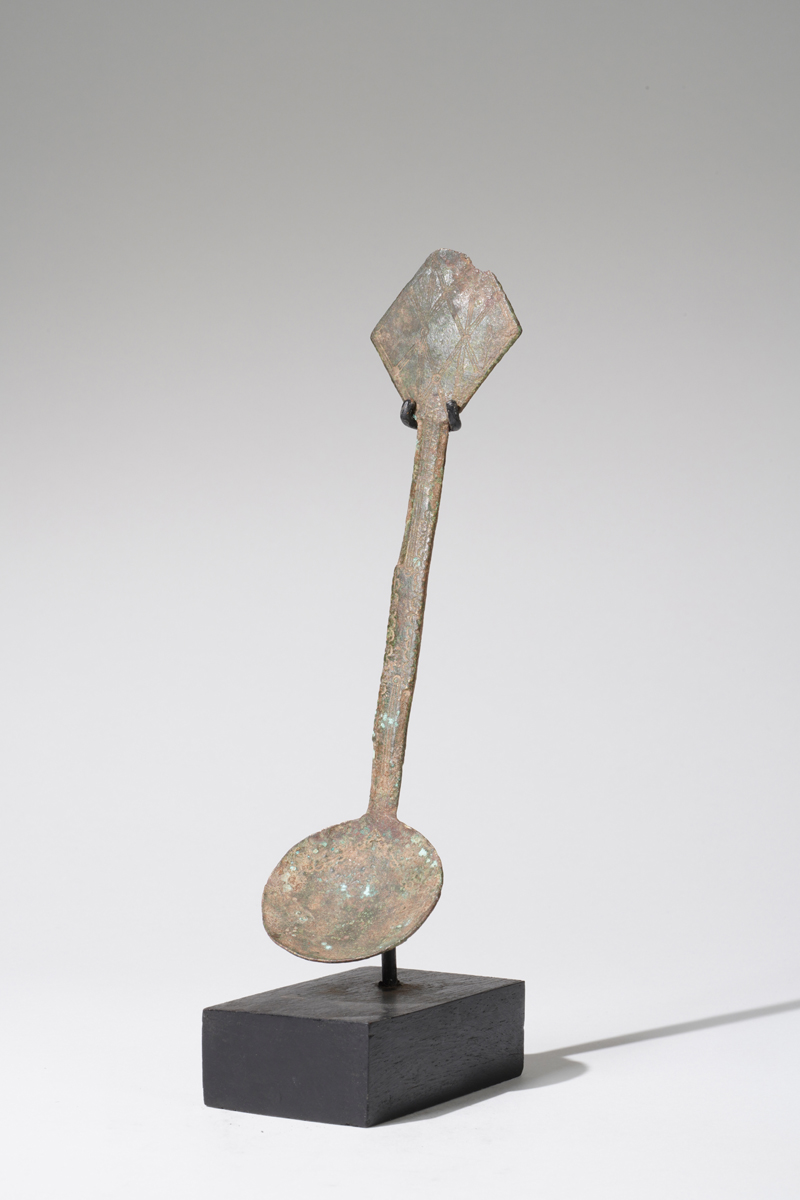 photo: wolfgang-jaenicke.com, for more information, please write us an e-mail with the identification number of the photo identification no. MAZ03329.jpg |
 |