 |
 A double headed Mumuye sculpture, remnants of a sacrification patina, incl. stand. Double-headed Mumuye sculptures are rare and highly distinctive examples of West African art, originating from the Mumuye people of northeastern Nigeria, primarily in the Taraba region. These sculptures are part of a broader corpus of Mumuye statuary known as iagalagana, which were traditionally carved for ritual and spiritual purposes rather than for aesthetic or decorative reasons [1]. The presence of two heads in these figures is not merely a formal choice but carries significant symbolic meaning. Dual-headed forms are commonly interpreted as representing duality or complementarity—such as male and female, past and future, or the earthly and the spiritual [2]. In the Mumuye cosmology, such polarities are often viewed as interconnected and interdependent, and figures with two heads may serve as mediators between these opposing forces. Some interpretations suggest that the two heads allow the figure to “see” in multiple directions, reinforcing a protective or watchful function within a community context [3]. Stylistically, Mumuye sculptures are marked by a strong verticality, cylindrical bodies, elongated limbs, and an abstract, geometric rendering of human features [4]. The heads—whether single or double—are often oval or hemispherical in shape, with prominent facial features that are stylized rather than naturalistic. Arms are typically carved free from the torso, creating a dynamic sense of volume and space. The surface of the sculptures is often smooth, though ritual handling and environmental exposure contribute to the patina that is highly valued in both ethnographic and art historical contexts [5]. While the precise ceremonial uses of Mumuye figures are not always well documented, field research and oral traditions indicate that they were employed by diviners and healers (known as alek) and played roles in initiation rites, ancestor veneration, and protective rituals [6]. The figures may have also served oracular functions, acting as spiritual intermediaries. In rare cases, figures with double heads are believed to possess heightened spiritual power, possibly due to their exceptional nature within the Mumuye visual canon [7]. European interest in Mumuye sculpture began in earnest in the mid-20th century, particularly after colonial officers and anthropologists brought examples back from fieldwork. Their striking abstraction resonated with modernist artists and collectors. Sculptures from the Mumuye became emblematic of a non-Western aesthetic that paralleled European modernism—drawing frequent comparison to works by Brancusi, Giacometti, and Modigliani [8]. Notably, the French collector and scholar Robert Détolle contributed significantly to the early study and dissemination of Mumuye art in Europe [9]. Major collections, including the Musée du quai Branly in Paris and the Barbier-Mueller Museum in Geneva, house exemplary Mumuye works. The double-headed variants remain extremely rare and are among the most prized by institutions and collectors alike. Their scarcity, combined with their formal audacity, positions them as important objects both within African art history and in broader dialogues about modern and contemporary sculpture [10]. [1] Frank Willett, African Art: An Introduction, Thames & Hudson, London, 2002. sold Height: 52 cm |
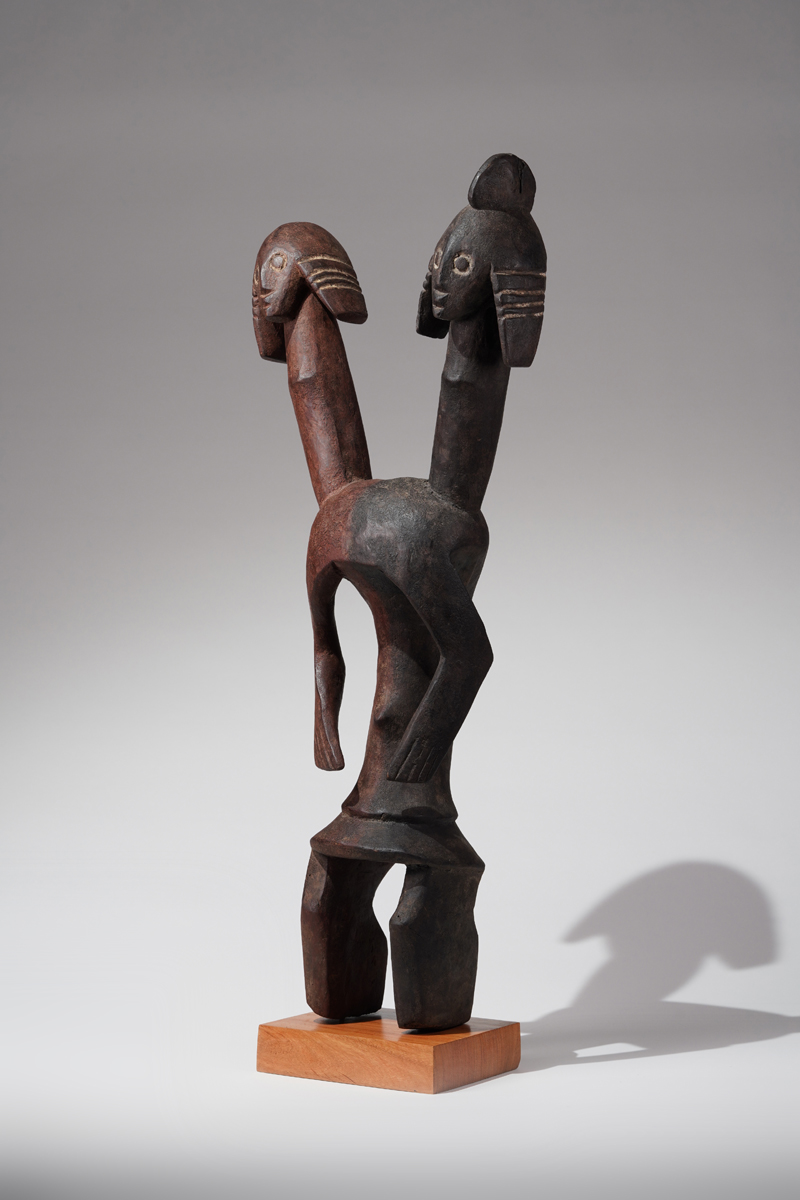 photo: wolfgang-jaenicke.com, for more information, please write us an e-mail with the identification number of the photo identification no. CAB10951.jpg |
 |