 |
 A Marka-Dafing Mask, North-Central Burkina Faso, a bush spirit mask, remnants of white and reddish pigments, incl. wooden stand. The Marka-Dafing mask from north-central Burkina Faso represents a distinctive expression of Mande cultural aesthetics and ritual practice. The Marka-Dafing, a subgroup of Mande-speaking peoples, inhabit regions of Kossi, Sourou, and Mouhoun provinces. Their artistic traditions, while regionally specific, are closely related to those of the Marka (Warka) in Mali and share formal and symbolic elements with broader Mande mask typologies. Traditionally used in initiation rites, funerary ceremonies, and agricultural festivals, Marka-Dafing masks serve both spiritual and social functions. They mediate between the human and the supernatural, channeling protective forces and ancestral authority. The masquerade context in which these masks are performed is linked to male secret societies, whose esoteric knowledge governs the use and transmission of these objects. Through dance and ritual, the masks embody spirit beings associated with moral order, fertility, and protection. Formally, Marka-Dafing masks are typically carved from wood and often exhibit a high degree of stylization. Their design reflects a balance between geometric abstraction and symbolic representation. Common features include elongated facial structures, symmetrical composition, and zoomorphic motifs such as horns or beak-like projections. Decorative elements such as metal inlays, cowrie shells, and pigment may be added to enhance their visual and spiritual potency. The use of metal, in particular, signifies both wealth and the ability of the mask to attract and reflect spiritual energy. While the aesthetic of these masks aligns with broader Mande traditions, particularly those of the Bamana and Bozo, the Marka-Dafing variant is distinguished by its restrained elegance and a compositional clarity that reflects a regional refinement. The mask’s form not only communicates spiritual presence but also encodes social values, reinforcing community cohesion and intergenerational transmission of cultural knowledge. In the context of the Marka-Dafing worldview, the mask is not merely an object but a locus of transformation. It enables the wearer to transcend individual identity and assume the persona of a spirit being, thus participating in a cosmological drama that binds the community to its ancestral past and to the forces that sustain its present and future. This example contributes to a broader understanding of the complexity and diversity of masquerade traditions across the Mande cultural sphere, illustrating how local forms can simultaneously maintain deep continuity with transregional aesthetic and ritual systems. sold Height: 50 cm without stand |
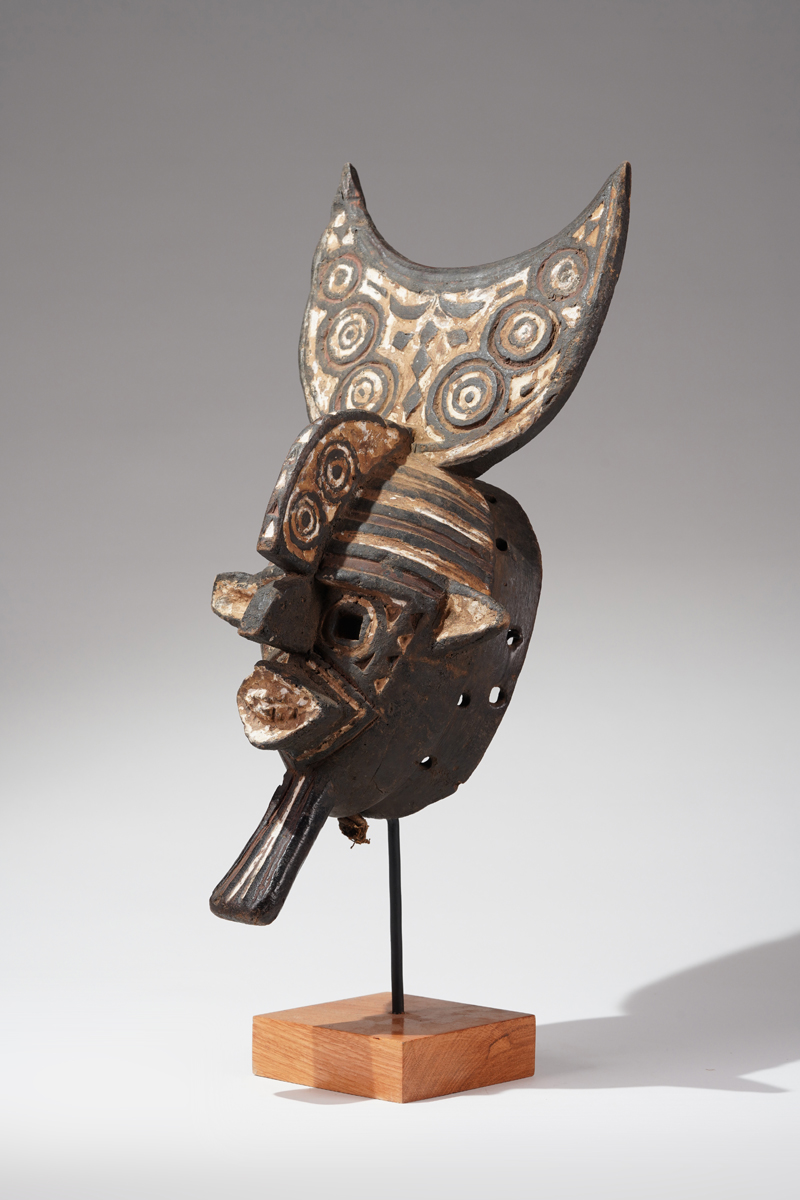 photo: wolfgang-jaenicke.com, for more information, please write us an e-mail with the identification number of the photo identification no. CAB11065.jpg |
 |