 |
 A terracotta couple in the style of Katsina, Nigeria, hugging each other, incl. stand. The Katsina Terracotta refers to a corpus of terracotta sculptures unearthed primarily in the region surrounding Katsina, in northern Nigeria. These sculptures are generally dated to between the 12th and 15th centuries CE and are considered among the most refined examples of early Sub-Saharan ceramic sculpture. They are stylistically distinct from the better-known Nok terracottas, though there are formal and technical continuities suggesting cultural and technological transmission across centuries in central Nigeria. What distinguishes the Katsina terracottas is their expressive naturalism, technical sophistication, and detailed anthropomorphic forms. The figures—often human heads, busts, or full bodies—are typically characterized by elaborate hairstyles, scarification patterns, and individualized facial features. Some display signs of ritual use or damage, possibly related to funerary or votive practices. Unlike the Nok style, which often shows schematic or abstracted anatomy, the Katsina terracottas demonstrate a heightened realism, suggesting a different ideological or ceremonial context. The discovery of the Katsina terracottas is closely tied to the broader history of colonial-era excavations and looting in West Africa. Many of the known pieces were not recovered through systematic archaeological work but surfaced on the art market during the mid-20th century. Reports suggest that local farmers and diggers unearthed these works while cultivating land, particularly around ancient settlement mounds and burial sites. The region’s arid climate allowed for exceptional preservation of fired clay. From the 1950s onwards, numerous pieces made their way into European and North American collections, both public and private, often without clear provenance or archaeological context. Scholars such as Bernard de Grunne and Ekpo Eyo have attempted to contextualize these works within a broader regional artistic tradition, placing them in dialogue with other West African terracotta styles like those from Bura (Niger), Sokoto, and Ife. However, due to the lack of stratigraphic excavation data, precise cultural attributions remain speculative. Some researchers propose that the Katsina terracottas may be linked to early Hausa polities, possibly connected to courtly or elite burial traditions, but such theories await further archaeological validation. In sum, the Katsina terracottas represent a key, though understudied, chapter in West African sculptural history. Their aesthetic power and technical finesse mark them as the products of a sophisticated tradition of ceramic artistry, one that challenges linear narratives of African art history shaped by modern colonial boundaries and uneven documentation. References: sold Height: 31 cm incl. stand |
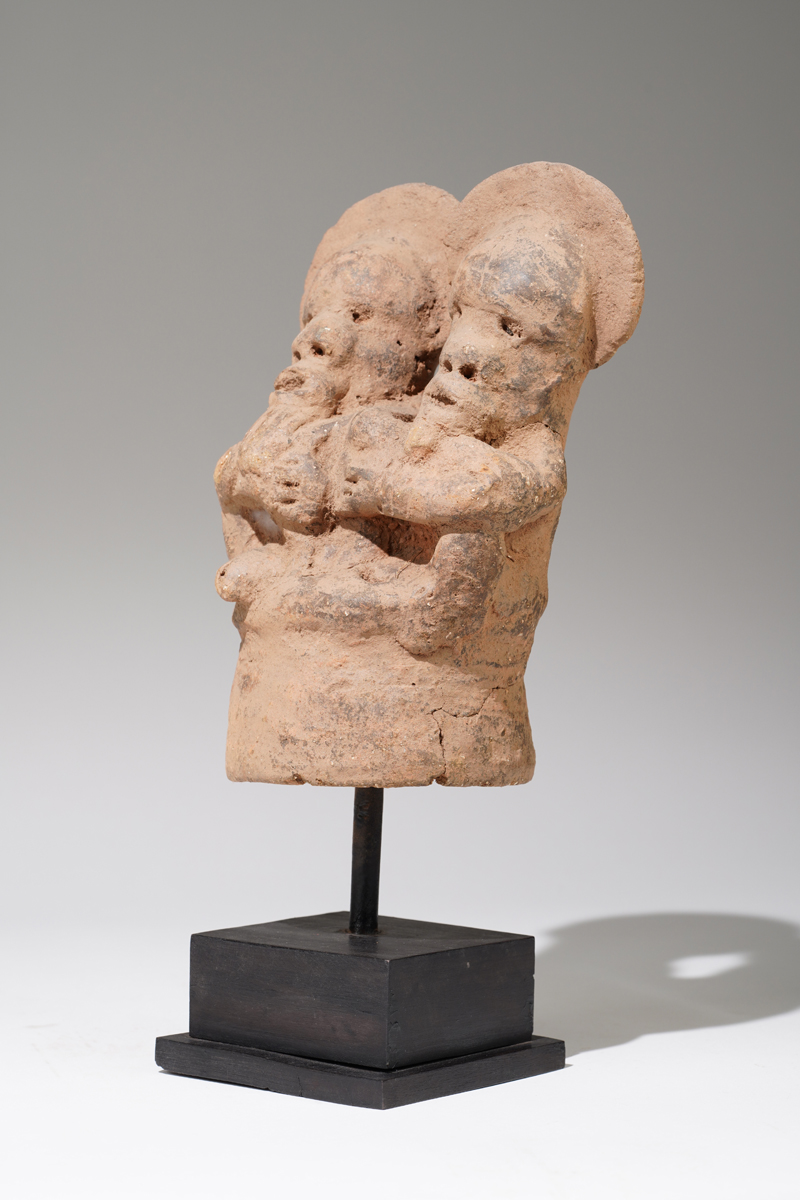 photo: wolfgang-jaenicke.com, for more information, please write us an e-mail with the identification number of the photo identification no. MAZ03582.jpg |
 |