 |
 A Katsina head, Nigeria, posted on a stand. In a curatorial or theoretical framework concerned with the intersection of African art traditions and global modernisms, the so-called Katsina heads offer a compelling case study in how African objects have been re-signified through aesthetic and ideological regimes shaped by colonialism, primitivism, and postcolonial modernity. Their presence in European and North American collections—often dislocated from original use and attributed to "Katsina" more as a regional label than a culturally precise origin—mirrors the broader process by which African forms were absorbed into the canon of modernist art history as sources of "pure form" or "primitive expression," largely divorced from their socio-ritual functions. When integrated into exhibitions of modern or contemporary art, Katsina heads operate in two conflicting registers: as ethnographic objects and as sculptural fragments that resonate formally with modernist abstraction. This ambivalence reflects the ongoing tension in museum practice between contextualization and aestheticization. For instance, exhibitions such as Africa: The Art of a Continent (Royal Academy of Arts, 1995) or Primitivism in 20th Century Art (MoMA, 1984) placed such heads within a genealogy of influence, but often reinforced Eurocentric narratives of discovery and appropriation. Conversely, more recent exhibitions—such as Postwar: Art Between the Pacific and the Atlantic, 1945–1965 (Haus der Kunst, 2016)—attempt to re-frame these objects within a decentered history of modernism, where African artists and forms are positioned not as precursors to European modernism, but as coeval producers of modernist vocabularies. Within Nigerian intellectual history, the Katsina heads can also be read as synecdoches for a broader cultural memory—part of a fractured but retrievable heritage that artists and scholars in the post-independence period sought to reclaim and reinterpret. The Zaria Art Society, for instance, saw in such archaic forms a source for the development of a distinctly Nigerian modernism, unmoored from European academic conventions but also critical of reductive ethnographic framings. This synthesis was not merely formal but epistemological: it proposed that African modernity must be grounded in indigenous ontologies, and that sculptural abstraction in African traditions was not "primitive" but metaphysical, strategic, and contemporaneous with global modernist thought. Contemporary curatorial strategies may thus treat the Katsina heads as active agents in the construction of transhistorical dialogue—objects that mediate between ritual and aesthetic domains, between vernacular knowledge systems and the institutions of art history. Their fragmented condition and uncertain provenance become not liabilities, but indices of a colonial archive in need of re-reading. For extended reading, consider: Enwezor, Okwui, ed. Postwar: Art Between the Pacific and the Atlantic, 1945–1965. Munich: Prestel, 2016. Okeke-Agulu, Chika. Postcolonial Modernism: Art and Decolonization in Twentieth-Century Nigeria. Durham: Duke University Press, 2015. Vogel, Susan. Africa Explores: 20th Century African Art. New York: Center for African Art, 1991. sold Height: 12 cm incl. stand |
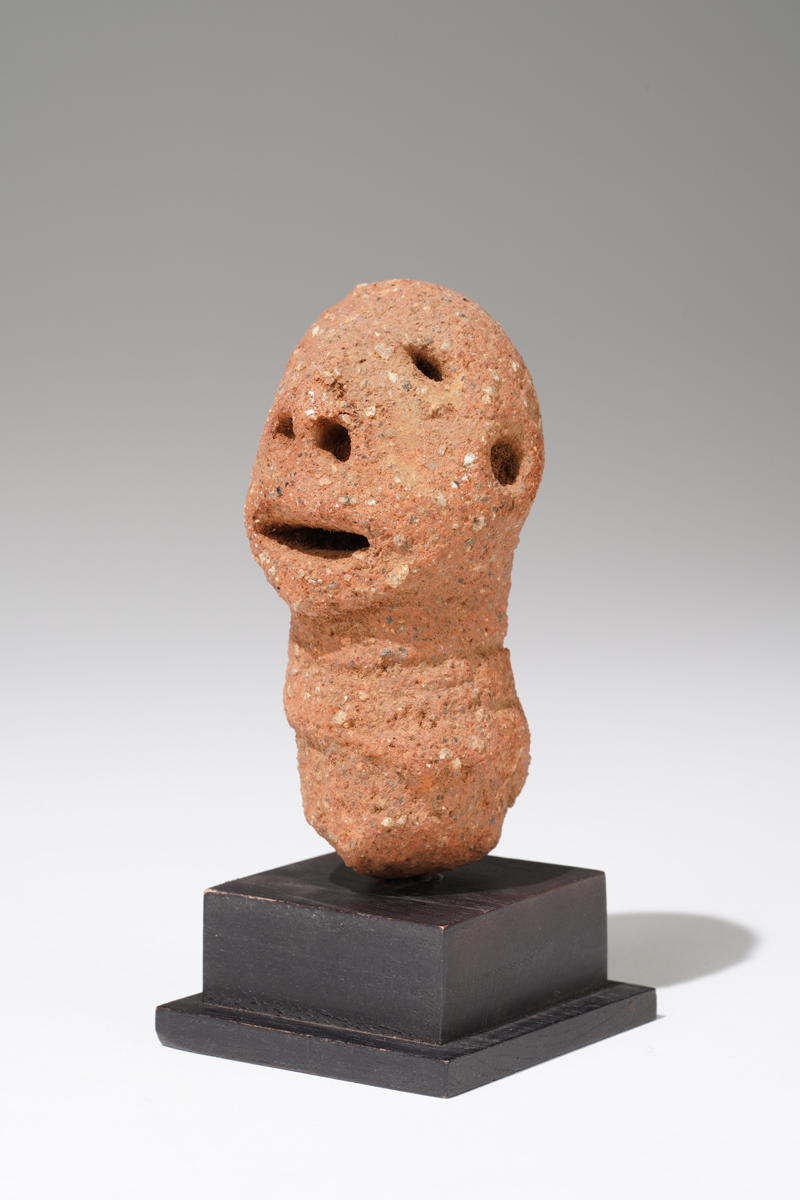 photo: wolfgang-jaenicke.com, for more information, please write us an e-mail with the identification number of the photo identification no. MAZ03676.jpg |
 |