 |
 A small, fragmentary terracotta sculpture in the style of Ife. Fragmentary terracotta sculpture in the style of Ife, likely dating between the 12th and 15th centuries CE, represents an artistic tradition associated with the Yoruba cultural sphere in what is today southwestern Nigeria. The Ife corpus is notable for its naturalistic modeling of the human form, often characterized by an idealized physiognomy, elaborate coiffure, and incised vertical striations on the face, possibly indicative of scarification patterns. While many original Ife sculptures were executed in brass or copper alloy using the lost-wax casting technique, terracotta variants demonstrate a parallel tradition of ceramic modeling, likely serving ritual, commemorative, or funerary purposes. The fragmentary nature of such a piece—be it a portion of a head, torso, or limb—does not diminish its aesthetic or archaeological value, as it may still convey significant information regarding stylistic conventions, workshop practices, and socio-political structures of Ife society. Although precise dating often relies on contextual archaeological data, stylistic analysis allows for its provisional placement within the classical Ife period. See Drewal and Schildkrout, Kingdom of Ife: Sculptures from West Africa (British Museum, 2010), and Frank Willett, Ife in the History of West African Sculpture (Thames & Hudson, 1967) for broader context and typological parallels. sold Height: 12 cm |
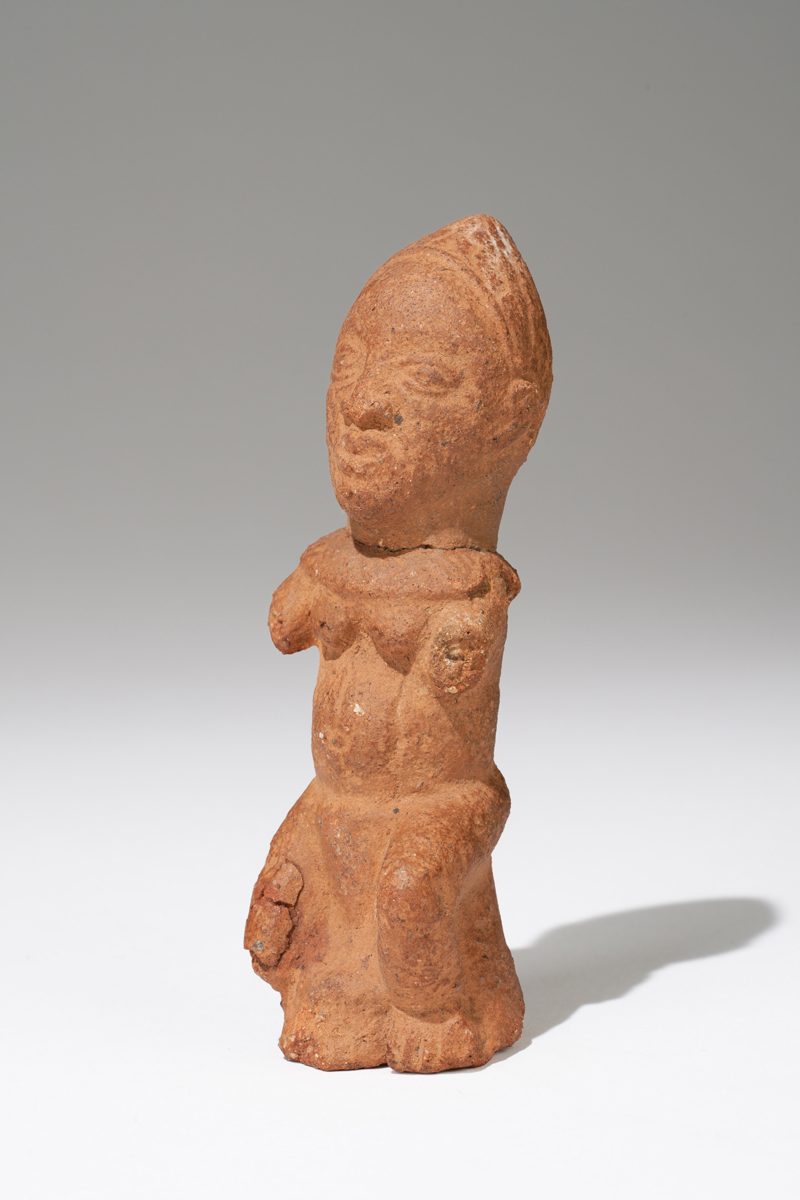 photo: wolfgang-jaenicke.com, for more information, please write us an e-mail with the identification number of the photo identification no. MAZ03695.jpg |
 |