 |
 This Allo Kafi Gida board belongs to the Qur’anic writing traditions of the Hausa people of northern Nigeria, where wooden tablets (allo) function as central tools of Islamic pedagogy. Students inscribe Qur’anic verses, commit them to memory, and wash the surface for reuse, embedding repetition and erasure into the object’s material and intellectual life. The designation “Kafi Gida” points to a shift from the instructional setting to the domestic sphere, where such boards may be retained as protective or commemorative objects. Carved from dense, light-colored wood, the board is designed for resilience under repeated handling. The handle, covered with animal skin, enhances both grip and symbolic presence. Its surface bears reddish and blackened pigments alongside stylized zoomorphic motifs. These forms, often highly abstracted, reflect a localized visual vocabulary that coexists with Islamic textual practice, conveying protective or symbolic meanings rather than literal figuration. Beyond their pedagogical function, Qur’anic boards are implicated in devotional and healing practices. The washing of inscriptions produces a liquid imbued with baraka, extending the board’s efficacy into embodied experience. In its domestic afterlife, the Allo Kafi Gida board operates at the intersection of text, image, and ritual, challenging rigid distinctions between educational implement and aesthetic artifact within West African Islamic culture.
An Excerpt from Our Book Review,. Antoine Lema’s Allo Kafii Gida: Secret Qur’anic Boards from Northern Nigeria (Five Continents Editions, Milan, 2019) examines a little-documented corpus of Hausa Qur’anic writing boards as both ritual tools and visual artefacts. Produced within Islamic pedagogical contexts yet marked by elaborate ornament and coded imagery, these boards occupy an ambiguous position between sanctioned devotion and esoteric practice. Lema foregrounds this tension, noting the culture of secrecy surrounding the objects and the risks historically associated with their possession. The study advances an interpretive framework that treats the boards as narrative and mnemonic surfaces. Rather than mere supports for Qur’anic inscription, they encode cosmological knowledge through graphic means, reflecting an intersection of Islamic learning and local epistemologies. In this sense, the boards function as repositories of layered meaning that exceed their immediate didactic use. Drawing on a private collection assembled over two decades, the publication combines ethnographic sensitivity with art-historical attention to form. Yet it remains attentive to the limits of interpretation, acknowledging the partial opacity that results from restricted access to indigenous exegesis. High-quality reproductions underscore this point: the images resist full translation into scholarly discourse, preserving an intentional ambiguity. Lema’s contribution lies in framing these objects within broader debates on African material culture, where distinctions between art, ritual, and knowledge are often unstable. The book ultimately positions opacity not as a deficit but as an essential condition of the allo kafii gida. Read more in our blog Selected literature Abdalla Uba Adamu, “Transnational Influences and the Transformation of Hausa Visual Culture,” 2010. sold Height: 65 cm |
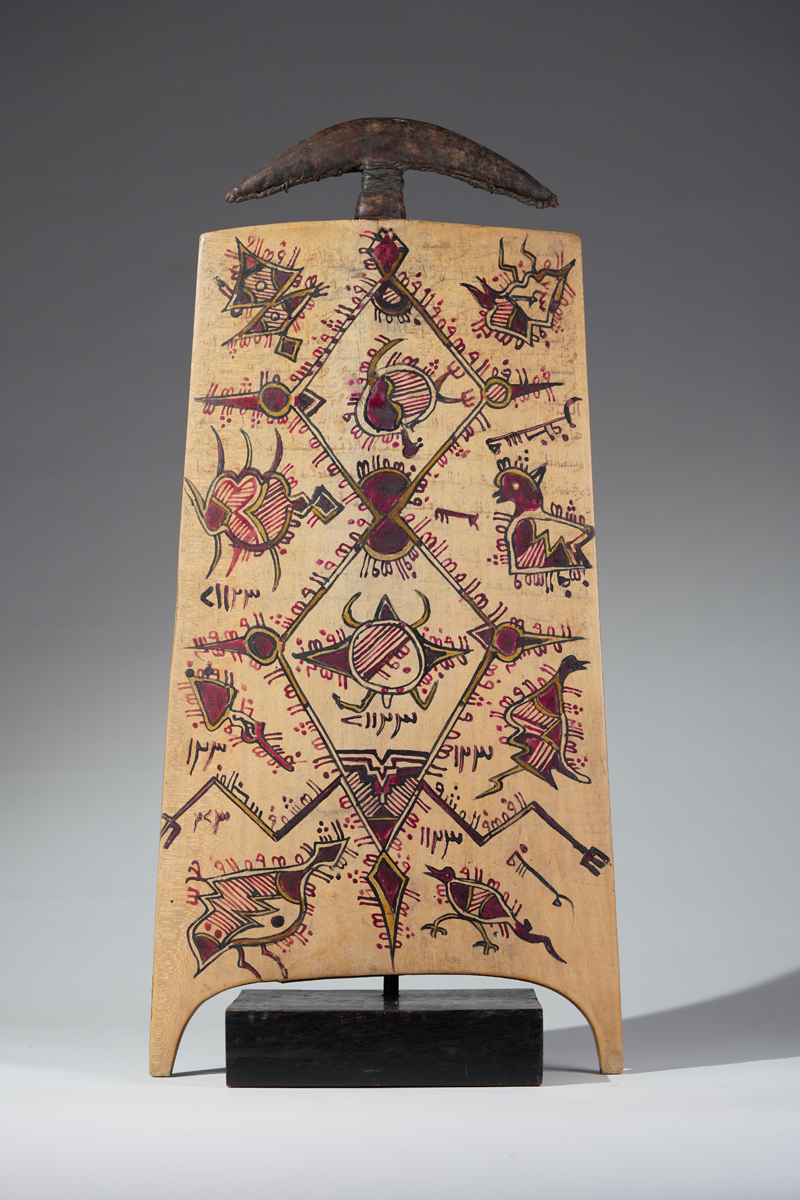 photo: wolfgang-jaenicke.com, for more information, please write us an e-mail with the identification number of the photo identification no. CAB45862.jpg |
 |
