|
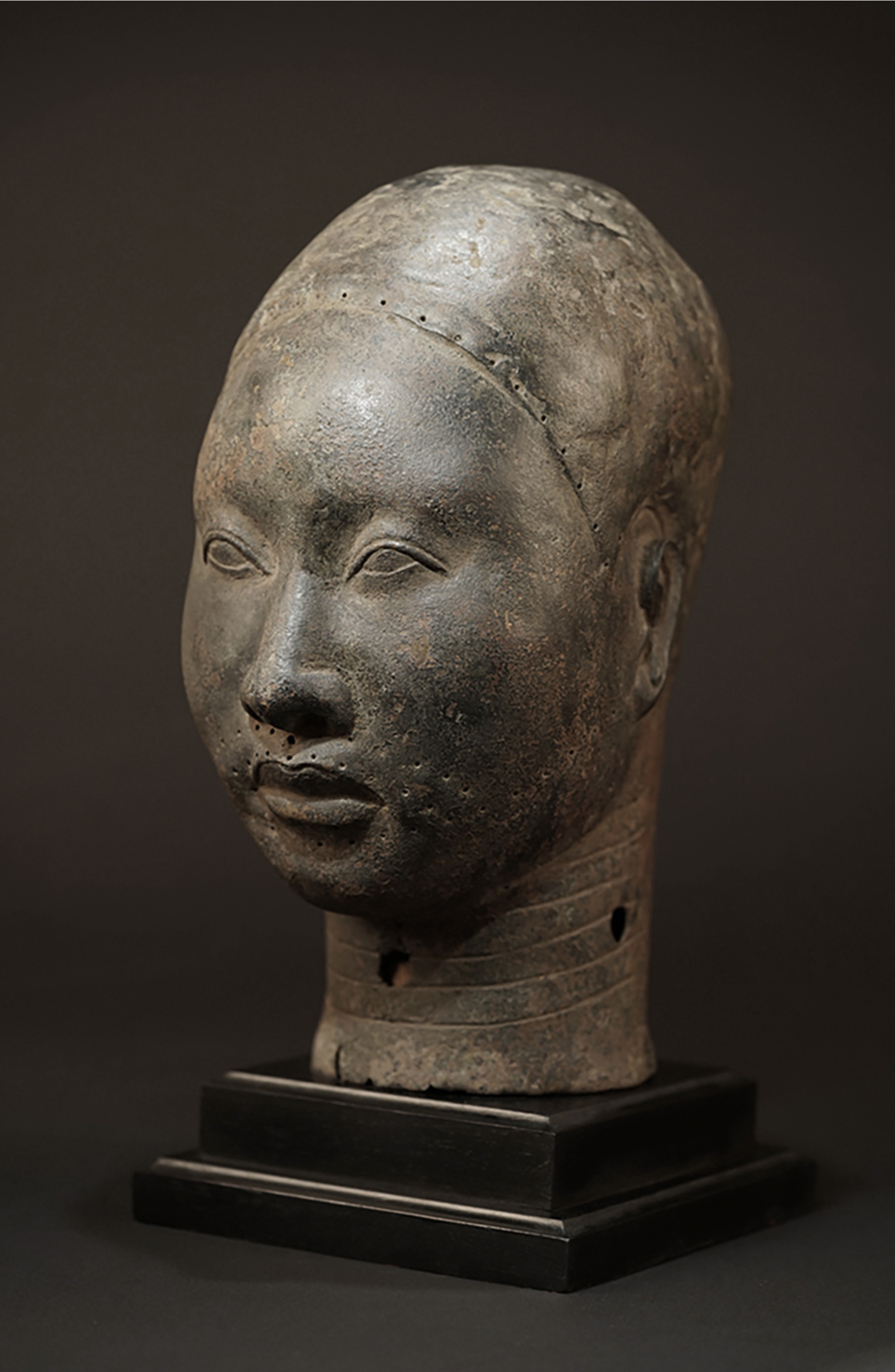
 Thie corpus of this cast brass head associated with the ancient Yoruba city of Ife occupies a central position in the study of early West African art, both for its technical sophistication and for the naturalism of its representation. Among these works, the bronze head described here exemplifies the refined stylistic canon often linked to royal portraiture, plausibly representing a youthful Ooni or sacred ruler. The sculpture demonstrates the hallmarks of classical Ife aesthetics: composure, balance, and a controlled naturalism that resists overt individualization while still conveying a distinct presence. The rendering of the facial features is especially significant, as it conforms to a visual language that appears standardized across multiple heads recovered from the region. The eyes are particularly diagnostic. The corners of the upper eyelids extend downward and overlap those of the lower lids, producing a characteristic almond shape that has often been interpreted as an idealized convention rather than a literal anatomical observation. This feature contributes to the calm, introspective expression that typifies Ife heads, suggesting not only physical likeness but also a metaphysical dimension of rulership. Around the lips, the sculptor has accentuated a defined edge, especially along the upper lip, creating a subtle emphasis that may reflect conventions of beauty or symbolic notions of speech and authority. Such detailing demonstrates a sophisticated understanding of both form and surface, achieved through the lost-wax casting technique that underpins much of Ife metalwork. Equally noteworthy are the grooves encircling the neck. These parallel striations, sometimes interpreted as scarification marks or as indications of regalia, reinforce the vertical rhythm of the composition while grounding the head structurally. The presence of small perforations at the hairline remains a subject of scholarly debate. Their function is not definitively established; hypotheses range from the attachment of organic materials, such as beaded veils or hair elements, to ritual applications involving the insertion of substances or fibers. These openings, combined with the four larger holes at the base of the neck, strongly suggest that the head was originally affixed to another medium, most likely a wooden superstructure forming part of a complete figure or shrine assemblage. The surface condition of the bronze further enriches its interpretive context. The heavy encrustation of reddish-brown to greenish patina, layered and partially eroded, attests to prolonged burial or exposure to environmental conditions that facilitated oxidation and mineral accretion. While such patination can obscure finer details, it also provides valuable evidence of age and authenticity, situating the object within a long temporal continuum. In formal trms, the head’s proportions and symmetry align with what scholars have identified as the “Ife naturalistic tradition,” a mode of representation that predates and possibly influences later developments in West African court art, including that of the Benin City bronzes. The technical mastery required to produce such a work—evident in the thinness of the cast, the precision of the features, and the integration of decorative and structural elements—points to a highly organized workshop system and a cultural milieu that placed considerable value on metallurgical expertise. These heads are often associated with commemorative or funerary contexts, possibly serving as embodiments of ancestral kings or as focal points in ritual practices that reinforced dynastic continuity. Ultimately, this bronze head stands as a testament to the intellectual and artistic achievements of Ife society. Its synthesis of idealization and observation, combined with its complex materiality, invites ongoing inquiry into the social, political, and spiritual dimensions of early Yoruba civilization. The interplay between form, function, and meaning in such works continues to challenge reductive narratives about African art, positioning Ife as a critical locus in the global history of sculpture. References Willett, Frank. Ife in the History of West African Sculpture. London: Thames and Hudson, 1967. Blier, Suzanne Preston. Art and Risk in Ancient Yoruba: Ife History, Power, and Identity, c. 1300. Cambridge: Cambridge University Press, 2015. Fagg, William, and John Pemberton III. Yoruba: Sculpture of West Africa. New York: Knopf, 1982. Drewal, Henry John, and John Pemberton III. Yoruba: Nine Centuries of African Art and Thought. New York: Center for African Art, 1989. Lawal, Babatunde. “Àwòrán: Representing the Self and Its Metaphysical Other in Yoruba Art.” The Art Bulletin 83, no. 3 (2001): 498–526. Similar bronze heads like the one of the Wunmonije Compound type are quite often found, which raises the question of their use. It is assumed that they were attached to a life-size wooden figure, possibly with movable limbs. These figures were dressed in the same way as the person depicted would have been. Perhaps the Oba was thus able to attend ceremonies and burials without being personally present. When a new Oba came into power perhaps only the bronze head was replaced. Lit.: Frank Willet, Ife. Neue Entdeckungen der Archäologie, 2. Auflage 1975, Tafel 2 und 3. H. Meyerowitz and V. Meyerowitz, Bronzes and Terra-Cottas from Ile-Ife, The Burlington Magazine for Connoisseurs (Oct., 1939). Arts de L'Afrique Noire, Jean Laude, translated by Jean Decock, University of California Press Berkeley, 1966, 1. Paperback-Edition 1973. TL Analysis on requestr 350,- Euro CAB46325 Height: 32 cm
|
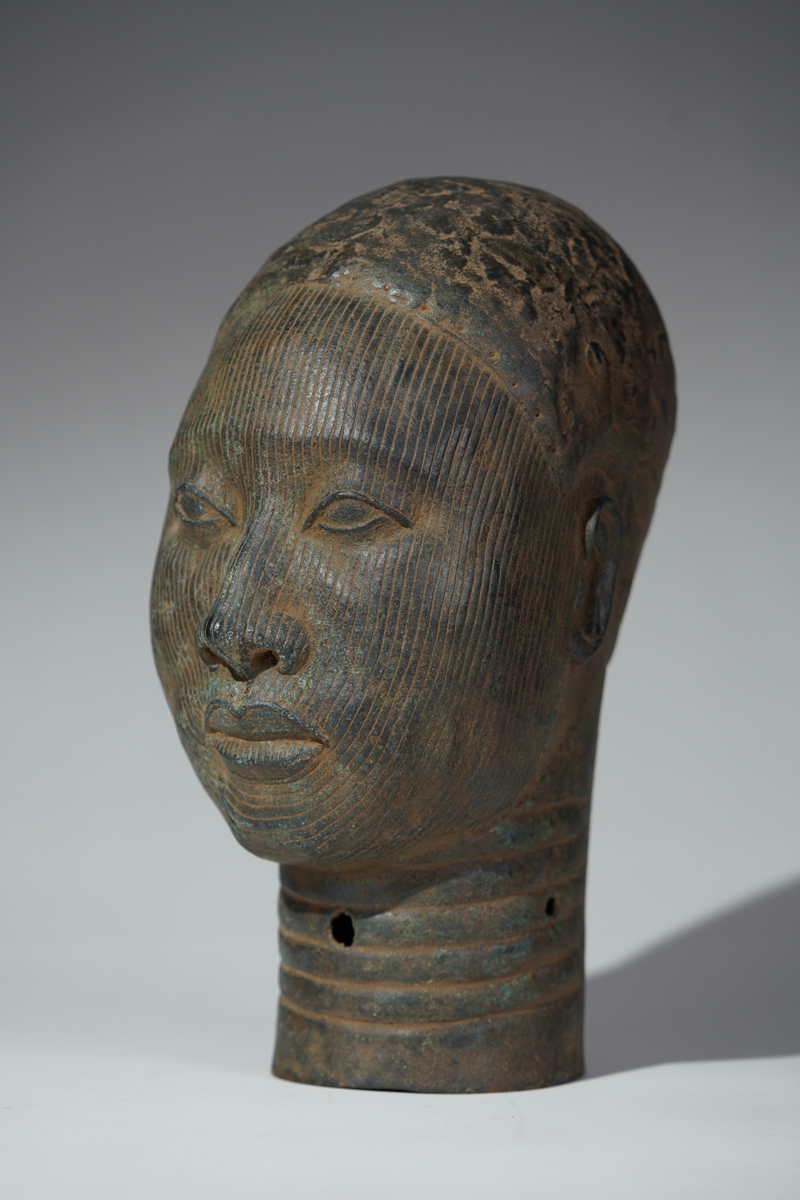 photo: wolfgang-jaenicke.com, for more information, please write us an e-mail with the identification number of the photo identification no. CAB46325.jpg |
 The culture of Ile-Ife is widely regarded as one of the foundational centers of the Yoruba world—both in mythology and in historical reconstruction, though the two perspectives differ in important ways. In Yoruba cosmology, Ile-Ife is understood as the place where the world began. According to oral traditions, it is there that Oduduwa descended and established order, founding the first royal lineage. This narrative is not merely symbolic; it also serves as a political and genealogical framework linking many Yoruba kingdoms back to Ile-Ife as their spiritual origin. From an archaeological perspective, Ile-Ife emerges as a major urban and artistic center between roughly the 11th and 16th centuries CE. Its most striking legacy is the corpus of highly naturalistic terracotta and brass sculptures, often referred to as the Ife Bronzes. These works demonstrate an extraordinary level of technical and aesthetic sophistication, developed independently within West Africa.
As for the question of origin, two main interpretive frameworks exist: One emphasizes internal development. In this view, Ife culture arose indigenously out of earlier West African societies, shaped by local processes such as agricultural intensification, trade networks, and increasing social and religious complexity. Ile-Ife became a ritual and political hub within this evolving landscape. The other, now largely outdated, proposed external influences—suggesting diffusion from North Africa or beyond, partly in an attempt to explain the naturalism of Ife art. However, these theories lack solid linguistic, archaeological, or cultural evidence and are no longer widely supported. Current scholarship therefore understands Ile-Ife as an autochthonous African civilization: a place where myth, kingship, and urban life converged, and from which cultural and political models spread across the wider Yoruba region. In short, Ile-Ife did not “come from” elsewhere—it emerged as a central node within West Africa itself. The encounter between Leo Frobenius and the sculptural corpus of Ile-Ife in 1910 occupies a paradoxical position in the historiography of African art, at once inaugurating its international recognition and distorting its cultural attribution. Confronted with a group of terracotta and copper alloy heads of striking naturalism, Frobenius found himself unable to reconcile their formal sophistication with the prevailing European assumptions about sub-Saharan Africa. The serene modeling of flesh, the proportional coherence, and the refined surface treatment—often articulated through delicate linear striations—appeared to him as evidence of a classical tradition whose origins must lie beyond the continent. This interpretive impasse led Frobenius to advance his now notorious Atlantis hypothesis, through which the Ife sculptures were cast as vestiges of a lost Mediterranean or trans-Atlantic civilization. Such a projection reveals less about the objects themselves than about the epistemological constraints of early twentieth-century ethnology, in which the possibility of an autonomous African classicism remained largely unthinkable. The Ife heads, removed from their ritual and historical contexts, were thus inscribed into a speculative narrative that displaced their authors and effaced the continuity of Yoruba cultural production. At the same time, Frobenius’s expedition entailed the physical removal of several works, a gesture that today must be understood within the broader framework of colonial extraction. Yet the circulation of these objects and the publication of his findings also catalyzed a sustained scholarly engagement. It was only through subsequent archaeological investigations, culminating in the stratigraphic work of Frank Willett in the mid-twentieth century, that the chronological and cultural parameters of Ife art were securely established. These studies demonstrated that the terracottas and cast heads belong to a florescence of urban and ritual life between the twelfth and fifteenth centuries, rooted in the courtly and religious institutions of the Yoruba. The historiographical significance of Frobenius thus resides in a double movement: the simultaneous revelation and misrecognition of Ife as a center of artistic innovation. His writings, while deeply compromised by speculative diffusionism, nonetheless marked the moment at which the objects of Ife entered a global discourse, eventually compelling a reassessment of the capacities and histories of African societies on their own terms.
|