 |
 A Bété sculpture from the Guiberou region of Ivory Coast belongs to a sculptural tradition in which form, ritual, and social function are inseparable. Among Beté-speaking communities, such figures are not conceived as autonomous artworks but as active agents within systems of initiation, conflict mediation, and spiritual intervention. The designation “Eine” is associated with presences that emerge in controlled ceremonial contexts, where the sculpture’s meaning is activated through performance, sound, and restricted viewing. Carved primarily in wood, examples attributed to Guiberou often emphasize the head as the seat of potency, with compact volumes and features that shift between abstraction and expressive distortion. Surfaces may bear residues of libation or sacrificial substances, producing a patina that records use rather than age alone. Visible tool marks and asymmetries should not be read as lack of finish but as integral to an aesthetic grounded in efficacy rather than naturalism. The removal of such sculptures during the colonial and postcolonial periods transformed their status. Once embedded in performative and communal frameworks, they entered museum and private collections, where interpretation privileged form over function. Recent scholarship has sought to recontextualize these works, emphasizing indigenous knowledge systems and the ongoing cultural significance of Beté practices. In this light, an Eine Beté sculpture is understood as both a historical artifact and a participant in evolving debates on heritage and restitution. References Bacquart, Jean-Baptiste. The Tribal Arts of Africa. Thames & Hudson, 1998.
CAB46561 Height: 80 cm |
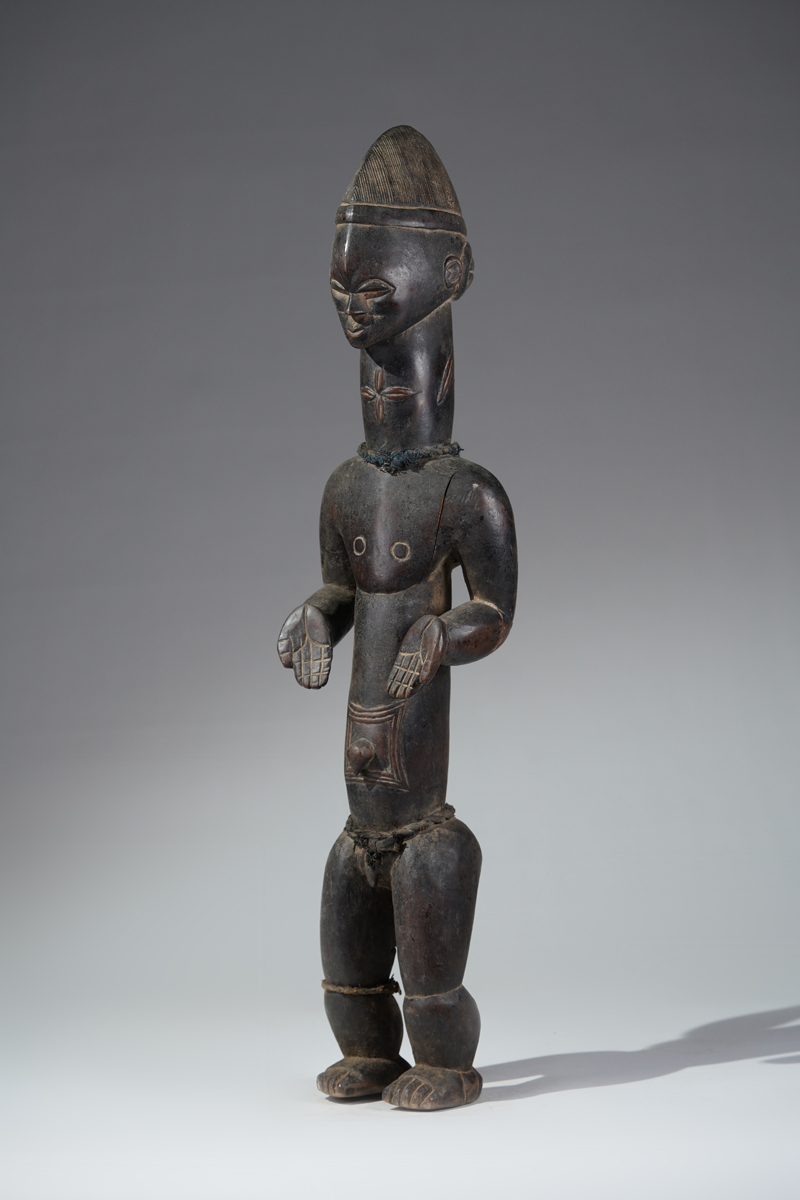 photo: wolfgang-jaenicke.com, for more information, please write us an e-mail with the identification number of the photo identification no. CAB46561.jpg |
 |