 |
 A Fon fetish figure from the region of Ouidah, in present-day Benin, belongs to a sculptural and ritual tradition closely tied to vodun practice. Often identified as a bocio, such figures are not primarily aesthetic objects but instruments of efficacy, designed to act within specific spiritual, protective, or judicial contexts. The carved wooden core provides an anthropomorphic framework, yet the figure’s meaning emerges through the accumulation of materials and the activation of embedded forces. The presence of colorful painting on the surface serves more than a decorative function. Polychromy may articulate symbolic distinctions, emphasize anatomical or ritual features, and enhance the figure’s visibility as a charged object. Pigments can also index associations with particular vodun entities or ritual intentions, reinforcing the object’s operative role. The inclusion of thunder-irons is especially significant. These iron elements, associated with the deity Hevioso, evoke lightning, power, and divine retribution. Inserted into the wooden structure, they materially anchor the presence of this force, transforming the figure into a locus of spiritual authority. Iron itself carries strong cosmological associations in the region, linked to transformation and cy ritual specialists, forming accumulations that enhance their potency. Originating near Ouidah, a major center of vodun practice, the figure reflects a dynamic intersection of material form, ritual knowledge, and spiritual agency. References Blier, Suzanne Preston. African Vodun: Art, Psychology, and Power. 1995. Informant Bature CAB46633 sold Height: 62 cm |
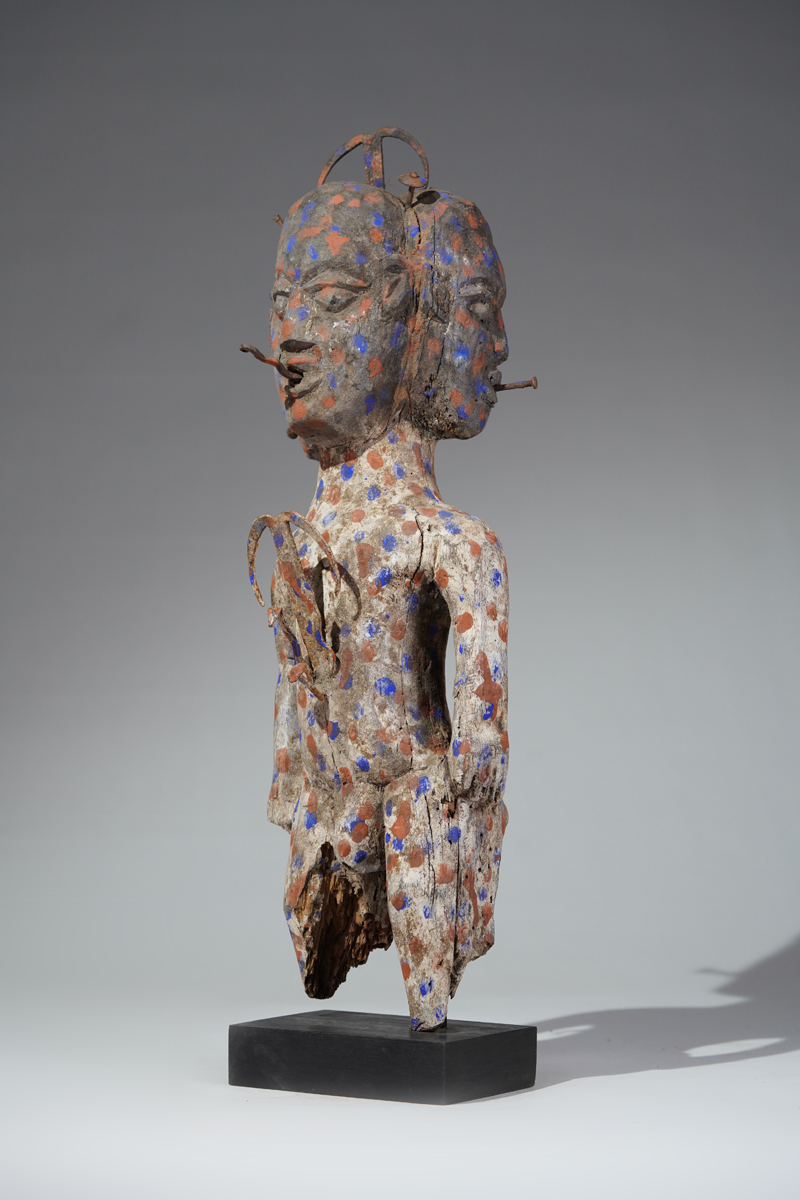 photo: wolfgang-jaenicke.com, for more information, please write us an e-mail with the identification number of the photo identification no. CAB46633.jpg |
 |