 |
 A rare Bété mask from the Gahizabo region of Côte d’Ivoire exemplifies the forceful abstraction and material accumulation characteristic of Bété masquerade traditions. Carved in wood and conceived for performance, such masks function as active agents within communal and spiritual life, embodying presences that mediate between the visible world and that of potent, often volatile forces. The present example is notable for the dense aggregation of animal horns affixed to its surface, creating a dynamic and outward-thrusting silhouette. These հավելված elements evoke vitality, aggression, and the concentration of power; the fragmentary state of one horn further suggests prolonged use and repeated activation in ritual contexts. The facial composition is dominated by a broad mouth and pronounced nose, lending the mask an emphatic, almost confrontational expression. The eyes, rendered as projecting tubular forms, are encircled with white kaolin. This chromatic framing establishes a stark visual contrast while also invoking the symbolic valence of white clay as a marker of spiritual presence, liminality, and heightened perception. The چشم, thus accentuated, become sites of intensified vision, signaling capacities that exceed the human. Rather than naturalistic depiction, the mask relies on exaggeration and accumulation to articulate a state of charged transformation. Collected in the Gahizabo region, it reflects both localized stylistic features and broader aesthetic principles within western Ivorian masking practices. In its current state, the object retains visible traces of wear and alteration, pointing to a history of performative engagement and ongoing material and spiritual negotiation. References Vogel, Susan Mullin. Baule: African Art, Western Eyes. 1997. CAB46770 sold Height: 27 cm |
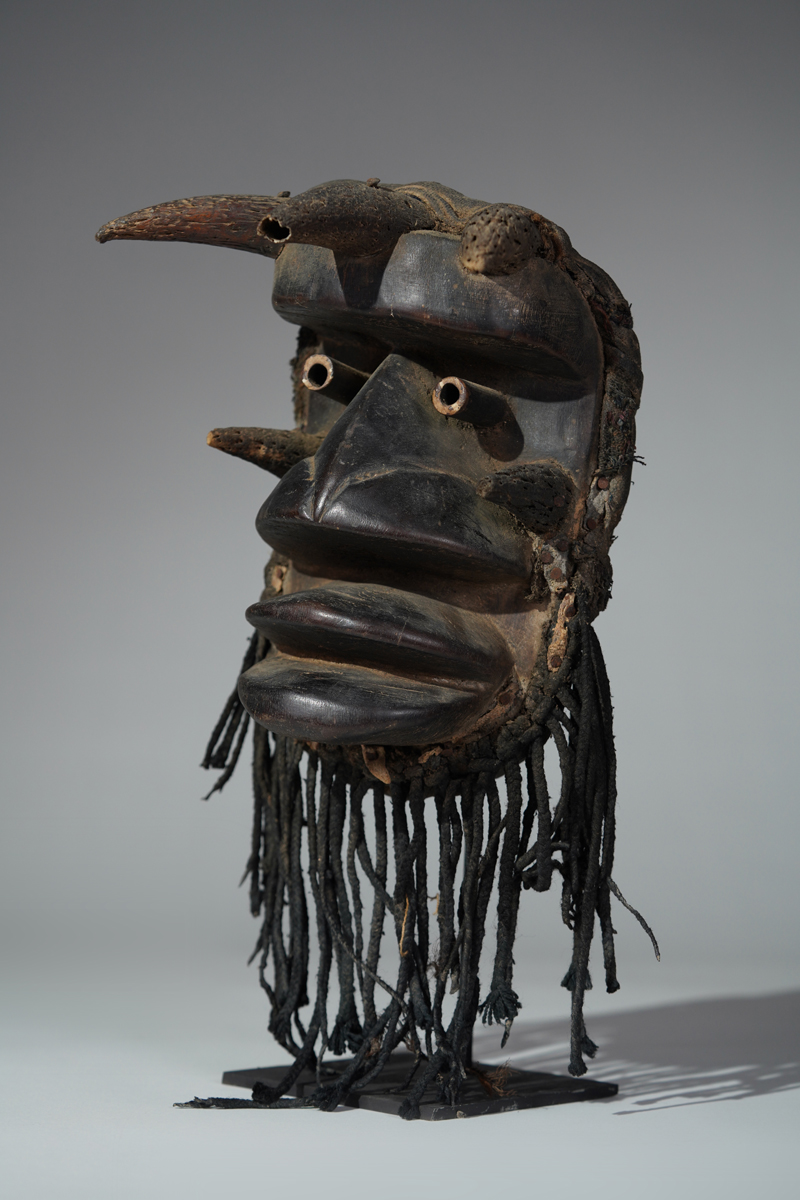 photo: wolfgang-jaenicke.com, for more information, please write us an e-mail with the identification number of the photo identification no. CAB46770.jpg |
 |