 |
 This mother-and-child figure from Sakassou, in the heart of the Baule region, must be understood within the context of the complex sculptural traditions of this Akan-speaking society. Sakassou is considered a historical center of political and ritual authority, where the development of elaborate figurative forms was also concentrated. Mother figures are frequently associated with notions of fertility, nurturing, and the connection between the visible and invisible worlds. The woman, seated on a stool and facing forward, holds a child in her arms and embodies an ideal of motherhood that encompasses both social and spiritual dimensions. The finely crafted, segmented hairstyle, held in place by a headband, testifies to a high level of artistic virtuosity and alludes to aesthetic norms as well as status. The relatively flatly modeled face with slightly pursed lips conveys a controlled, inner tension. Ornamental structures on the face, neck, chest, and back incorporate scarification motifs and rhythmically punctuate the surface. The child faces its mother, with bent limbs and already hinted-at facial ornamentation, creating a visual and symbolic continuity between generations. The emphasized forearms and shins, as well as the finely crafted stool, stabilize the composition. Age-related cracks in the face, chest, and base indicate a long history of use and underscore the object's ritual significance. In its balanced combination of intimacy and representation, the figure articulates an ideal of motherhood as the bearer of social and cosmic order. Literature (selection) Vogel, Susan Mullin: Baule: African Art, Western Eyes. New Haven, 1997. CAB 46894 sold Height: 42 cm |
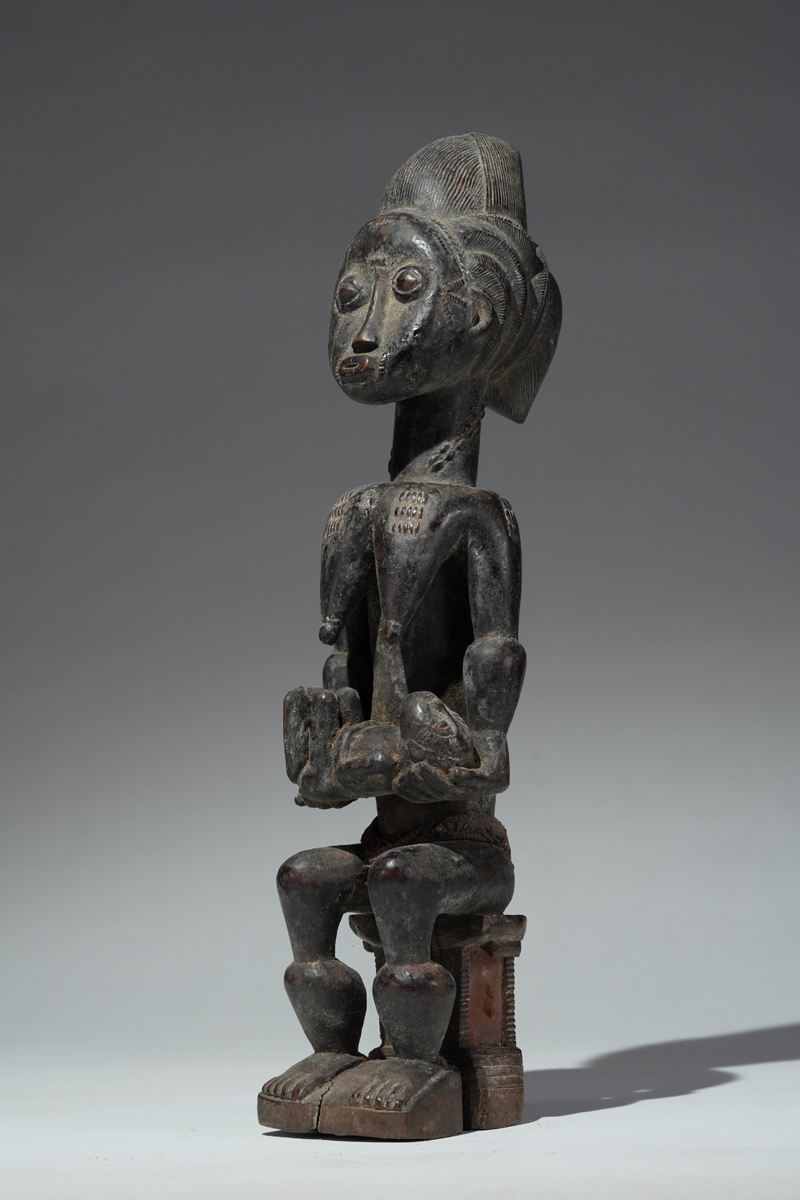 photo: wolfgang-jaenicke.com, for more information, please write us an e-mail with the identification number of the photo identification no. CAB46894.jpg |
 |